Pair AirPods for the First Time
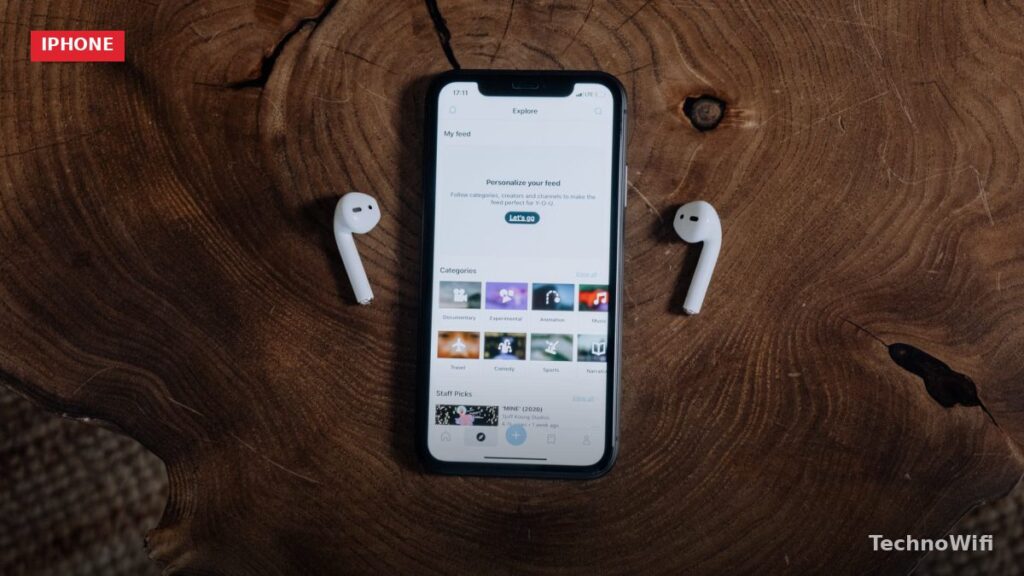
Pairing AirPods with an iPhone takes about 10 seconds. The process is the same for AirPods, AirPods Pro, and AirPods Max.
- Make sure Bluetooth is on (Settings, then Bluetooth).
- Open the AirPods charging case lid with the AirPods inside. Hold it near your iPhone (within a few inches). For AirPods Max, take them out of the Smart Case.
- A setup animation appears on your iPhone screen showing your AirPods model.
- Tap “Connect.”
- Follow any additional prompts (setting up “Hey Siri,” customizing controls, enabling Personalized Spatial Audio).
- Tap “Done.” Your AirPods are paired.
Your AirPods automatically pair with every Apple device signed into the same Apple ID – your iPad, Mac, Apple Watch, and Apple TV. You don’t need to repeat the pairing process on each device.
Reconnect AirPods That Are Already Paired
Once paired, AirPods reconnect automatically. Put them in your ears (or put on AirPods Max), and they connect to whichever Apple device you used last. If they don’t connect automatically:
Need internet on the go? See our iPhone hotspot setup guide.
- Open Control Center (swipe down from the top-right corner).
- Long-press the audio playback card.
- Tap the AirPlay icon (triangle with circles).
- Select your AirPods from the list.
You can also go to Settings, then Bluetooth, and tap your AirPods in the device list. If they show as “Not Connected,” tapping them forces the connection.
Switch AirPods Between Devices
AirPods with the H1 or H2 chip support automatic switching. When you start playing audio on a different Apple device, the AirPods switch over without any manual action. This works between iPhone, iPad, Mac, and Apple Watch.
If automatic switching gets annoying – maybe you’re watching a video on your Mac and don’t want your AirPods jumping to your iPhone for every notification – you can turn it off. Go to Settings, then Bluetooth, tap the info icon next to your AirPods, and change “Connect to This iPhone” from “Automatically” to “When Last Connected to This iPhone.”
To manually switch, use the AirPlay menu on whichever device you want audio from. On iPhone, that’s Control Center, then the AirPlay icon.
Customize AirPods Settings
With your AirPods connected, go to Settings, then Bluetooth, and tap the info icon (i) next to your AirPods.
Name: Tap the name to change it from the default (e.g., “Ugur’s AirPods”) to anything you want.
Double-tap or press-and-hold actions: Set what happens when you double-tap an AirPod (1st/2nd gen) or press and hold the stem (AirPods Pro/3rd gen). Options include Siri, Play/Pause, Next Track, Previous Track, and Noise Control.
Noise Control (AirPods Pro and AirPods Max): Toggle between Active Noise Cancellation, Transparency, Adaptive, and Off. You can also choose which modes appear when you press and hold the stem or Digital Crown.
Spatial Audio: Enable Personalized Spatial Audio for immersive surround sound with supported content. AirPods Pro and AirPods Max support head-tracked spatial audio that adjusts as you turn your head.
Ear Tip Fit Test (AirPods Pro): Run this test to check if your ear tips create a proper seal. A good seal is important for noise cancellation and bass response. Try different tip sizes (small, medium, large) if the test says the fit isn’t ideal.
Check AirPods Battery
With the case: Open the AirPods case lid near your iPhone. A popup shows battery levels for both earbuds and the case.
Batteries widget: Add the Batteries widget to your home screen. It shows real-time battery percentages for all connected devices.
Siri: Ask “Hey Siri, what’s my AirPods battery?” for a spoken response.
Control Center: The battery percentage appears on the audio playback card when AirPods are connected.
Use AirPods With Siri
AirPods with the H1 or H2 chip support hands-free “Hey Siri” (or just “Siri” on newer iOS versions). Say the wake phrase and Siri listens through the AirPods microphone. You can make calls, send messages, get directions, control music, and adjust volume entirely by voice.
Original AirPods (1st gen) with the W1 chip require a double-tap to activate Siri. Set “Double-Tap” to “Siri” in AirPods settings.
- Connect your AirPods to your iPhone.
- Start playing audio.
- Open Control Center and long-press the audio card.
- Tap the “Share Audio” button.
- Bring the second pair of AirPods (in the open case) near your iPhone.
- The second pair appears on screen. Tap “Share Audio.”
- Both pairs now play the same audio. Each person controls their volume independently.
Audio Sharing also works with most Beats headphones that have an Apple chip (W1/H1/H2).
Troubleshooting
AirPods won’t connect. Put the AirPods in the case, close the lid, wait 15 seconds, then open the lid near your iPhone. If they still won’t connect, reset them: with the AirPods in the case and the lid open, press and hold the setup button on the back for 15 seconds until the status light flashes amber then white. Re-pair them from scratch.
One AirPod not working. Check that both earbuds are charged (open the case near your iPhone to see individual battery levels). Clean the charging contacts on the earbud and inside the case with a dry cotton swab. If one earbud consistently dies faster, it may have a degraded battery – contact Apple Support.
Audio is choppy or cutting out. Move your iPhone closer. Bluetooth interference from WiFi routers, microwaves, and other wireless devices can cause dropouts. Update to the latest iOS version since Apple regularly improves AirPods connectivity through software updates. Try resetting the AirPods if the problem persists.
AirPods connected but sound plays through iPhone speaker. Open Control Center, long-press the audio card, and make sure your AirPods are selected as the output device. Sometimes audio routes to the speaker after a phone call ends – switching the output manually fixes it.
Can I use one AirPod at a time?
Yes. Remove one AirPod from the case and it works independently – calls, music, Siri, everything. When you switch which ear you’re using, the microphone automatically switches too. The AirPod in the case charges while you use the other one, so you can alternate and effectively double your listening time.
Do AirPods work with older iPhones?
AirPods work with any iPhone running iOS 10 or later (iPhone 5 and newer for the one-tap setup). Standard Bluetooth pairing works on even older devices. However, features like automatic switching, Spatial Audio, and “Hey Siri” require newer hardware and iOS versions. AirPods Pro 2 with USB-C require iOS 16 or later for full feature support.
How far can AirPods be from iPhone?
Bluetooth range is about 30 to 50 feet in open space. Walls and obstacles reduce this. In a typical home, AirPods stay connected within one or two rooms of the iPhone. If you walk too far away, audio pauses and a “Disconnected” message appears. Moving back in range reconnects automatically.
Sources
For camera transfers, check our Canon G7X to iPhone guide.
Need to get to your photos across devices? Our iCloud photos access guide walks through every method.
Apple – Set Up AirPods | Apple – AirPods Settings