The PS5 DualSense controller works on PC, and setting it up is simpler than most people expect. You can connect it with a USB cable for instant plug-and-play, pair it over Bluetooth for wireless gaming, or run it through Steam’s built-in controller support for the best compatibility with your game library. Windows 10 and Windows 11 both recognize the DualSense natively, and Steam offers full support for its advanced features including haptic feedback and adaptive triggers.
Everything in this guide applies to both the standard DualSense and the DualSense Edge. If you own the pro model with swappable stick modules and back paddles, the connection process is identical.
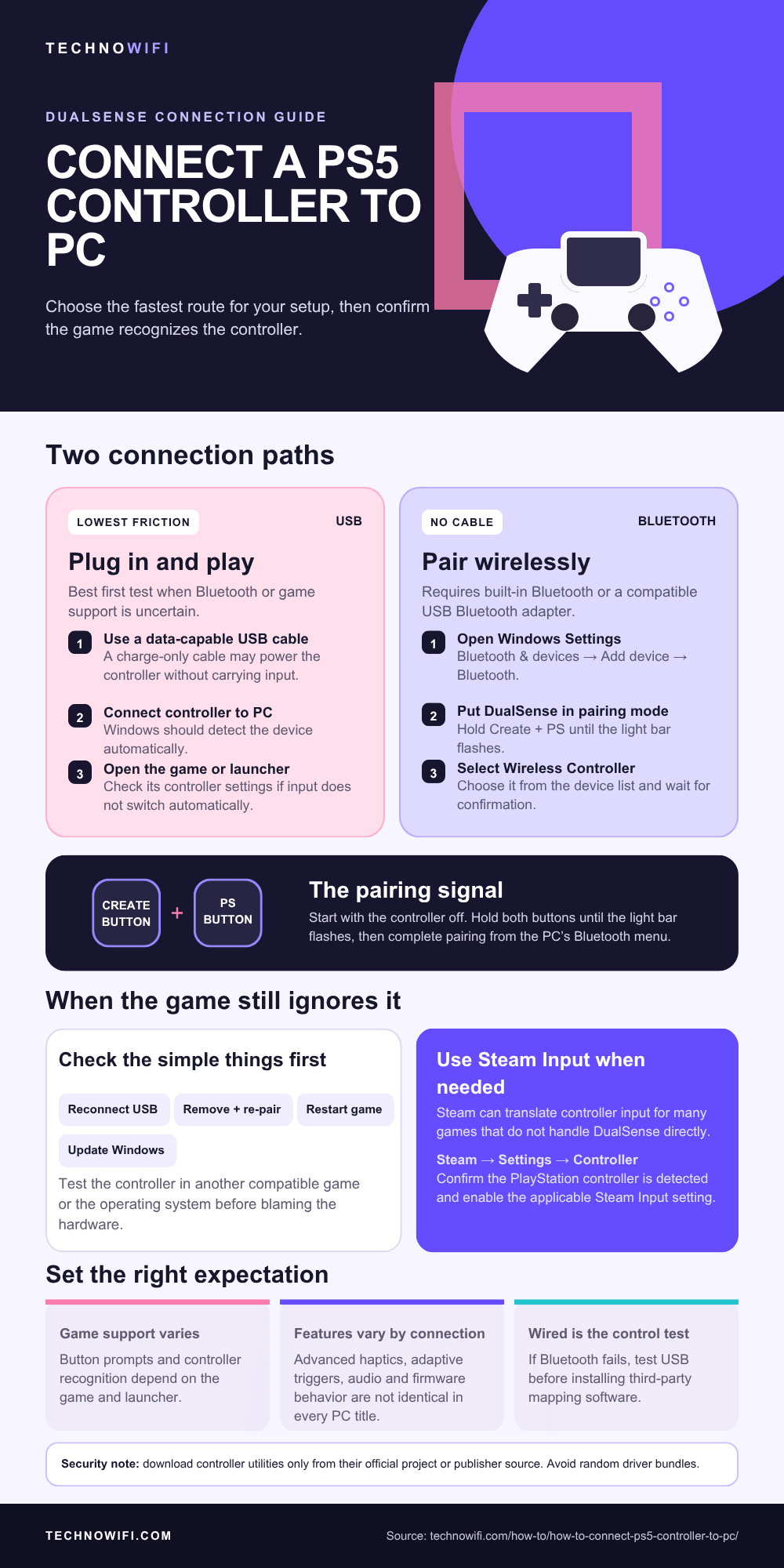
Method 1: Connect PS5 Controller to PC With a USB Cable
USB is the fastest and most reliable way to get your DualSense working on PC. There is no pairing process, no driver installation, and no software to configure. You plug it in and start playing.
What you need
A USB-C to USB-A cable (the same kind that ships with the PS5) or a USB-C to USB-C cable if your PC has USB-C ports. Both cable types deliver the same performance for controller use.
Steps
- Plug the USB-C end of the cable into the port on top of the DualSense controller.
- Plug the USB-A (or USB-C) end into any available USB port on your PC.
- Wait a few seconds. Windows automatically installs the necessary HID drivers. The controller’s light bar turns on, confirming the connection.
- Open your game. The DualSense is ready to use immediately.
Tips for wired connections
Not all USB-C cables carry data. Some budget cables that ship with headphones or earbuds are charge-only. If the light bar turns on but Windows does not detect the controller, swap to a different cable. Cables that came with a game console, external hard drive, or data-capable phone will work reliably.
On desktop PCs, use a rear USB port when possible. Rear ports connect directly to the motherboard and typically deliver steadier power and data than front-panel ports, which sometimes cause intermittent disconnections on older PC cases.
The DualSense charges while connected over USB, so battery life is never a concern during wired play. USB also delivers the lowest input latency of any connection method.
Method 2: Connect PS5 Controller to PC Over Bluetooth
Bluetooth gives you wireless freedom without buying extra hardware, as long as your PC has a Bluetooth adapter. Most laptops include one. Many desktop PCs do not, unless they have a WiFi and Bluetooth combo card on the motherboard. If you need one, a USB Bluetooth dongle costs about $10 to $15 and works well. Bluetooth 4.0 or newer is recommended.
Pairing steps (Windows 10 and 11)
- Make sure the DualSense is powered off. If the light bar is on, hold the PS button for about 10 seconds until the light shuts off.
- Put the controller into pairing mode: press and hold the PS button and the Create button (the small button left of the touchpad) at the same time. Hold both until the light bar starts flashing blue rapidly.
- On your PC, open Settings, then Bluetooth and devices, then Add device. Select Bluetooth from the options.
- Windows scans for nearby devices. When “Wireless Controller” appears, click it. The controller pairs within seconds and the light bar switches to a steady glow.
If “Wireless Controller” does not appear, make sure the light bar is still flashing blue. The pairing window times out after about 30 seconds, so you may need to repeat step 2.
Reconnecting after the first pairing
Once paired, the DualSense remembers your PC. In future sessions, simply press the PS button and the controller reconnects automatically within a second or two. No need to re-pair each time.
Things to know about Bluetooth
Input latency over Bluetooth is slightly higher than wired. For single-player games and casual play, you will not notice any difference. For competitive shooters or rhythm games, wired is the better option. Battery life over Bluetooth runs about 8 to 12 hours per charge, depending on your settings and how heavily the game uses haptic features.
The DualSense can only store one Bluetooth pairing at a time. If you pair it with your PS5, the PC pairing is lost, and vice versa. To avoid constant re-pairing, use USB on one device and Bluetooth on the other.
Using the PS5 Controller With Steam
Steam has built-in DualSense support, and it is one of the best ways to use the controller on PC. Valve has steadily expanded this support since late 2020, and in 2026 it covers nearly every feature the DualSense offers.
This topic ties into our PS5 games for kids guide, which covers the next steps.
How to enable it
- Open Steam and go to Settings, then Controller.
- Check the box for “Enable PlayStation Controller Support.”
- Connect your DualSense via USB or Bluetooth. Steam detects it automatically.
What Steam adds
PlayStation button prompts: In supported games, Steam shows Cross, Circle, Triangle, and Square icons instead of Xbox button labels. Most modern cross-platform titles include PlayStation prompt artwork.
Per-game configuration: Right-click any game in your library, open Properties, and go to the Controller tab. You can set custom button mappings, adjust stick dead zones, configure the gyroscope, and customize touchpad behavior for each game individually.
Steam Input translation: Many older PC games only support Xbox controllers through XInput. Steam Input translates DualSense signals into XInput, making the controller compatible with virtually every game in the Steam library, even titles that were never designed for PlayStation controllers.
Gyroscope controls: Steam lets you use the DualSense’s built-in gyroscope for motion aiming. Tilt the controller for fine aim adjustments while using the right stick for larger movements. You can configure gyro sensitivity, dead zones, and activation buttons through Steam’s controller settings. This is popular in shooters and action games where you want precision without switching to a mouse.
Haptic feedback: Steam’s API allows developers to send haptic signals to the DualSense, enabling more detailed vibration effects than standard rumble. Games that support Steam Input’s haptic system can take advantage of the DualSense’s dual actuators for richer feedback.
Using the PS5 Controller on PC Without Steam
If you play games through the Epic Games Store, GOG, Battle.net, Xbox Game Pass, or standalone launchers, you need a different solution for controller support.
DS4Windows
DS4Windows is a free, open-source tool that makes Windows treat your DualSense as an Xbox 360 or Xbox One controller. Since nearly every PC game supports Xbox controllers, this gives you near-universal compatibility.
- Download DS4Windows from its official GitHub repository.
- Install the ViGEmBus driver when the installer prompts you.
- Launch DS4Windows. It detects the DualSense automatically over USB or Bluetooth.
- The controller now appears as an Xbox controller to all games.
DS4Windows lets you remap buttons, adjust stick curves, create per-game profiles, and customize the light bar color. It runs quietly in the system tray and uses minimal resources. The app also displays your controller’s battery level, which is helpful since older Windows builds do not show Bluetooth controller battery status natively.
Games with native DualSense support
Some PC games detect the DualSense directly without needing Steam or DS4Windows. Titles like Final Fantasy VII Rebirth, Death Stranding Director’s Cut, Call of Duty, and Marvel’s Spider-Man Remastered all recognize the controller natively over USB. In these games, you get PlayStation button prompts and sometimes full haptic and adaptive trigger support without any extra software.
Adding non-Steam games to Steam
Another option: add non-Steam games to your Steam library by going to Games, then “Add a Non-Steam Game.” Launch the game through Steam to get Steam Input support, including controller translation and custom mappings, without needing DS4Windows.
Avoid running DS4Windows and Steam together
Do not run DS4Windows and Steam’s PlayStation Controller Support at the same time. Both try to intercept the controller’s inputs, causing double inputs, unresponsive buttons, or other conflicts. Use one or the other. Close whichever program you are not using before launching any game.
Do Haptics and Adaptive Triggers Work on PC?
Partially, and support continues to improve in 2026. On the PS5, nearly every game takes advantage of the DualSense’s haptic feedback and adaptive triggers. On PC, a smaller but growing number of titles support these features.
Our guide on multiplayer games for PS5 goes into more detail if you need it.
Haptic feedback replaces standard rumble motors with dual actuators that produce a wide range of vibrations. You can feel different surface textures, weather effects, and impacts with much more detail than traditional rumble. Adaptive triggers use built-in motors to vary the resistance of L2 and R2 dynamically, simulating the tension of a bowstring, the resistance of a trigger pull, or the feel of a brake pedal.
On PC, these features generally require a USB connection. Bluetooth bandwidth limits prevent full haptic and trigger data from transmitting wirelessly in most games. Sony’s USB wireless adapter is the exception, supporting both features without a cable.
Games with confirmed PC support for haptics and adaptive triggers include Call of Duty: Modern Warfare III, Final Fantasy VII Rebirth, Death Stranding Director’s Cut, Marvel’s Spider-Man Remastered, Returnal, Alan Wake 2, Final Fantasy XVI, and Metro Exodus Enhanced Edition. The list grows with each new PlayStation-to-PC port.
Troubleshooting: PS5 Controller Not Working on PC
If your DualSense is not responding on PC, work through these fixes in order.
1. Try a different USB cable
This is the most common cause of wired connection failures. If the light bar turns on but Windows does not detect the controller, your cable likely supports charging only. Use a data-capable cable from a console, external drive, or phone.
2. Update the controller firmware
Sony periodically releases firmware updates that fix bugs and improve compatibility. If you have a PS5, connect the controller to the console and check for updates in Settings under Accessories. If you do not own a PS5, download Sony’s free DualSense Firmware Updater for Windows from the PlayStation support website. Connect the controller via USB and run the updater.
3. Reset the controller
On the back of the DualSense, near L2, there is a small reset hole. Insert a paperclip or SIM eject tool and hold the button for about 5 seconds. The light bar turns off and the controller resets to factory settings. You will need to pair it again from scratch after a reset.
4. Check Bluetooth range and interference
If the controller disconnects or behaves erratically over Bluetooth, move closer to your PC. Walls, wireless routers, and other 2.4 GHz devices can interfere with the signal. A USB Bluetooth dongle placed on your desk in the open performs better than an internal adapter inside a desktop case. Also avoid plugging a Bluetooth dongle into a USB 3.0 port next to other USB 3.0 devices, since USB 3.0 is a known source of Bluetooth interference.
5. Disable conflicting software
Running both Steam’s PlayStation Controller Support and DS4Windows simultaneously causes double inputs and unresponsive buttons. Disable one before using the other.
6. Reinstall the controller in Device Manager
Open Device Manager, find “Wireless Controller” under Human Interface Devices, right-click it, and select “Uninstall device.” Unplug the controller, restart your PC, and reconnect. Windows reinstalls the drivers fresh.
7. Update Windows
Microsoft has released multiple updates since 2020 that improved DualSense compatibility. If you are running an older Windows build, go to Settings, then Windows Update, and install any pending updates.
Connection Methods Compared
| Method | Setup | Input Lag | Haptic Support | Battery |
|---|---|---|---|---|
| USB wired | Plug and play | Lowest (under 4ms) | Full in compatible games | Charges while playing |
| Bluetooth | One-time pairing | Slightly higher (8 to 12ms) | Limited in most games | 8 to 12 hours per charge |
| Sony USB wireless adapter | Plug adapter, pair once | Low (close to wired) | Full in compatible games | 8 to 12 hours per charge |
For most people, USB wired is the recommended starting point. It is the simplest option with the best latency and full feature support. Choose Bluetooth if you prefer wireless play and sit away from your PC. Pick up Sony’s USB wireless adapter if you want wireless performance close to wired, with full haptic and trigger support.
Frequently Asked Questions
Can I use a PS5 controller on PC wirelessly?
Yes. Bluetooth is free if your PC already has an adapter. Hold the PS button and Create button to enter pairing mode, then connect through Windows Bluetooth settings. Sony also sells a USB wireless adapter that provides lower latency and full haptic support over a wireless connection.
Does the PS5 controller work with every PC game?
Not directly, but you can make it work with virtually any title. Games that support DirectInput detect the DualSense natively. Games that only support XInput (the Xbox controller protocol) need Steam’s PlayStation Controller Support or DS4Windows to translate inputs. With either tool running, the DualSense appears as an Xbox controller to the game.
Can I use two PS5 controllers on one PC?
Yes. Each controller can connect independently over USB or Bluetooth. Steam supports multiple controllers for local co-op, and DS4Windows handles multiple controllers with individual profiles. Over Bluetooth, most adapters support 2 to 4 simultaneous controller connections reliably.
Does the headphone jack on the controller work on PC?
Over USB, yes. Windows recognizes the DualSense’s 3.5mm jack as a separate audio output device. Over Bluetooth, the headphone jack does not function because Bluetooth bandwidth is already fully used by controller input data.


