Rotate With a Keyboard Shortcut
The fastest way to rotate your Chromebook screen.
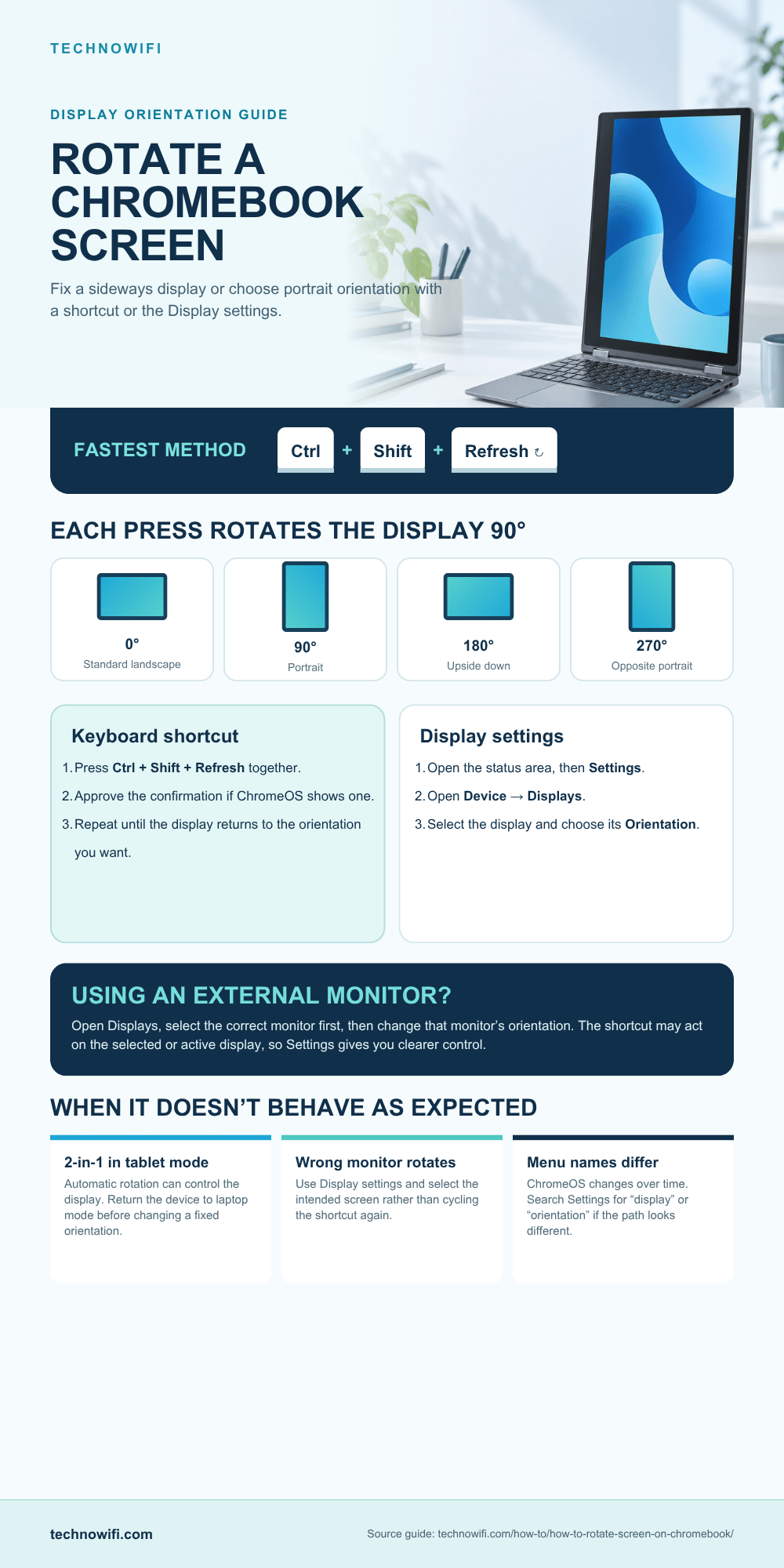
- Press Ctrl + Shift + Rotate (the Rotate key has a circular arrow icon and is usually in the top row of the keyboard, where F3 or F4 would be on a standard keyboard).
- Each press rotates the screen 90 degrees clockwise.
- Press it again to continue rotating: 90, 180, 270, then back to normal (0 degrees).
If your Chromebook doesn’t have a dedicated Rotate key, use Ctrl + Shift + Reload instead (the Reload key has a circular arrow and is typically where F3 would be).
A confirmation dialog appears asking if you want to keep the rotation. Click “Keep rotation” or wait 10 seconds for it to revert automatically. This prevents getting stuck if you accidentally rotated the screen.
Rotate in Display Settings
- Click the clock area in the bottom-right corner (system tray).
- Click the Settings gear icon.
- Click “Device” in the sidebar, then “Displays.”
- Under “Orientation,” select the rotation you want: Default, 90 degrees, 180 degrees, or 270 degrees.
This method gives you precise control and lets you set the rotation for external monitors independently from the built-in display.
Auto-Rotate on Convertible Chromebooks
If you have a 2-in-1 convertible Chromebook (one that folds into tablet mode), the screen rotates automatically when you flip the device.
Enable auto-rotate: When in tablet mode (keyboard folded behind the screen), swipe down from the top-right to open Quick Settings. Tap the “Auto-rotate” icon (looks like a phone with a circular arrow). When enabled, the screen rotates based on how you hold the device.
For the complete picture, our how to connect 2 monitors to Chromebook guide fills in the gaps.
Lock rotation: Tap the Auto-rotate icon again to lock the screen in its current orientation. The icon changes to show a lock. This is useful when you’re lying down and don’t want the screen flipping around.
Auto-rotate only works in tablet mode. In laptop mode (with the keyboard facing you), the screen stays in its default orientation regardless of this setting.
Rotate an External Monitor
If you have an external display connected to your Chromebook, you can rotate it independently.
- Go to Settings, then Device, then Displays.
- Click on the external display (it shows as a separate display in the arrangement section).
- Change the “Orientation” setting for that specific display.
This is useful when mounting a monitor in portrait mode for reading documents, coding, or viewing vertical content. The Chromebook screen stays in its normal orientation while the external monitor rotates.
Common Rotation Angles
| Orientation | Use Case |
|---|---|
| 0 degrees (default) | Normal landscape mode |
| 90 degrees | Portrait mode (useful for reading long documents and web pages) |
| 180 degrees | Upside-down landscape (useful for ceiling-mounted displays) |
| 270 degrees | Reverse portrait mode |
Troubleshooting
Screen is stuck rotated. Press Ctrl + Shift + Rotate (or Ctrl + Shift + Reload) to cycle through orientations until you get back to normal. If the keyboard shortcut doesn’t work, navigate to Settings (it will be sideways, but the mouse still works) and change the Orientation back to Default in Device, then Displays.
We break down minecraft on a Chromebook in a separate post that complements this one.
Auto-rotate not working. Make sure you’re in tablet mode (keyboard folded back or detached). Check that auto-rotate is enabled in Quick Settings. Restart the Chromebook. If auto-rotate still doesn’t work, the accelerometer sensor may have an issue – check for ChromeOS updates since sensor bugs are sometimes fixed in software updates.
External monitor won’t rotate. Not all external monitors support all orientations through ChromeOS. Make sure you’ve selected the correct display in Settings, then Device, then Displays. Some monitors also have their own rotation settings in their on-screen display menu that may conflict with ChromeOS settings.
Touchscreen input misaligned after rotation. After rotating, the touchscreen should automatically realign to the new orientation. If touch input is offset, restart the Chromebook. This is a rare bug that a reboot almost always fixes.
Does rotating the screen affect performance?
No. Rotating the screen doesn’t use extra processing power or affect Chromebook performance. The display controller handles the rotation at the hardware level. Battery life is also unaffected.
Will rotation settings stick after restarting?
Rotation set through Display Settings persists after a restart. Rotation set with the keyboard shortcut also persists until you change it again. Auto-rotate settings in tablet mode persist as well. Your Chromebook remembers the last orientation you selected.
Can I rotate just one app or window?
No. ChromeOS rotates the entire screen, not individual apps. All windows rotate together. If you need different orientations for different content, use the split-screen feature to arrange windows side by side in the rotated view, or use an external monitor at a different orientation.
Sources
Google – Chromebook Display Settings | Google – Use Chromebook in Tablet Mode