Canon puts a fully articulating flip screen on nearly every camera in its current lineup. Out of all the RF-mount mirrorless bodies you can buy today, only the budget EOS R100 ships with a fixed screen, everything else flips, tilts, and rotates.
That’s great for vloggers, travel shooters, and anyone who works from unusual angles, but it also means “Canon camera with flip screen” describes ten different models ranging from $649 to $3,899. Picking the right one isn’t about the screen, they all have essentially the same vari-angle touchscreen design. It’s about everything else: sensor size, video specs, autofocus performance, burst speed, and whether you need in-body image stabilization.
This guide covers every Canon camera with a flip screen you can buy right now, organized by who each one is actually for, with a full comparison table so you can see the differences at a glance.
Key Takeaways
Every Canon RF mirrorless camera (except the R100) has a fully articulating vari-angle touchscreen. This guide compares 10 models from $649 to $3,899.
The Canon EOS R6 Mark III ($2,799) is the best overall pick for creators who shoot both photo and video.
Best value: the EOS R6 Mark II ($1,999) delivers 90% of the R6 III for $800 less.
Budget pick: the EOS R50 ($679) is the cheapest way into Canon’s RF system with a flip screen.
All 10 cameras include Dual Pixel CMOS AF with face/eye detection, 4K video, and a 3.5mm mic input.
A note from someone who has been through this decision: I started vlogging on a Canon 80D about six years ago. The flip screen was the whole reason I picked it over the Nikon D7200, which had better specs on paper but no articulating display. I shot hundreds of YouTube videos on that camera before the lack of 4K became a real limitation. I have also owned the T6i and handled several of the newer RF mirrorless bodies at B&H and Best Buy. This guide comes from someone who has actually used Canon flip screen cameras for content creation, not just read the spec sheets.
Quick Answer: Which One Should You Get?
If you don’t want to read the full breakdown, here’s the short version based on what you primarily shoot.
Vlogging on a budget → Canon EOS R50 V ($649). Built specifically for creators, with a front-facing record button and no viewfinder (the flip screen is the only display). Shoots 4K60 with a crop.
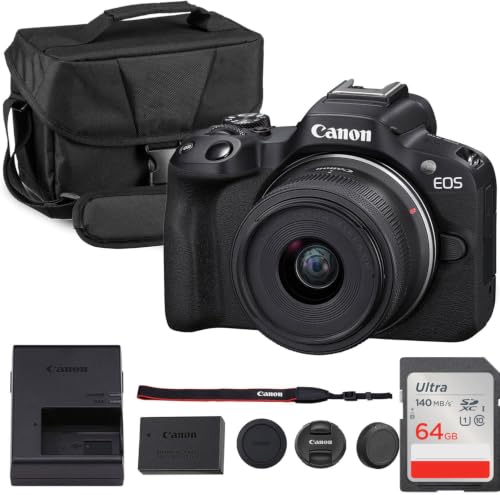
First serious camera → Canon EOS R50 ($679). Same sensor as the R50 V but with a viewfinder, making it better for learning photography alongside video.
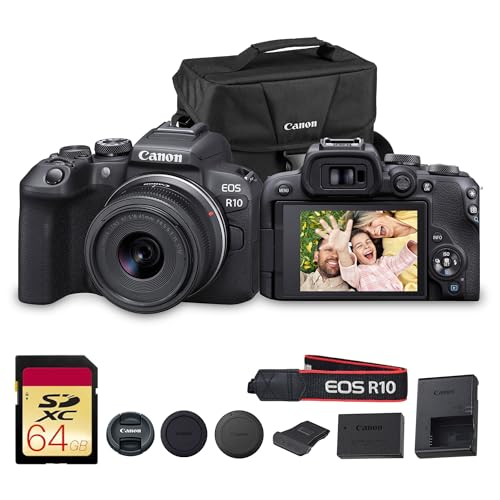
Best all-rounder under $1,000 → Canon EOS R10 ($879). Faster burst shooting (23fps), better ergonomics, and a more advanced autofocus system than the R50.
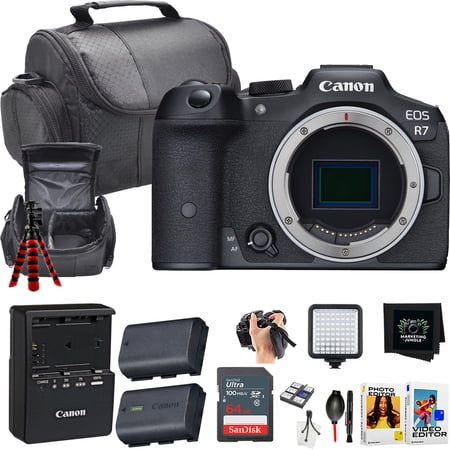
Sports and wildlife → Canon EOS R7 ($1,499). The 1.6x crop factor gives you extra reach, 7-stop IBIS keeps telephoto shots steady, and dual card slots provide backup.
Full-frame on a budget → Canon EOS R8 ($1,499). Same price as the R7 but with a full-frame sensor, better low-light performance and shallower depth of field for portraits and events.
Best full-frame value → Canon EOS R6 Mark II ($1,999). Same core experience as the R6 III (IBIS, weather sealing, dual cards, subject tracking) at $800 less. The best-selling Canon full-frame for a reason.
Cheapest full-frame entry → Canon EOS RP ($849). Older autofocus and poor 4K, but genuine full-frame image quality for under $1,000. Treat it as a stills-first camera.
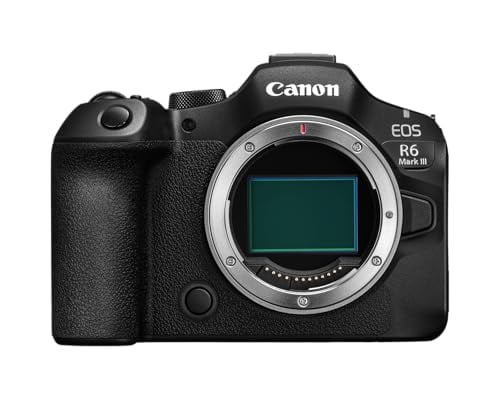
Best hybrid photo/video → Canon EOS R6 Mark III ($2,799). The camera that does everything well, 32.5MP, 7K RAW video, 40fps burst, 8-stop IBIS.
Dedicated video work → Canon EOS R6 V ($2,499). A video-first full-frame body with active cooling for unlimited recording, 7K60 RAW, and no viewfinder.
Flagship performance → Canon EOS R5 Mark II ($3,899). 45MP stacked sensor, 8K60 RAW, minimal rolling shutter, and the most advanced autofocus Canon makes.
Full Comparison Table
Before diving into individual cameras, here’s how they stack up side by side. Every camera in this table has a 3-inch fully articulating vari-angle touchscreen, Dual Pixel CMOS AF with eye detection, and at least one SD card slot.
| Camera | Sensor | Resolution | Max Video | IBIS | Burst Speed | Weight | Price (Body) |
|---|---|---|---|---|---|---|---|
| EOS R50 V | APS-C | 24.2 MP | 4K60 (crop) | No | 15 fps | ~350g | $649 |
| EOS R50 | APS-C | 24.2 MP | 4K30 | No | 15 fps | 375g | $679 |
| EOS R10 | APS-C | 24.2 MP | 4K60 (crop) | No | 23 fps | 429g | $879 |
| EOS R7 | APS-C | 32.5 MP | 4K60 | 7-stop | 15 fps | 612g | $1,499 |
| EOS R8 | Full-Frame | 24.2 MP | 4K60 | No | 40 fps (e) | 461g | $1,499 |
| EOS R6 V | Full-Frame | 32.5 MP | 7K60 RAW | 7.5-stop | 40 fps | ~600g | $2,499 |
| EOS R6 Mark III | Full-Frame | 32.5 MP | 7K RAW | 8-stop | 40 fps | 670g | $2,799 |
| EOS R5 Mark II | Full-Frame | 45 MP | 8K60 RAW | 8.5-stop | 30 fps | 738g | $3,899 |
A few things jump out from this table. The R8 and R7 are the same price but fundamentally different cameras, full-frame vs. APS-C. That’s not a mistake; they’re aimed at different shooters (more on this below). The R6 V is actually cheaper than the R6 Mark III because it trades the viewfinder for a cooling fan, a fair swap if you shoot mostly video.
Understanding Flip Screen Types
Before getting into individual cameras, it’s worth understanding what “flip screen” actually means on Canon cameras, because the term gets used loosely.
Canon uses a fully articulating vari-angle screen on all its current RF-mount cameras (except the R100). This screen swings out to the left side of the camera on a hinge, then rotates up to 270 degrees. You can face it forward for vlogging, angle it up or down for waist-level or overhead shooting, or fold it inward against the body to protect the display during transport.
This is different from a tilt screen, which stays centered behind the camera and only angles up and down. Some competitors use tilt screens (and Canon used them on some older models), but they can’t face forward for self-recording, a dealbreaker for vloggers.
The only Canon RF camera without a movable screen is the EOS R100, which has a fixed display. Since this article is specifically about flip screen models, the R100 isn’t included in the recommendations.
APS-C vs. Full-Frame: Which Sensor Size?
This is the single biggest decision you’ll make, and it affects everything, image quality, lens size, camera weight, and price.
Think of the sensor as the camera’s “eye.” A full-frame sensor is physically larger, about 2.5 times the area of an APS-C sensor. That extra surface area captures more light, which means cleaner images at high ISO settings (low light), shallower depth of field (more background blur in portraits), and a wider field of view at the same focal length.
APS-C sensors are smaller but have their own advantages. The 1.6x crop factor effectively multiplies your lens focal length, which means a 200mm lens behaves more like a 320mm, a significant advantage for wildlife and sports where you want maximum reach. APS-C cameras and their dedicated lenses (RF-S mount) are also physically smaller, lighter, and significantly cheaper.
Choose APS-C if: You’re on a budget, you prioritize portability, or you shoot wildlife/sports where the extra reach helps.
Choose full-frame if: Low-light performance matters, you want the shallowest possible depth of field, or you need the highest overall image quality for professional work.
The Cameras: Detailed Breakdown
Canon EOS R50. Best for Beginners ($679)
The R50 is Canon’s lightest mirrorless camera at 375 grams, light enough that you’ll forget it’s in your bag. Despite its small size, it has the same 24.2MP APS-C sensor and Dual Pixel CMOS AF II found in Canon’s more expensive crop-sensor bodies, which means the image quality and autofocus performance punch well above this price point.
For photography, the R50 shoots 15fps bursts with the electronic shutter, has a multi-function shoe for accessories, and includes Canon’s guided interface that walks beginners through settings using plain-language descriptions instead of technical jargon. For video, it records 4K at 30fps (6K oversampled for clean footage) and 1080p at 120fps for slow motion.
The flip screen is the same 3-inch vari-angle touchscreen used across Canon’s lineup. It faces forward for selfies and vlogging, has responsive touch-to-focus, and folds flat for protection.
What it’s missing: No in-body image stabilization (you’ll rely on lens-based IS), no top LCD panel, and the grip is small, fine for compact lenses, but larger telephoto glass makes it feel front-heavy. The single UHS-I card slot is also slower than the UHS-II slots on the R10 and R7.
Best for: First-time camera buyers, casual photographers, travel shooters who want something pocketable with interchangeable lenses.
Canon EOS R50 V. Best for Vloggers on a Budget ($649)
The R50 V takes the R50’s sensor and autofocus system and wraps them in a body designed entirely for video creators. The most obvious difference: there’s no electronic viewfinder. Canon replaced it with a flat top that makes the body even more compact, and the fully articulating screen becomes your only framing device.
This trade-off makes sense for its target audience. Vloggers frame with the screen, not the viewfinder, so removing it shaves off weight and cost without losing functionality. Canon also added a front-facing record button (so you can start and stop recording while facing the camera), a dedicated livestream button, and support for four different streaming methods including USB UVC/UAC for direct computer streaming.
Video specs get a bump over the standard R50: 4K at 60fps (with a 1.56x crop), 10-bit 4:2:2 color, and Canon Log 3 / HDR PQ, features that are unusual at this price and give editors much more flexibility in color grading.
What it’s missing: No viewfinder means this isn’t ideal if you also want to shoot stills in bright sunlight where the screen washes out. The 4K60 crop narrows your field of view significantly, so you’ll want a wider lens to compensate.
Best for: YouTube and social media creators, livestreamers, anyone who shoots primarily video and wants a Canon system for under $700.
Canon EOS RP. Cheapest Full-Frame Entry ($849)
The EOS RP is Canon’s most affordable full-frame mirrorless camera, and while it is starting to show its age (released in 2019), it still makes a strong case for photographers who want that full-frame look without spending $1,500. The 26.2MP sensor delivers pleasing color rendition, clean images up to about ISO 6400, and that characteristic shallow depth of field you can only get from a larger sensor.
The flip screen is the same 3-inch vari-angle touchscreen found across Canon’s lineup. Autofocus uses the original Dual Pixel CMOS AF (not the newer AF II), which is reliable for face tracking but lacks the deep-learning subject detection found in newer bodies. For talking-head vlogs and controlled shooting, it tracks your face well. For fast-moving subjects or tough lighting, you will notice the gap.
Video is the RP’s weak spot. 4K recording applies a heavy 1.6x crop and drops to contrast-detect AF, making it essentially a 1080p video camera in practice. If video matters to your workflow, the R50 or R10 are better choices at similar or lower prices.
What it’s missing: No IBIS, older autofocus system, heavily cropped 4K with contrast AF, single card slot, and no weather sealing. The grip is small and can feel cramped with larger lenses.
Best for: Budget-conscious photographers who prioritize stills over video and want full-frame image quality for portraits, events, or travel photography without breaking $1,000.
Canon EOS R10. Best All-Rounder Under $1,000 ($879)
The R10 is where Canon’s crop-sensor lineup starts to feel serious. It shares the R50’s 24.2MP sensor but pairs it with a significantly better autofocus system, faster burst shooting (23fps electronic shutter vs. 15fps), and more physical controls including a top dial, rear dial, and dedicated AF joystick.
The autofocus is the standout upgrade. The R10 uses Canon’s Dual Pixel CMOS AF II with deep-learning subject detection, it can identify and track people, animals (dogs, cats, birds), and vehicles in real time. This is the same underlying AF technology used in Canon’s $3,000+ cameras, just implemented in a $879 body. For bird photography, wildlife tracking, or action sports, it makes a noticeable difference over the R50’s simpler tracking system.
Video specs include 4K60 (with a 1.6x crop), 4K30 oversampled from 6K, and 1080p at 120fps. The vari-angle flip screen works identically to the R50’s, same size, same touch responsiveness, same forward-facing capability.
What it’s missing: No IBIS, which means handheld video at telephoto focal lengths can be shaky unless you use IS-equipped lenses. Single card slot (UHS-II, which is at least fast). The body is still fairly small, though noticeably larger than the R50.
Best for: Enthusiast photographers stepping up from a phone or entry-level camera, hobbyist wildlife shooters, content creators who want good stills and good video in one body.
Canon EOS R7. Best for Sports and Wildlife ($1,499)
The R7 is Canon’s top APS-C mirrorless camera and the only crop-sensor body in the current lineup with in-body image stabilization. That 7-stop IBIS is a major upgrade for handheld telephoto work, pair it with a stabilized lens and you’re looking at up to 8 stops of combined stabilization, enough to handhold a 400mm lens at walking-around shutter speeds.
The 32.5MP sensor is the highest resolution APS-C sensor in Canon’s lineup, and the 1.6x crop factor means that resolution is packed into a smaller area, ideal for cropping into distant subjects. A 100-400mm lens effectively becomes a 160-640mm, with enough pixel density to crop further and still get usable images. Dual UHS-II card slots provide redundancy for professional shoots (write to both simultaneously or use one for overflow).
Video shoots 4K at 60fps without a crop (using the full width of the APS-C sensor), with Canon Log 3 and HDR PQ for grading flexibility. The fully articulating touchscreen is the same 3-inch design as the rest of the lineup.
What it’s missing: APS-C sensor means noisier high-ISO performance than full-frame alternatives at the same price (the R8 is also $1,499). No 10-bit internal recording in 4K60 (4K30 only for 10-bit). The body is larger and heavier than other APS-C options at 612 grams.
Best for: Bird photographers, wildlife enthusiasts, motorsport shooters, anyone who needs maximum reach and fast tracking autofocus with stabilization.
Canon EOS R8. Best Full-Frame Value ($1,499)
The R8 is Canon’s most affordable full-frame mirrorless camera, and at 461 grams, it’s remarkably light for a full-frame body, barely heavier than the APS-C R10. It uses the same 24.2MP full-frame sensor and DIGIC X processor as the original R6, which means proven image quality with excellent low-light performance and the shallow depth of field that full-frame is known for.
Autofocus is Dual Pixel CMOS AF II with the same deep-learning subject detection found in the R6 Mark III. Burst shooting hits 40fps with the electronic shutter, faster than any other Canon camera under $2,500 and genuinely useful for capturing peak moments in action, events, and wildlife.
Video includes 4K60, 10-bit Canon Log 3, and HDR PQ. The flip screen is the same vari-angle touchscreen design.
What it’s missing: No IBIS. This is the R8’s biggest compromise. Canon removed in-body stabilization to keep the body small and the price low. You’ll need IS-equipped lenses for handheld video work. Also a single card slot and no top LCD info panel. The small body can feel unbalanced with heavy L-series lenses.
Best for: Event photographers, portrait shooters, travel photographers who want full-frame quality in the lightest possible body, filmmakers working with stabilized lenses or gimbals.
Canon EOS R6 Mark II. Proven Workhorse ($1,999)
The R6 Mark II has been Canon’s best-selling full-frame camera since its 2022 launch, and it hits a value sweet spot that the newer R6 Mark III does not replicate at $800 less. The 24.2MP sensor is the same proven chip from the R8, paired with 8-stop IBIS, weather sealing, dual SD card slots, and Canon’s Dual Pixel CMOS AF II with full subject detection.
Video shoots 4K at 60fps oversampled from 6K (giving you cleaner footage than the cropped 4K60 on APS-C bodies), 4K at 30fps oversampled from the full sensor width, and 1080p at 180fps for extreme slow motion. Canon Log 3 and HDR PQ are both available with 10-bit color. The flip screen is the same 3-inch vari-angle touchscreen.
Where the R6 Mark II still wins over the newer R6 Mark III is value. At $1,999, you get IBIS, weather sealing, dual card slots, a headphone jack, and proven full-frame video quality. The R6 III adds 7K RAW and jumps to 32.5MP, but if you do not need those features, the Mark II saves you $800 that is better spent on glass.
What it’s missing: 24.2MP is lower resolution than the R6 III’s 32.5MP. No 7K RAW or 4K120 video. The electronic shutter shows more rolling shutter than the R6 III. Slightly less dynamic range recovery than the R6 III’s new sensor.
Best for: Wedding photographers, event shooters, travel vloggers, and anyone who wants a proven full-frame all-rounder without paying $2,800. This is the camera most working professionals are actually buying.
Canon EOS R6 Mark III. Best Hybrid Camera ($2,799)
The R6 Mark III is the camera that does everything well. Its 32.5MP full-frame sensor is a significant resolution upgrade over the R6 Mark II’s 24.2MP, and it shoots 7K RAW video internally, a feature that was previously exclusive to Canon’s Cinema EOS line.
For photography, 40fps electronic shutter burst with 20 frames of pre-shooting buffer (the camera captures frames before you fully press the shutter), 8-stop IBIS, and Canon’s most sophisticated autofocus system with subject detection for people, animals, vehicles, and aircraft. For video, 7K RAW at up to 30fps, 4K120 for slow motion, 10-bit Canon Log 3, and no recording limits.
The body is weather-sealed, has dual card slots (one CFexpress, one SD UHS-II), a top LCD panel, and full physical controls including a dedicated AF joystick, dual command dials, and a mode dial. The fully articulating touchscreen is 3 inches with 1.62 million dots, the highest resolution LCD in Canon’s non-cinema lineup.
What it’s missing: At $2,799 body-only, it’s a significant investment. The 32.5MP files are larger and require more storage and processing power. The body is heavier than the R8 at 670 grams. No active cooling means extended 7K recording may trigger thermal warnings in hot conditions.
Best for: Professional hybrid shooters, wedding photographers, documentary filmmakers, serious enthusiasts who want one camera that handles every genre.
Canon EOS R6 V. Best for Dedicated Video ($2,499)
The R6 V is Canon’s video-focused addition to the lineup, announced in 2026. It takes the R6 Mark III’s 32.5MP sensor and repackages it as a video-first camera, removing the viewfinder and adding an active cooling fan that allows unlimited recording without overheating.
The result is a camera that records 7K RAW at 60fps (double the R6 III’s 7K30 limit), oversampled 4K at 60fps, 4K at 120fps, and 2K at 180fps for extreme slow motion. The built-in fan means you can run these high-bitrate modes continuously, during long interviews, events, or multi-camera livestreams, without the camera throttling.
The 7.5-stop IBIS and Dual Pixel CMOS AF II with subject detection are both carried over. The vari-angle touchscreen (3 inches, 1.62 million dots) is the sole display since there’s no viewfinder.
What it’s missing: No electronic viewfinder, which makes it less versatile for stills photography in bright conditions. The active fan could potentially introduce noise in very quiet recording environments.
Best for: Filmmakers, long-form video producers, multi-cam livestreamers, anyone who needs a full-frame video tool that won’t overheat.
Canon EOS R5 Mark II. Flagship Performance ($3,899)
The R5 Mark II sits at the top of Canon’s mirrorless lineup (below the R1, which is a sports/journalism body). Its 45MP back-illuminated stacked CMOS sensor is the highest resolution in any Canon mirrorless camera, and the stacked design means blazing readout speeds with minimal rolling shutter, critical for shooting fast-moving subjects with the electronic shutter.
This camera is overkill for most people, but for professionals who need every advantage: 8K60 RAW internal recording, 4K120, 30fps burst shooting, 8.5-stop IBIS, dual CFexpress/SD card slots, and the most advanced autofocus Canon makes (including action prediction based on AI analysis of subject movement patterns).
The fully articulating touchscreen is the same proven vari-angle design, and the body is fully weather-sealed with a magnesium alloy chassis.
What it’s missing: At $3,899 body-only, it’s the most expensive option. The 45MP files are large (about 25MB per RAW), demanding fast cards and significant storage. The body is the heaviest in the lineup at 738 grams. The high resolution exceeds what many lenses can actually resolve, meaning you’ll need top-tier glass to see the full benefit.
Best for: Professional photographers and filmmakers who need maximum resolution, no-compromise video specs, and the fastest possible autofocus and burst performance.
What About Canon DSLRs with Flip Screens?
Canon has effectively discontinued its DSLR lineup. The company’s last DSLR announcements were the EOS 90D and EOS Rebel T8i, both from 2019-2020, and no new DSLRs are in development. Canon’s full focus is on the RF-mount mirrorless system.
I shot with an 80D as my main vlogging camera for years, and it is still a capable tool for 1080p content. The Dual Pixel AF was a game-changer when it launched, and the flip screen hinge on the 80D feels more solid than some of the newer, lighter mirrorless bodies. If you find one used for $400-500, pair it with the EF-S 10-18mm for vlogging and you will have a setup that can produce perfectly good YouTube content. Just know that you are locked into 1080p and the body is noticeably heavier than anything in the RF lineup.
That said, if you’re looking at the used market, several Canon DSLRs with flip screens are still available at steep discounts. The EOS 90D (32.5MP, 4K, 10fps) and EOS 80D (24.2MP, 1080p, 7fps) are the standouts, both have fully articulating touchscreens and are solid cameras that still take great photos. The EOS 6D Mark II is the only full-frame Canon DSLR with a flip screen and can be found used for under $800.
Just keep in mind that buying into the EF lens mount at this point is a shrinking ecosystem. Canon is putting all new lens development into RF mount, and the used EF lens market, while still large, isn’t growing. If you’re starting fresh, the RF mirrorless system is the better long-term investment.
Best Canon Flip Screen Camera by Use Case
The right camera depends on what you actually shoot, not which one has the most impressive spec sheet. A vlogger doesn’t need 45MP and 8K, and a wildlife photographer doesn’t need a front-facing record button. Match the camera to the job.
Buying Considerations
If you are upgrading from a Canon DSLR: I went through this exact decision when my 80D started feeling limited. The temptation is to jump to the most expensive body you can afford, but the R50 at $679 with modern autofocus and 4K will produce better video than a $2,000 DSLR from 2018. Spend the difference on a good lens and an external microphone. Your audience cares about audio quality and lighting far more than whether you shoot on an R50 or an R6.
Lenses matter more than the body. A $679 R50 with a great lens will outperform a $2,799 R6 III with a kit lens. Budget roughly equal amounts for the body and your first one or two lenses. Canon’s RF-S 18-150mm is a versatile APS-C starter, and the RF 50mm f/1.8 is an affordable full-frame portrait lens.
IBIS vs. lens IS. Only the R7, R6 Mark III, R6 V, and R5 Mark II have in-body stabilization. The R50, R10, and R8 rely entirely on lens-based image stabilization, which means you need IS-equipped lenses for smooth handheld video. This isn’t a dealbreaker, but factor it into your lens budget.
Video crop factors. Some cameras apply a crop when recording certain video modes. The R50 V shoots 4K60 with a 1.56x crop, the R10 applies a 1.6x crop for 4K60, and even the R7 crops slightly in some modes. At 4K30, most of these cameras use the full sensor width. If wide-angle video matters to you, check the specific crop factor for the resolution and frame rate you plan to use most.
Memory cards and storage. Higher-resolution video modes generate massive files. 7K RAW on the R6 III produces roughly 2.8GB per minute of footage. Make sure your card is fast enough (CFexpress for the R6 III and R5 II) and that your editing computer can handle the files. The more affordable cameras use standard SD cards, which are cheaper and more widely available.
Weight and ergonomics. The difference between a 375g R50 and a 738g R5 II is significant, especially after carrying it for a full day. If you’re traveling or vlogging, that weight difference compounds when you add lenses, batteries, and accessories. Heavier bodies have better grip and more physical controls, though, so there’s a trade-off.
Frequently Asked Questions
Do all Canon mirrorless cameras have flip screens? Almost all. The only exception in Canon’s current RF-mount lineup is the EOS R100, which has a fixed (non-moving) screen. Every other Canon RF camera, from the $649 R50 V to the $3,899 R5 Mark II, has a fully articulating vari-angle touchscreen.
What’s the difference between a flip screen and an articulating screen? Nothing, they’re different names for the same thing. Canon officially calls it a “vari-angle” screen. It swings out to the left on a hinge, then rotates to face forward, up, down, or backward. “Flip screen,” “articulating screen,” and “vari-angle screen” all describe this same mechanism.
Can I use Canon EF lenses on these RF-mount cameras? Yes, with the Canon EF-EOS R mount adapter. It maintains full autofocus, IS, and aperture control with no image quality loss. Canon makes three adapter versions: the standard adapter, one with a control ring, and one with a drop-in filter slot.
Which Canon flip screen camera is best for YouTube? For most YouTubers, the EOS R50 V ($649) offers the best value, it’s specifically designed for creators with a front-facing record button and livestream capabilities. If your budget allows and you want better low-light performance and background blur, the EOS R8 ($1,499) is a significant step up with its full-frame sensor.
Is IBIS necessary? It depends on your shooting style. For handheld video, especially at telephoto focal lengths, IBIS makes a huge difference. For studio work, tripod shooting, or photography with fast shutter speeds, it’s nice to have but not essential. If IBIS is important to you, your options are the R7, R6 Mark III, R6 V, and R5 Mark II.
Prices listed are manufacturer’s suggested retail prices (MSRP) for body-only configurations as of 2026. Street prices may vary.