How To Adjust Canon M50 Video Settings in 5 Steps
The Canon M50 is still one of the best budget-friendly cameras for video in 2026. It’s a mirrorless camera with Dual Pixel autofocus, a flip-out touchscreen, and 4K recording – all packed into a compact body that won’t break the bank. If you’re getting into vlogging, YouTube, or short-form content creation, the M50 is a solid starting point.
But to get the best footage out of it, you need to tweak the Canon M50 Video Settings beyond what the camera gives you by default. The factory configuration is aimed at beginners who just want to point and shoot. For better video quality, you’ll want to unlock the full menu system, reassign buttons, take control of aperture and focus, and manage stabilization manually.
Here’s a five-step walkthrough to set up your M50 for better video.
5 Steps to Adjust Canon M50 Video Settings
Step 1. Getting Started with Initial Settings
Canon M50 Video Settings – initial settingsWhen you first power on the Canon M50, you’ll notice that several menu options are hidden. That’s because the camera ships with “Guided” display mode enabled by default. This simplified interface is designed for beginners, but it hides a lot of the settings you need for proper Canon M50 Video Settings control.
To unlock the full menu, go to Menu, then Display Settings. Find the Menu Display option and switch it from “Guided” to “Standard.” This reveals the classic Canon menu system with all the advanced options exposed.
Once you’ve done this, you’ll see additional tabs in the menu for video-specific settings, custom functions, and manual controls that were previously hidden. This is the first and most important step – everything else in this guide depends on having the full menu available.
Step 2. Adjusting the Shutter Button
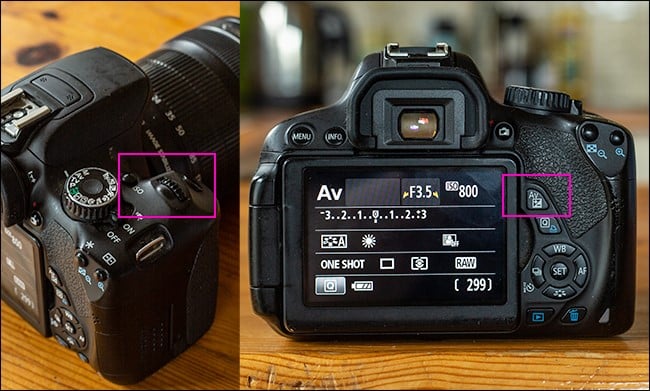
The M50’s dedicated record button is small and awkwardly placed. If you’ve ever fumbled with it while trying to start or stop a recording, you know the frustration. The fix is simple: reassign the shutter button to act as the record button when the camera is in video mode.
To do this, go to Menu, navigate to tab 5 in the camera settings, and find the “Btn function” option. Set it so that a full press of the shutter button starts and stops video recording. The shutter button is bigger, more tactile, and easier to reach – especially when the camera is on a tripod or gimbal.
This small change makes a big difference in your shooting experience. You’ll stop accidentally bumping the tiny record button, and you’ll have more confident control over when your takes start and end. It’s one of the first things most M50 video shooters change, and for good reason.
Step 3. Controlling the Aperture
Aperture control is key to getting a cinematic look in your videos. A wider aperture (lower f-number) creates a shallower depth of field, blurring the background and drawing attention to your subject. A narrower aperture keeps more of the scene in focus.
By default, the front dial on the M50 controls shutter speed when you’re in video mode. But for most video work, you’ll want to lock your shutter speed (following the 180-degree rule) and adjust aperture instead.
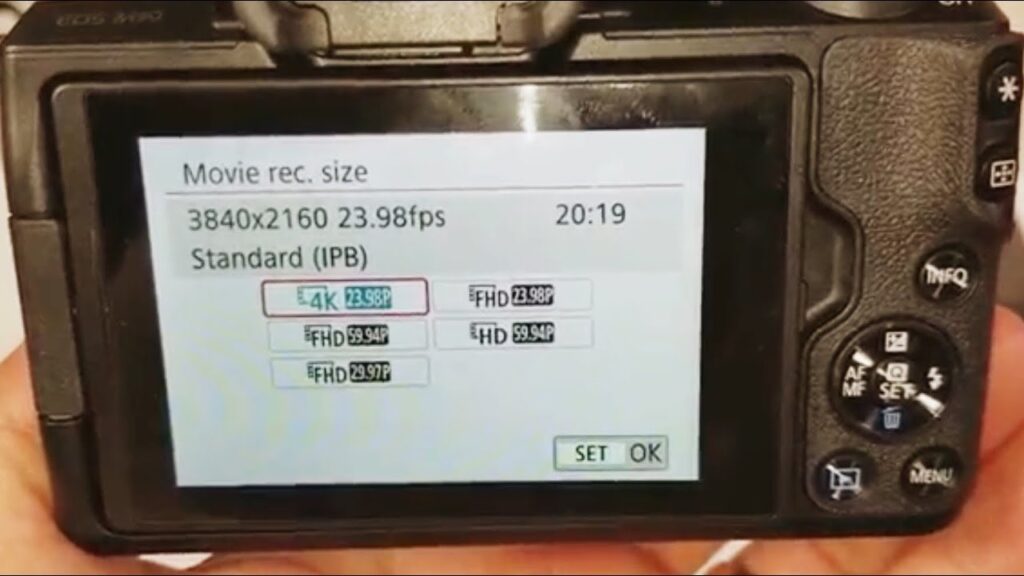
Here’s how to switch it: first, make sure you’re in video mode. Then press the D-pad or the Exposure Compensation button to toggle the front dial between controlling shutter speed and controlling aperture. Once it’s set to aperture, you can use the dial to adjust depth of field while keeping your shutter speed locked.
This gives you direct, quick access to one of the most important creative controls for video. You can pull the background out of focus for interviews or tighten it up for product shots – all without diving into menus. The M50 records in 4K resolution at 24fps, and controlling aperture helps you make the most of that image quality.
Step 4. Enabling Focus Peaking
The M50’s screen is sharp enough to see fine detail, but judging precise focus on a small LCD is still tricky – especially when you’re shooting video and can’t review each frame individually. Focus peaking solves this problem by highlighting the edges of in-focus areas with a colored overlay on your screen.
To enable focus peaking for your Canon M50 Video Settings, go to Menu, select the Camera tab, navigate to option 5, and find the MF (Manual Focus) settings. Inside, you’ll find focus peaking controls.
You can adjust the peaking level from Low to High. A lower setting shows peaking only on the sharpest edges, while a higher setting is more sensitive and highlights a broader area. Start with Medium and adjust based on your preference.
You also get to pick the peaking color – red, blue, or yellow. Choose whichever stands out best against the subjects you typically shoot. Red works well for most scenes, but if you’re filming something with a lot of warm tones, blue or yellow might be easier to see.
Focus peaking is especially useful when you’re using manual focus lenses or pulling focus manually during a shot. It gives you visual confirmation that your subject is sharp without having to zoom in on the LCD.
Step 5. Stabilization and IS Settings
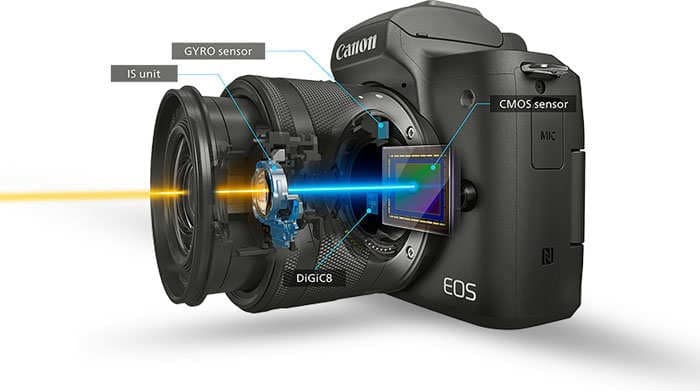
The Canon M50 has a built-in digital stabilizer for video. It’s electronic, not mechanical, meaning the sensor doesn’t physically shift. Instead, the camera crops into the image slightly and uses software to smooth out camera movement.
Whether you should use it depends on your setup. If you’re shooting handheld and walking around, the digital IS can help smooth out your footage. If you’re on a tripod, turn it off – it’s not needed, and the crop reduces your field of view for no benefit.
To adjust your Canon M50 video settings for stabilization, open the menu, go to the Camera tab, and select option 5. You’ll find the IS Settings section there. Click on Digital IS and choose your preferred mode.
The standard “Enable” mode applies a mild crop and light stabilization. The “Enhanced” mode crops more aggressively and stabilizes more, but you lose a noticeable chunk of your frame. For most situations, standard mode is the better choice. Enhanced mode can be useful for walking shots, but the heavy crop means you’ll need a wider lens to compensate.
If your lens has optical image stabilization (IS), that works alongside the digital IS. But be aware that stacking both can sometimes cause weird jitter artifacts. Test your specific lens and body combo to see what gives the smoothest results.
Keep these tradeoffs in mind when adjusting stabilization. The digital IS crops your video, which means you’re not using the full width of the sensor. If you’re already shooting in 4K (which has its own crop on the M50), stacking digital IS on top of that can give you a very narrow field of view.
Follow these five steps and you’ll have your Canon M50 set up for quality video recording. Whether you’re shooting vlogs, short films, or product reviews, these settings give you the control you need to produce polished footage.
How we verify what we publishLast checked October 10, 2026Report an error