Choosing the right Canon EOS Rebel T7 lens can make a bigger difference in your photos than any other upgrade. The T7 (also sold as the Canon 2000D internationally) is a capable entry-level DSLR, and pairing it with the right glass unlocks its full potential. This guide covers everything from understanding the kit lens to picking the best upgrade lenses for portraits, landscapes, wildlife, and more.
Understanding the Canon EOS Rebel T7 Kit Lens
The Canon EOS Rebel T7 typically ships with the EF-S 18-55mm f/3.5-5.6 IS II kit lens. This is a versatile all-purpose lens that covers a useful focal range, wide enough for group shots and landscapes at 18mm, and long enough for casual portraits at 55mm.
The “IS” stands for Image Stabilization, which compensates for hand movement and lets you shoot at slower shutter speeds without blur. For a beginner, this lens does a solid job of covering everyday shooting situations. The image quality is perfectly acceptable for learning, social media, and prints up to about 8×10 inches.
That said, the kit lens has limitations. The variable aperture (f/3.5 at 18mm, f/5.6 at 55mm) means it struggles in low light. The autofocus motor is audible, which can be distracting during quiet moments. And the optical quality, while fine, won’t match dedicated prime or professional zoom lenses. Think of it as your starting point, not your destination.
Canon EOS Rebel T7 Lens Compatibility: EF and EF-S Mount
The Rebel T7 uses Canon’s EF mount, which is one of the biggest advantages of buying into the Canon ecosystem. The T7 is compatible with two types of Canon lenses:
EF-S lenses are designed specifically for Canon’s APS-C crop-sensor cameras like the T7. They’re typically smaller, lighter, and more affordable than their full-frame counterparts. The “S” stands for “short back focus,” meaning the rear element sits closer to the sensor. EF-S lenses can only be used on crop-sensor Canon DSLRs.
EF lenses are designed for Canon’s full-frame cameras but work perfectly on crop-sensor bodies like the T7. When you mount an EF lens on the T7, the effective focal length is multiplied by 1.6x (the crop factor). So a 50mm EF lens behaves like an 80mm lens on the T7. This is worth keeping in mind when choosing lenses, it can work in your favor for telephoto reach but makes wide-angle lenses less wide.
Between EF and EF-S, you have access to hundreds of lenses from Canon and third-party manufacturers like Sigma, Tamron, and Tokina. This massive selection is one of the best reasons to own a Canon DSLR. If you’re exploring Canon’s broader lineup, check out our guide to Canon lenses for more options.
What About RF Mount Lenses?
Canon’s newer RF mount lenses, designed for their mirrorless cameras, are not compatible with the Rebel T7. There is no adapter that converts RF lenses to work on EF-mount DSLRs. Stick to EF and EF-S lenses for the T7.
How to Remove and Attach Lenses on the Canon EOS Rebel T7
Swapping lenses is straightforward, but doing it properly protects your camera from dust and damage.
To remove a lens: Turn off the camera first. Press the lens release button on the camera body (located to the left of the lens mount when the camera faces you) and rotate the lens counterclockwise until it detaches. Immediately cap the lens and attach a body cap or your next lens to prevent dust from reaching the sensor.
To attach a lens: Align the white dot (for EF-S lenses) or red dot (for EF lenses) on the lens with the corresponding dot on the camera body. Insert the lens and rotate clockwise until you hear a click. Give it a gentle tug to confirm it’s locked in place.
Always swap lenses in a clean environment with the camera body facing downward to minimize dust entry. Avoid changing lenses in windy, dusty, or rainy conditions when possible.
Best Upgrade Lenses for the Canon EOS Rebel T7
Ready to go beyond the kit lens? Here are the best options for different types of photography.
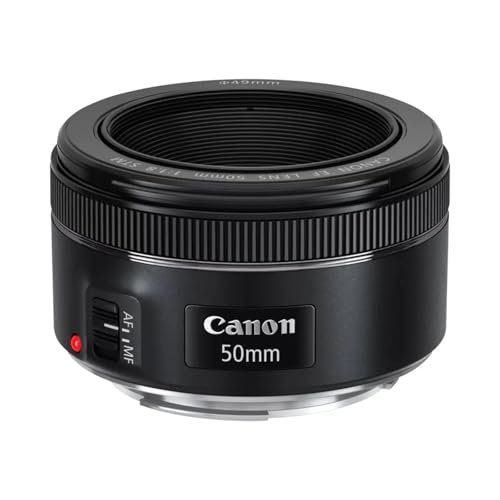
Best Portrait Lens: Canon EF 50mm f/1.8 STM
The “nifty fifty” is the first lens upgrade every Canon DSLR owner should consider. At around $100-$125 new, it’s absurdly affordable for the quality it delivers. The f/1.8 aperture creates beautiful background blur (bokeh) that makes portraits pop, and it lets in far more light than the kit lens, a huge advantage in dimly lit rooms, golden hour shooting, and indoor events.
On the T7’s crop sensor, the 50mm becomes an effective 80mm, which is a classic portrait focal length. The STM autofocus motor is quiet and smooth, making it suitable for video work too. This lens is small, light, and produces images that will make you wonder why you ever settled for the kit lens.
Best Wide-Angle Lens: Canon EF-S 10-18mm f/4.5-5.6 IS STM
If you shoot landscapes, architecture, interiors, or real estate, an ultrawide lens transforms your perspective. The EF-S 10-18mm gives you a dramatically wider field of view than the kit lens, at 10mm, you can fit entire rooms, sweeping vistas, and towering buildings into a single frame.
The Image Stabilization and STM motor make it practical for handheld shooting and video. At around $200-$250 used, it’s an affordable way to add a focal range your kit lens simply can’t match.
Best Telephoto Lens: Canon EF-S 55-250mm f/4-5.6 IS STM
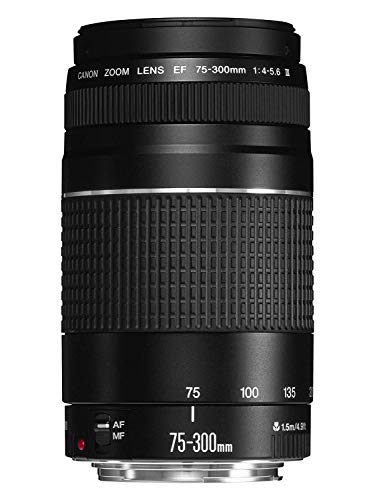
For wildlife, sports, and anything that’s far away, the EF-S 55-250mm IS STM is the natural companion to the kit lens. It picks up right where the 18-55mm stops and reaches out to 250mm (400mm equivalent on the crop sensor), letting you fill the frame with distant subjects.
The Image Stabilization is effective, the STM autofocus is quick and quiet, and the image quality punches well above its price class. At $150-$200 used, it’s the most affordable way to get serious telephoto reach on the T7. If you want to explore Canon flip screen models that pair well with telephoto lenses, we have a dedicated guide.
Best All-Around Upgrade: Sigma 17-50mm f/2.8 EX DC OS HSM
If you want one lens that does everything the kit lens does but better, the Sigma 17-50mm f/2.8 is the answer. The constant f/2.8 aperture means consistent performance across the entire zoom range, better low-light capability, creamier background blur, and more creative control than the variable-aperture kit lens.
The optical stabilization (OS) works well, the Hyper Sonic Motor (HSM) autofocus is fast and quiet, and the image quality is significantly sharper than the kit lens, especially at the edges of the frame. At $250-$350 used, it’s the best “do everything” lens upgrade for the T7.
Best Macro Lens: Canon EF-S 35mm f/2.8 Macro IS STM
For close-up photography of flowers, insects, jewelry, food, and products, the EF-S 35mm Macro is a compact and affordable option. It offers 1:1 magnification (true macro) and includes a built-in LED ring light for illuminating tiny subjects. The IS and STM features make it versatile for non-macro shooting too, at 35mm on the crop sensor (56mm equivalent), it works as a nice everyday walkaround lens.
Autofocus vs. Manual Focus on the Canon EOS Rebel T7
Most Canon EF and EF-S lenses offer autofocus on the T7, but understanding when to use manual focus will improve your photography.
Use autofocus for most shooting situations, it’s faster and more accurate than focusing by hand, especially for moving subjects. The T7’s 9-point autofocus system works best when you select a single AF point and place it directly over your subject, rather than relying on the camera to choose the focus point for you.
Switch to manual focus for macro photography (where precise focus placement is critical), low-contrast scenes where autofocus hunts back and forth, astrophotography, and creative situations where you want to control exactly what’s sharp. Flip the AF/MF switch on the lens to MF and turn the focus ring by hand while looking through the viewfinder.
Lenses with full-time manual focus override (STM lenses support this) let you fine-tune focus after the autofocus locks on, which is useful for portraits where you want to ensure the eyes are tack-sharp. To learn more about your T7’s other features, see our guide on Canon t7 flash settings.
Image Stabilization: Why It Matters for Your Lens Choice
Image Stabilization (IS in Canon’s terminology) compensates for camera shake when you’re shooting handheld. This is especially important at longer focal lengths, where even slight hand movement gets amplified.
The general rule is that your shutter speed should be at least 1/(effective focal length) for sharp handheld shots. On the T7, a 55mm lens becomes 88mm effective, so you’d need at least 1/90th of a second without IS. With IS, you can shoot 3-4 stops slower, down to about 1/10th of a second, and still get sharp results.
Not every lens has IS, and that’s okay. Fast prime lenses like the 50mm f/1.8 compensate by letting in more light, which allows faster shutter speeds. But for zoom lenses, especially telephotos, IS is a feature worth prioritizing.
Frequently Asked Questions
Can I use full-frame Canon lenses on the Rebel T7?
Yes. All Canon EF (full-frame) lenses mount directly on the T7 and autofocus normally. The 1.6x crop factor changes the effective focal length, so a 100mm EF lens behaves like a 160mm lens on the T7.
What’s the best first lens upgrade for the T7?
The Canon EF 50mm f/1.8 STM, without question. It costs about $100, dramatically improves your low-light shooting, produces beautiful background blur, and teaches you to think about composition differently since it’s a fixed focal length.
Do third-party lenses work well on the Canon T7?
Yes. Sigma, Tamron, and Tokina all make excellent lenses in Canon EF mount. The Sigma 17-50mm f/2.8 and Tamron 70-300mm are particularly popular with T7 owners. Just make sure you buy the Canon-mount version of any third-party lens.
Can I use Canon RF mirrorless lenses on the T7?
No. RF lenses are designed for Canon’s mirrorless cameras and cannot be adapted to work on EF-mount DSLRs like the T7. The reverse, using EF lenses on RF-mount cameras with an adapter, does work, which is one reason EF lenses remain a smart investment.