Verizon Fios is a fiber-to-the-home (FTTH) internet, TV, and phone service that’s available in parts of nine states and Washington, D.C., mostly along the US Northeast corridor. Fios runs internet over fiber optic cables going directly to the home, not copper phone lines like DSL and not coaxial cable like Xfinity or Spectrum.
What does that get you? Symmetrical upload and download speeds (your upload matches your download), no data caps, and consistently low latency. Verizon’s Fios plans range from 300 Mbps to 2 Gbps. Pricing starts around $50 per month, and there are no annual contracts to worry about.
The downside is availability. Verizon only offers Fios where it operates as the local telephone company (the old Bell Atlantic wireline territory). That covers parts of the Northeast and Mid-Atlantic but nothing west of Virginia or south of D.C. Even within those states, Fios doesn’t reach every address. Verizon paused Fios expansion back in 2010 because running fiber to every home was too expensive. The company has resumed building out fiber more recently, but coverage is still address-specific.
You can live in a Fios state and still not have Fios on your street. This guide covers exactly where Fios is available, what plans and speeds you can get, how to check your specific address, and what alternatives exist if Fios doesn’t reach you.
Verizon Fios Internet Plans and Prices
Verizon Fios has four internet tiers. All plans come with no data caps, no annual contracts, and symmetrical speeds (upload matches download). The prices below are for internet only. Bundling with Fios TV or phone service may change pricing. Verizon runs promotional deals fairly often, so check verizon.com/fios for current pricing at your address.
| Plan | Download speed | Upload speed | Approximate price | Best for |
|---|---|---|---|---|
| Fios 300 | 300 Mbps | 300 Mbps | $50/month | 1-3 people, streaming, browsing, video calls |
| Fios 500 | 500 Mbps | 500 Mbps | $70/month | 3-5 people, multiple 4K streams, gaming, working from home |
| Fios Gigabit | 940 Mbps | 880 Mbps | $90/month | 5+ people, heavy downloading, content creators, smart home with dozens of devices |
| Fios 2 Gig | 2,000 Mbps | 2,000 Mbps | $120/month | Power users, home offices with large file transfers, future-proofing |
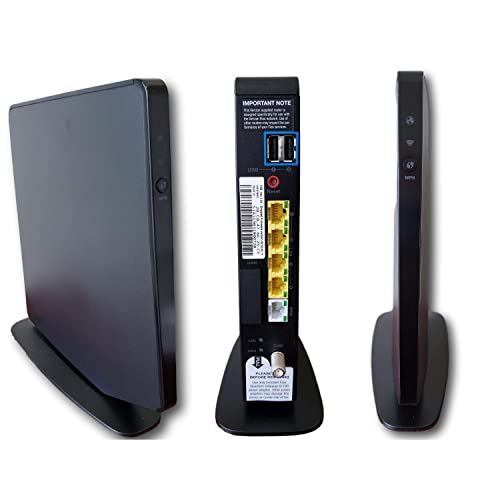
A few things about Fios pricing. The prices listed above are standard monthly rates after any promotional period ends. Verizon often has introductory deals on the lower-tier plans. There’s no price lock guarantee unless your order specifically says so. On the flip side, there’s no contract either, so you can cancel anytime without paying an early termination fee. Equipment (the Verizon Fios router) is included with some plans or available as a monthly rental at around $15/month. You’re free to use your own router instead, though you’ll still need the Verizon ONT (Optical Network Terminal) that hooks up to the fiber line.
Why symmetrical speeds matter. Most cable internet providers (Xfinity, Spectrum, Cox) give you fast downloads but much slower uploads. A typical cable plan might advertise 300 Mbps download but only deliver 10-20 Mbps upload. Fios gives you 300 Mbps in both directions. That makes a real difference for video calls (Zoom, Teams), uploading large files to cloud storage, live streaming, running a home security camera system that uploads footage, or working from home with a VPN. If you’ve ever had a video call freeze while someone else in the house was watching Netflix, the bottleneck was probably your upload speed, not download.
Where Is Verizon Fios Available?
Verizon Fios is available in parts of nine states plus Washington, D.C. All are within Verizon’s legacy wireline telephone territory along the Northeast and Mid-Atlantic corridor. Fios is not available anywhere west of Virginia, south of Virginia, or in New England outside of Massachusetts and Rhode Island.
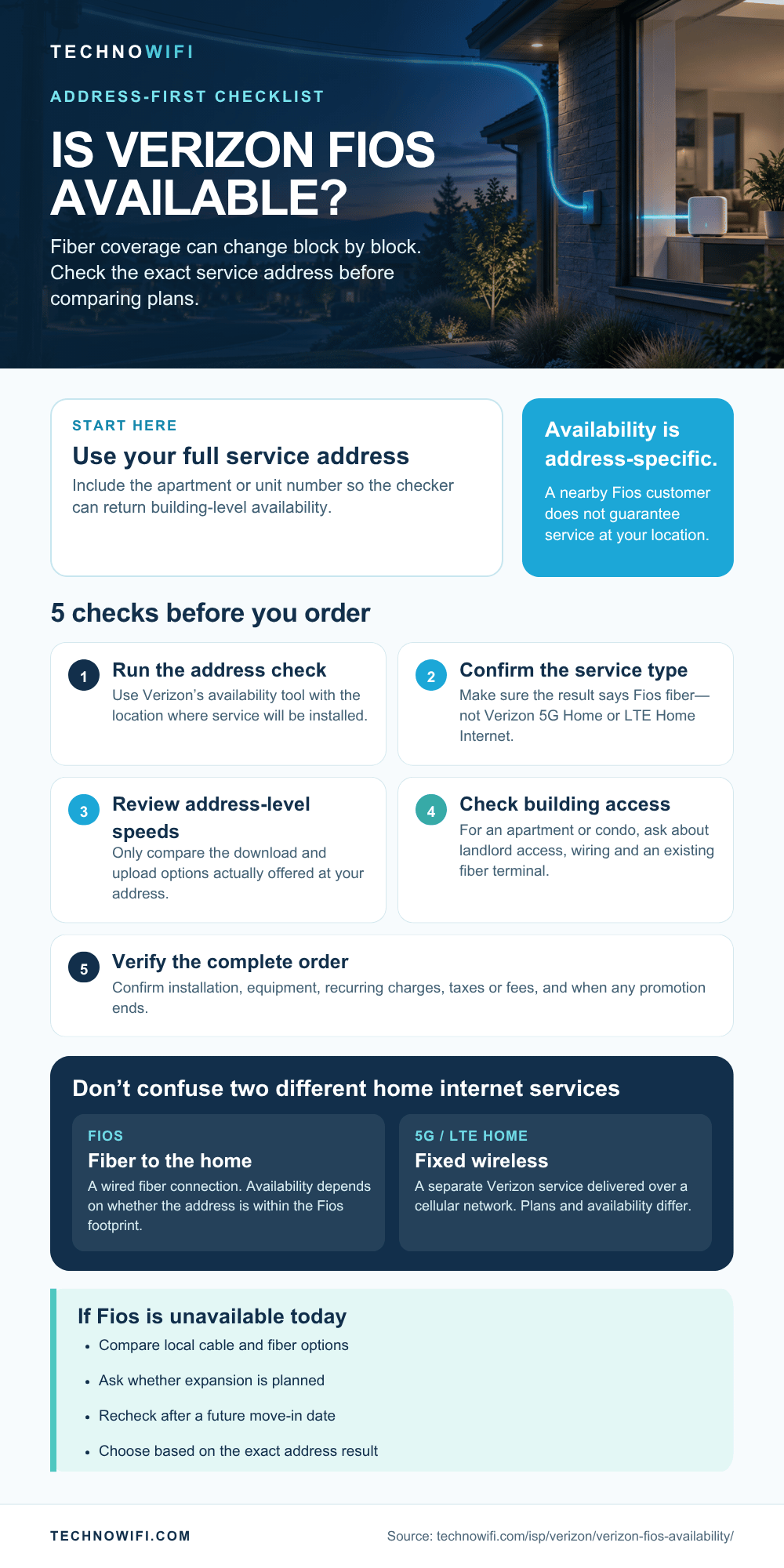
Coverage within each state varies by city, neighborhood, and sometimes by individual street. Fios may be available on one side of a road but not the other if the fiber line wasn’t extended far enough. The only way to confirm availability at your exact address is to use Verizon’s address checker at verizon.com/home/fiosavailability.
New York
New York has the biggest Fios footprint of any state. Coverage spans New York City (all five boroughs, including Manhattan, Brooklyn, Queens, the Bronx, and Staten Island), Long Island (both Nassau and Suffolk counties), Westchester County, Rockland County, and parts of the Hudson Valley north of the city. Further upstate, Fios is available in parts of Albany, Syracuse, and surrounding suburbs. Coverage thins out quite a bit in rural upstate areas and western New York. Buffalo and Rochester are outside Verizon’s Fios territory.
New Jersey
New Jersey has some of the densest Fios coverage in the country for its size. Major coverage areas include Newark, Jersey City, Paterson, Trenton, Toms River, Edison, Woodbridge, Elizabeth, Clifton, Passaic, Union City, Bayonne, Hoboken, and much of the suburban area between New York City and Philadelphia. Northern New Jersey and the central part of the state have the widest coverage. Southern New Jersey near the shore communities also has solid Fios presence. Coverage is widespread enough that most New Jersey residents in urban and suburban areas can get Fios.
Pennsylvania
Fios coverage in Pennsylvania sits mainly in the eastern half of the state. The Philadelphia metro area has the strongest coverage, including Philadelphia proper, Bucks County, Montgomery County, Delaware County, and Chester County. Coverage reaches into the Lehigh Valley (Allentown, Bethlehem, Easton area) and parts of northeastern Pennsylvania. Harrisburg and the state capital region have Fios service in some areas. Western Pennsylvania, including Pittsburgh and Erie, falls outside Verizon’s Fios coverage area. Those areas are served by other providers (Comcast Xfinity is the dominant cable option in Pittsburgh).
Virginia
Virginia’s Fios coverage is strongest in the Northern Virginia suburbs of Washington, D.C., including Arlington, Fairfax County, Loudoun County, Prince William County, and the cities of Alexandria, Fairfax, Falls Church, Manassas, and Reston. This is one of the highest-income, highest-demand broadband markets in the country, and Verizon built out Fios heavily here. Coverage also exists in the Richmond metro area and the Hampton Roads region (Norfolk, Virginia Beach, Newport News, Hampton, Chesapeake). Central and western Virginia (Charlottesville, Roanoke, Lynchburg) are generally outside the Fios footprint.
Maryland
Fios is available in the Baltimore metro area, including Baltimore City, Baltimore County, Anne Arundel County, and Howard County (Columbia). The D.C. suburbs in Maryland have strong coverage too, particularly Montgomery County (Bethesda, Silver Spring, Germantown, Rockville) and Prince George’s County. Frederick and Harford County have some Fios availability. The Eastern Shore and western Maryland mountain regions generally aren’t covered.
Massachusetts
Fios coverage in Massachusetts centers on the Boston metro area and extends into surrounding communities. Greater Boston, the South Shore, parts of the North Shore, MetroWest (Framingham, Natick area), and southeastern Massachusetts (Taunton, parts of Bristol County) all have Fios service. Western Massachusetts (Springfield, Worcester) is largely outside the Fios territory. Keep in mind that some parts of Massachusetts that used to have Verizon landline service have shifted to other carriers, so coverage can be spotty even in the eastern part of the state.
Washington, D.C.
The District of Columbia has widespread Fios availability. Most neighborhoods in D.C. can get Fios, making it one of the most fully covered Fios markets. D.C. residents typically pick between Fios and Xfinity as their two main high-speed internet options.
Rhode Island
Fios is available in parts of Rhode Island, including Providence, Pawtucket, Cranston, Warwick, and communities in the South County area (South Kingstown). Being a small state within Verizon’s wireline territory, Rhode Island has decent Fios penetration relative to its population, though coverage is still address-specific.
Delaware
Fios coverage in Delaware includes parts of the Wilmington metro area in New Castle County and portions of Dover. Delaware is a smaller Fios market, and coverage is more limited than in neighboring New Jersey or Maryland.
Connecticut
This is a common point of confusion. Connecticut used to have Verizon Fios service, but Verizon sold its wireline operations in the state to Frontier Communications in 2014. The fiber network still exists and runs as Frontier Fiber (formerly Frontier Fios), but it’s no longer a Verizon product. If you live in Connecticut and want fiber internet over the old Fios infrastructure, you’d sign up with Frontier, not Verizon.
Verizon Fios Availability by State – Summary
| State | Major metro areas with Fios | Coverage density |
|---|---|---|
| New York | New York City (all boroughs), Long Island, Westchester, Hudson Valley, Albany, Syracuse | High in NYC metro, moderate upstate |
| New Jersey | Newark, Jersey City, Paterson, Trenton, Toms River, Edison, and most suburban areas | Very high statewide |
| Pennsylvania | Philadelphia metro, Bucks/Montgomery/Delaware/Chester counties, Lehigh Valley | High in eastern PA, none in western PA |
| Virginia | Northern Virginia (Arlington, Fairfax, Loudoun), Richmond, Hampton Roads | High in NoVA and Hampton Roads |
| Maryland | Baltimore metro, Montgomery County, Prince George’s County, Howard County | High in Baltimore and D.C. suburbs |
| Massachusetts | Greater Boston, South Shore, MetroWest, Taunton area | Moderate, concentrated in eastern MA |
| Washington, D.C. | Districtwide | Very high |
| Rhode Island | Providence, Pawtucket, Cranston, Warwick, South Kingstown | Moderate |
| Delaware | Wilmington area, parts of Dover | Limited |
How to Check Verizon Fios Availability at Your Address
The state-level info above tells you if Fios exists in your general area, but the only way to know for sure at your exact address is to check directly with Verizon.
Go to verizon.com/home/fiosavailability. Enter your street address, apartment number (if applicable), and zip code. The tool will return one of three results: Fios is available (and it shows you plans and pricing for your address), Fios is not available but Verizon 5G Home Internet is, or neither is available in your area.
Call Verizon at 1-800-VERIZON (1-800-837-4966). A representative can look up your address and tell you exactly what’s available. This can be more accurate than the website for new construction, recently built-out areas, or addresses with unusual formatting.
Check for MDU (Multi-Dwelling Unit) availability. If you live in an apartment building or condo complex, Fios availability depends on whether the building’s management has an agreement with Verizon to allow fiber installation. Some buildings have Fios available on the ground floor but not on upper floors, or the other way around. If the website says Fios isn’t available at your apartment address, contact your building management to ask if they have a Verizon Fios agreement or if one can be arranged.
How Verizon Fios Installation Works
If Fios is available at your address and you order service, Verizon sends a technician to your home for installation. The process typically takes 2-4 hours. Here’s what happens:
The technician installs an ONT (Optical Network Terminal). This is a small white box, roughly the size of a paperback book, mounted on the outside or inside wall of your home (often in the basement or garage). The ONT is the point where the fiber optic cable from Verizon’s network connects to your home’s internal wiring. It converts the light signals traveling through the fiber into electrical signals your router and devices can use. The ONT needs to be plugged into a power outlet.
The fiber line is run from the street to the ONT. If your home has never had Fios, the technician runs a fiber cable from the nearest Verizon junction point (usually a utility pole or underground conduit) to the ONT location. This may involve drilling a small hole through an exterior wall. For homes that previously had Fios (or where a previous owner had it installed), the fiber line and ONT may already be in place.
The router connects to the ONT. For plans up to Gigabit, the ONT connects to the Verizon Fios router via Ethernet cable. For the 2 Gig plan, the connection uses a combination of Ethernet and the newer Verizon Fios router with Wi-Fi 6E capable of handling the higher speeds. The technician sets up the router, configures your Wi-Fi network name and password, and tests the connection.
The installation appointment is free for standard residential installations. Verizon covers the cost of running fiber to your home and installing the ONT as part of signing up for service. There’s no installation fee for most standard setups. Custom or complex installations (very long runs, difficult building access) may cost extra, but the technician will discuss this before starting work.
Verizon Fios Equipment
| Equipment | What it does | Cost | Can you use your own? |
|---|---|---|---|
| ONT (Optical Network Terminal) | Converts fiber optic signal to Ethernet. Installed on your wall. | Provided by Verizon, no charge | No – Verizon’s ONT is required |
| Fios Router (CR1000A or similar) | Wi-Fi 6/6E router, provides wireless and wired connections | $15/month rental or included with some plans | Yes – you can use your own router with the ONT |
| Fios Extender | Wi-Fi mesh extender for large homes | $10/month rental per unit or one-time purchase | Yes – any third-party mesh system works |
Using your own router. The ONT has an Ethernet port. You can plug any third-party router directly into the ONT and skip the Verizon router rental entirely. That saves you $15/month ($180/year). Good options include the TP-Link Archer AX80 ($170-$200), ASUS RT-AX86U Pro ($220-$250), or any Wi-Fi 6 or Wi-Fi 6E router. If you have Fios TV, using your own router requires some extra configuration (the Fios TV set-top boxes pull guide data through the Verizon router), but internet-only customers can swap routers without any issues. Just connect the Ethernet cable from the ONT to the WAN port on your router.
Verizon Fios vs Verizon 5G Home Internet
Verizon sells two different home internet products: Fios (fiber) and 5G Home Internet (fixed wireless). They aren’t the same thing. In areas where Fios isn’t available but Verizon has deployed 5G, you may be offered 5G Home Internet instead.
| Feature | Verizon Fios | Verizon 5G Home Internet |
|---|---|---|
| Technology | Fiber optic cable to the home | Fixed wireless (5G mmWave or C-band from nearby cell tower) |
| Download speed | 300 – 2,000 Mbps (guaranteed tier) | 85 – 1,000 Mbps (typical range, not guaranteed) |
| Upload speed | 300 – 2,000 Mbps (symmetrical) | 10 – 50 Mbps (much lower than download) |
| Latency | 5 – 15 ms (very low) | 20 – 50 ms (higher, varies with congestion) |
| Data cap | None | None (but speeds may be deprioritized during congestion) |
| Reliability | Extremely consistent, fiber isn’t affected by weather or congestion | Variable, affected by weather, line of sight, tower congestion |
| Installation | Technician visit, ONT installation | Self-install (plug in router, no technician needed) |
| Contract | No contract | No contract |
| Price range | $50 – $120/month | $35 – $60/month (with Verizon mobile plan discount) |
| Availability | 9 states + D.C. (limited footprint) | Expanding nationwide (check address) |
If both are available at your address, go with Fios. Fiber is more reliable, faster (especially upload), lower latency, and consistent no matter how many neighbors are online. 5G Home Internet is a solid option where Fios doesn’t reach, but it’s not a replacement for fiber when fiber is on the table. The upload speed gap alone (300+ Mbps on Fios vs 10-50 Mbps on 5G Home) makes Fios the obvious pick for anyone who works from home, takes video calls, or uploads files regularly.
Verizon Fios vs Cable Internet Alternatives
In most Fios markets, the other option is a cable provider like Xfinity (Comcast), Spectrum, or Optimum (Altice/Suddenlink). Here’s how Fios stacks up against cable on the things that actually matter.
| Factor | Verizon Fios | Cable (Xfinity, Spectrum, Optimum) |
|---|---|---|
| Upload speed | Symmetrical (matches download) | Typically 5-35 Mbps, some DOCSIS 4.0 plans higher |
| Data caps | None on any plan | Xfinity: 1.2 TB cap (waivable for $30/month). Spectrum/Optimum: no cap |
| Latency | 5-15 ms | 15-30 ms (higher during peak hours) |
| Peak hour slowdown | Minimal, fiber has dedicated bandwidth per household | Common, cable bandwidth is shared among neighbors on the same node |
| Contract requirements | No contract | Varies: Xfinity no contract, Spectrum no contract, Optimum may require contract for best pricing |
| Technology | Fiber optic (GPON/XGS-PON) | Coaxial cable (DOCSIS 3.1, some DOCSIS 4.0) |
| Reliability in storms | Fiber is not affected by electromagnetic interference, water, or temperature | Coaxial and amplifiers can be affected by power outages and weather |
The biggest real-world difference comes down to upload speed and consistency during peak evening hours. Cable internet works fine for most of the day, but shared neighborhood bandwidth means speeds can dip when everyone on your street starts streaming between 7-10 PM. Fios doesn’t have that problem because each home has a dedicated fiber connection back to Verizon’s network.
What If Verizon Fios Isn’t Available at My Address?
If you live in a Fios state but the service doesn’t reach your specific address, you’ve got several alternatives depending on where you are:
Verizon 5G Home Internet. Available in more areas than Fios and still expanding. Check availability at verizon.com. Download speeds run between 85-1,000 Mbps depending on how strong the 5G signal is at your address. Upload speeds are lower than Fios but still faster than many cable upload speeds.
Cable internet (Xfinity, Spectrum, Optimum). Available in most urban and suburban areas in Fios states. Download speeds up to 1-2 Gbps depending on the provider and plan. This is the most common alternative to Fios across the Northeast.
T-Mobile Home Internet. Fixed wireless service running on T-Mobile’s 4G/5G network. Available at many addresses nationwide. Speeds typically fall between 33-245 Mbps depending on tower distance and congestion. Priced at $50/month with a T-Mobile phone plan. No data caps, no contract.
Verizon DSL. Verizon still offers DSL internet in some areas within its wireline territory where fiber hasn’t been built out. DSL speeds are typically 1-15 Mbps, which is dramatically slower than Fios but available at some addresses where Fios is not. Verizon has been phasing out DSL and pushing customers toward Fios or 5G Home where those options exist.
Local fiber providers. Some municipalities and smaller ISPs have built their own fiber networks in areas Verizon didn’t cover. EPB (Chattanooga, TN), Google Fiber (select cities), and various local cooperatives offer gigabit fiber in their service areas. If you’re outside the Verizon territory entirely, search “[your city] fiber internet” to see what local options pop up.
Verizon Fios Expansion History and Future
Verizon launched Fios in 2005 in Keller, Texas (that area is now served by Frontier Communications after Verizon sold its Texas wireline operations in 2016). By 2009, Fios had grown to roughly 3 million subscribers and was available to about 13 million homes across the Northeast.
In 2010, Verizon announced it would slow Fios expansion significantly. The reason came down to cost. Running fiber optic cable to individual homes is expensive, with estimates ranging from $700 to $1,500 per home passed. Verizon had invested over $23 billion in Fios infrastructure by that point and decided to shift investment toward its wireless (mobile) business, which had higher margins.
Between 2010 and 2022, Fios expansion was essentially frozen. Verizon continued serving existing Fios customers and adding new subscribers at already-wired addresses, but very few new streets or neighborhoods actually got fiber buildout.
Starting in 2023, Verizon reversed course and began expanding Fios again within its existing wireline territory. The company committed to extending fiber to more addresses in the states where it already operates, driven by increased demand for high-speed home internet (accelerated by remote work trends after 2020) and the availability of federal broadband subsidies. Verizon hasn’t announced plans to expand Fios outside its current nine-state-plus-D.C. territory, but it is actively building out fiber to addresses within those states that were previously skipped.
Verizon Fios Availability FAQs
How do I check if Verizon Fios is available at my address?
Go to verizon.com/home/fiosavailability and enter your full street address including apartment or unit number. The tool tells you if Fios, 5G Home Internet, or DSL is available at your location. You can also call 1-800-VERIZON (1-800-837-4966) to check by phone. Address-level results are more accurate than city or zip code searches because Fios coverage is street-specific.
Why is Verizon Fios only available in the Northeast?
Verizon Fios is built on top of Verizon’s legacy landline telephone network, the old Bell Atlantic territory. When the Bell System was broken up in 1984, each regional Bell company received a defined geographic territory. Bell Atlantic (which later merged with GTE to become Verizon) got the Mid-Atlantic and Northeast states. Verizon can only offer Fios in states where it owns the telephone infrastructure. It doesn’t own telephone lines in California, Texas, Florida, the Midwest, or the South, so it can’t offer Fios there. Those areas are served by other phone companies (AT&T, CenturyLink/Lumen, Frontier) with their own fiber products.
Is Verizon Fios better than cable internet?
For most people, yes. Fios offers symmetrical upload speeds (cable typically gives you 5-35 Mbps upload), no data caps (Xfinity has a 1.2 TB cap), lower latency, and more consistent speeds during peak evening hours. That’s because fiber provides dedicated bandwidth per household rather than shared neighborhood bandwidth. Cable internet works perfectly fine for most households, but Fios beats it on the metrics that matter most today, especially upload speed, which affects video calls, cloud backups, and remote work VPN performance.
Can I get Verizon Fios in an apartment or condo?
Only if the building management has an agreement with Verizon to allow Fios installation. Many apartment buildings and condo complexes in Fios markets do have Fios available, but some don’t, particularly older buildings or those with exclusive deals with a cable provider. Check availability at your exact unit address first. If Fios isn’t listed, ask your building management whether Verizon Fios is allowed and whether the infrastructure exists in the building. In some cases, building management can arrange a Verizon Fios buildout to the property.
Does Verizon Fios have a data cap?
No. None of the Verizon Fios internet plans have a data cap. You can use as much data as you want without overage charges or speed throttling. This applies to all tiers from Fios 300 through Fios 2 Gig. It’s one of the clearest advantages Fios has over Xfinity, which puts a 1.2 TB monthly data cap on most plans (unless you pay an extra $30/month for unlimited or subscribe to a 1.2 Gbps or higher plan).
What is the fastest Verizon Fios speed?
The Fios 2 Gig plan offers download and upload speeds of 2,000 Mbps (2 Gbps). You’ll need the latest Verizon Fios router (Wi-Fi 6E capable) and a wired Ethernet connection to hit the full 2 Gbps speed. Over Wi-Fi, actual speeds will be lower depending on your device’s Wi-Fi capabilities and how far you are from the router. For most households, the Fios Gigabit plan (940/880 Mbps) is more than enough. The 2 Gig plan is mostly for users with very high bandwidth needs or who want to future-proof their setup.
Can I keep my phone number if I switch to Verizon Fios?
Yes. If you’re switching from another provider and want to keep your existing landline or VoIP phone number, Verizon can port your number to Fios phone service. The porting process usually takes 1-2 business days. You’ll need your current account number and any PIN or password tied to your existing phone service. Verizon starts the port after you place your Fios order.
Is Verizon Fios expanding to new states?
No. Verizon hasn’t announced plans to expand Fios outside its current nine-state-plus-D.C. wireline territory. But Verizon is actively expanding Fios within those states, bringing fiber to addresses and neighborhoods that were previously passed over during the 2010 expansion freeze. If you’re in a Fios state but don’t have availability right now, you may get access as Verizon continues this in-territory buildout. There’s no public timeline for specific neighborhoods, but Verizon has committed to ongoing fiber investment within its existing footprint.
What happened to Verizon Fios in Texas, California, and Florida?
Verizon never built Fios in California or Florida because those states are outside Verizon’s legacy wireline territory (AT&T serves most of those areas). Verizon did build Fios in parts of Texas (the first Fios market was Keller, TX in 2005), but in 2016, Verizon sold its wireline operations in Texas, California, and several other states to Frontier Communications. The physical fiber network still exists and operates, but it’s now Frontier Fiber, not Verizon Fios. Customers in those areas would sign up with Frontier.
References:
Verizon Fios Availability Checker
FCC Broadband Map – Check ISP Coverage by Address
Verizon Investor Relations – Annual Reports and Fiber Expansion Updates
See also: Verizon Fios vs Cox, Spectrum vs Verizon Fios, Verizon Fios vs Optimum, Modem Router Combo for Verizon Fios, Verizon Fios Business, Verizon ISP
Comparing carriers? Our Verizon vs AT&T comparison covers pricing, coverage, and value.
To check availability for other providers in your area, try our ISP coverage checker.
For plan details, check our Verizon Fios packages breakdown.