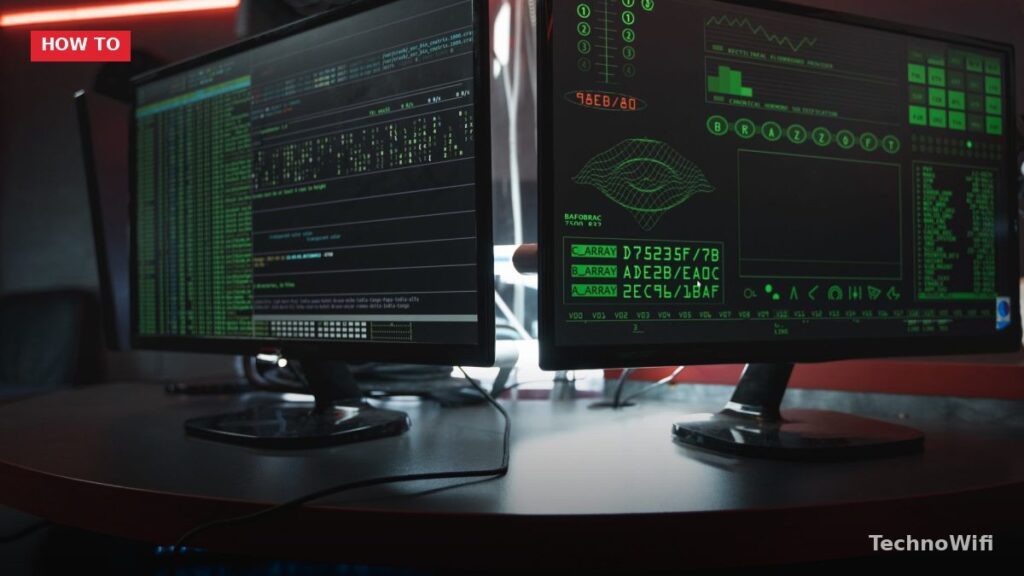
Zoom has a built-in dual monitor mode that splits your meeting across two screens. One screen shows the shared content – slides, documents, screen shares. The other shows the gallery or speaker view of participants. It works on both Windows and Mac, and it takes about 30 seconds to turn on.
Most people never find this setting because it is buried inside Zoom’s preferences. They end up alt-tabbing between shared content and participant video, or they shrink everything onto one screen and squint at tiny thumbnails. Dual monitor mode fixes that by automatically spreading the meeting across both displays.
This guide covers how to enable dual monitor mode in the Zoom desktop app, how screen sharing works across two monitors, how to set up a presentation with speaker notes on one screen and participants on the other, and how to fix the most common problems people run into.
For more than two screens, check our multi-monitor setup guide.
What Does Zoom Dual Monitor Mode Do
When you enable dual monitor mode, Zoom opens two windows instead of one during a meeting. The first window shows whichever view you prefer – gallery view, speaker view, or a minimized panel. The second window shows shared content whenever someone shares their screen.
Without dual monitor mode, everything gets stacked into one window. If someone shares a presentation, the shared content takes over your main view and the participant video gets pushed into a small floating strip. You can still see faces, but they are tiny. Switching between the shared content and gallery view requires clicking back and forth.
With dual monitor mode active, the shared content automatically appears full-size on your second monitor. Your first monitor keeps showing the participant gallery at full size. You get both views at once without any clicking or resizing.
| Feature | Single Monitor | Dual Monitors |
|---|---|---|
| Shared content view | Takes over the main window, shrinks participant video | Full-size on second monitor |
| Participant gallery | Small floating strip during screen shares | Full-size on first monitor |
| Speaker notes visibility | Not visible during presentation without extra setup | Visible on the non-shared monitor |
| Chat and controls | Overlaps shared content or gallery | Stays on the gallery monitor without blocking content |
| Multitasking during meetings | Difficult – Zoom covers your workspace | One screen for Zoom, other apps still accessible |
| Presentation delivery | Presenter cannot see audience reactions while sharing | Presenter sees audience on second monitor |
How to Enable Dual Monitor Mode in Zoom on Windows
Dual monitor mode is a setting inside the Zoom desktop app. It does not work in the Zoom web client or mobile apps. You need the desktop app installed and updated to the latest version.
- Open the Zoom desktop app on your Windows PC. Make sure you are signed in.
- Click your profile picture or initials in the top-right corner of the app.
- Select Settings from the dropdown menu.
- In the left sidebar, click General.
- Check the box next to “Use dual monitors.” The setting takes effect immediately.
- Join or start a meeting. Zoom will now open two windows – one on each monitor.
If you do not see the “Use dual monitors” option, update your Zoom app. Click your profile picture, then select “Check for Updates.” Older versions of Zoom may have this setting under a different label or may not support it at all. The current 2026 desktop client shows it under General settings.
How to Turn On Zoom Dual Monitors on Mac
The process on macOS is nearly identical to Windows. The setting is in the same place inside the Zoom desktop app.
- Open the Zoom desktop app on your Mac.
- Click Zoom in the top menu bar, then select Settings (or Preferences on older versions).
- Click General in the left sidebar.
- Check the box next to “Use dual monitors.”
- Close the settings window. The change applies immediately.
- Start or join a meeting. Two Zoom windows will appear, one on each screen.
On macOS, your second monitor must be connected and recognized by the system before you open Zoom. Check System Settings, then Displays, to confirm macOS sees both screens. If only one display appears there, Zoom will not split across two monitors regardless of the setting.
If you are still exploring options, our 3 monitors Lenovo laptop docking station guide is a solid next read.
How Does Zoom Screen Sharing Work With Two Monitors
Screen sharing on a dual monitor setup gives you more flexibility than a single-screen setup. When you click “Share Screen” in a meeting, Zoom shows you a selection window that lists every monitor, every open application, and a whiteboard option. You pick exactly what to share.
With two monitors connected, Zoom shows both screens as separate sharing options. Screen 1 and Screen 2 appear as distinct thumbnails at the top of the sharing window. You can share one entire screen while keeping the other screen private. This is useful when you want to share a presentation on one monitor but keep your email, notes, or chat visible on the other without participants seeing them.
You can also share a single application window instead of an entire screen. This is often the safer choice. If you share a specific PowerPoint or browser window, only that window is visible to other participants. Everything else on both monitors stays hidden. You avoid accidentally showing a notification, a personal message, or your desktop wallpaper.
Picking the right monitor to share matters. Share the wrong one and your audience sees your participant gallery, your email, or whatever else is on that screen.
- Before joining the meeting, arrange your windows so the content you want to share is on one specific monitor. Move your presentation, browser, or document to that screen.
- In the Zoom meeting, click the green “Share Screen” button on the toolbar.
- At the top of the sharing selection window, you will see thumbnails of each connected monitor. They are labeled “Screen 1” and “Screen 2” (or “Desktop 1” and “Desktop 2” on some versions).
- Hover over each thumbnail to see a preview. Click the monitor that shows your presentation content.
- Click Share. Zoom will now broadcast everything visible on that monitor.
If you are unsure which screen is which, move your mouse to the left or right edge of one monitor and watch where the cursor appears on the other. The monitor labels in Zoom correspond to the monitor numbers in your Windows Display Settings or macOS System Settings under Displays.
How to Set Up Zoom for Presentations With Speaker Notes
Presenters who use PowerPoint or Google Slides can take full advantage of dual monitors by showing their slides on one screen and keeping speaker notes plus the participant gallery on the other. This is one of the strongest reasons to use a two-monitor Zoom setup.
- Open your presentation in PowerPoint (or Keynote, or Google Slides).
- In PowerPoint, go to Slide Show, then click “Set Up Slide Show.” Under “Show on,” select the monitor you want your audience to see (usually your second monitor). Click OK.
- Start the slideshow. PowerPoint will show the full-screen slides on your chosen monitor and the Presenter View (with speaker notes, upcoming slides, and a timer) on your other monitor.
- In Zoom, click “Share Screen” and select the monitor displaying the full-screen slideshow. Do not select “PowerPoint” as a window – select the actual monitor.
- Click Share. Your audience sees only the slides. You see your speaker notes, the next slide preview, and the Zoom participant gallery on your other monitor.
For Google Slides, start the presentation in Presenter View from the dropdown arrow next to the Present button. This opens the slides in one browser tab and the speaker notes in another. Drag the speaker notes tab to your private monitor and share the monitor showing the full-screen slides.
Why Is My Second Monitor Not Detected in Zoom
The most common reason Zoom does not use your second monitor is that the operating system itself does not see it. Zoom depends entirely on your OS display settings. If Windows or macOS does not recognize the second screen, Zoom cannot use it either.
Start by checking your display settings. On Windows, right-click the desktop and select Display Settings. You should see two numbered rectangles. If only one appears, click the Detect button. On macOS, go to System Settings, then Displays. Both monitors should be listed there.
If the OS detects both monitors but Zoom still opens only one window, try these steps.
This topic ties into our HP docking station dual monitor setup guide, which covers the next steps.
- Make sure “Use dual monitors” is checked in Zoom Settings under General. Close Zoom completely and reopen it after enabling the setting.
- Check that your display mode is set to “Extend” and not “Duplicate” or “Mirror.” If your screens are mirrored, Zoom treats them as one display. On Windows, press Windows + P and select “Extend.” On macOS, open System Settings, click Displays, then click Arrangement and uncheck “Mirror Displays.”
- Update your display drivers. Outdated GPU drivers sometimes cause detection issues. On Windows, open Device Manager, expand Display adapters, right-click your GPU, and select “Update driver.”
- Try a different cable or port. A loose HDMI or DisplayPort connection can cause intermittent detection failures.
- Restart Zoom after connecting the second monitor. Zoom checks for connected displays when it launches. If you plugged in the second monitor after Zoom was already running, it may not pick it up until you restart the app.
Zoom Not Splitting Views Across Two Monitors
Sometimes the dual monitor setting is enabled and both screens are detected, but Zoom still does not split the meeting into two windows. This usually comes down to one of a few causes.
First, check your Zoom version. Very old versions of the desktop app may not support dual monitors properly. Open Zoom, click your profile icon, and select “Check for Updates.” Install whatever is available and restart the app.
Second, make sure you are not using the web client. Zoom’s dual monitor feature only works in the installed desktop application. If you joined the meeting from a browser, the dual monitor setting does not apply. Always use the Zoom desktop app for dual-screen meetings.
Third, some Zoom admin policies disable certain features for managed accounts. If your company or school administers your Zoom account, the dual monitor option might be locked or hidden. Contact your IT admin to ask whether the feature is restricted at the account level.
Finally, try toggling the setting off and back on. Go to Zoom Settings, uncheck “Use dual monitors,” close the settings window, reopen it, and check the box again. Then restart Zoom and join a meeting. This simple reset fixes the issue for many users.
Frequently Asked Questions
Does Zoom dual monitor mode work with ultrawide monitors?
Zoom’s dual monitor mode requires two separate displays detected by your operating system. An ultrawide monitor counts as one display, so Zoom will not automatically split across it. You can manually resize and position two Zoom windows side by side on an ultrawide, but the automatic dual-window behavior only activates when the OS reports two distinct screens.
Can I use dual monitors in Zoom on a laptop?
Yes, as long as you have an external monitor connected to your laptop. The laptop screen counts as monitor one and the external display counts as monitor two. Enable “Use dual monitors” in Zoom settings, and the app will split across both screens during meetings. Any laptop with an HDMI, USB-C, or Thunderbolt port that supports video output works.
Does Zoom dual monitor mode use more bandwidth?
No. Dual monitor mode only changes how Zoom displays the meeting content on your end. The video streams coming into your computer are the same regardless of whether you view them on one screen or two. Your upload and download bandwidth usage stays identical.
Zoom decides this automatically. The shared content appears on whichever monitor does not have the main Zoom controls. You can drag the Zoom windows between monitors to swap which screen shows what. Once you rearrange them, Zoom remembers your preference for future meetings.
What happens if I disconnect my second monitor during a Zoom meeting?
Zoom consolidates everything back into a single window on your remaining monitor. The meeting continues without interruption. If you reconnect the second monitor during the meeting, you may need to leave and rejoin (or restart Zoom) for the dual-window layout to reappear.
Does dual monitor mode work in Zoom breakout rooms?
Yes. When you move into a breakout room, Zoom keeps the dual-window layout active. The gallery view of breakout room participants appears on one screen, and any shared content within the breakout room appears on the other. The behavior is the same as in the main meeting session.
Adding a webcam? See our dual monitor webcam setup guide.
Thinking about adding more screens? Our triple monitor setup guide covers everything from hardware to configuration.
Sources:
- Zoom Support – Using Dual Monitors with Zoom
- Zoom Support – Sharing Your Screen or Desktop
- Microsoft Support – Use Presenter View in PowerPoint