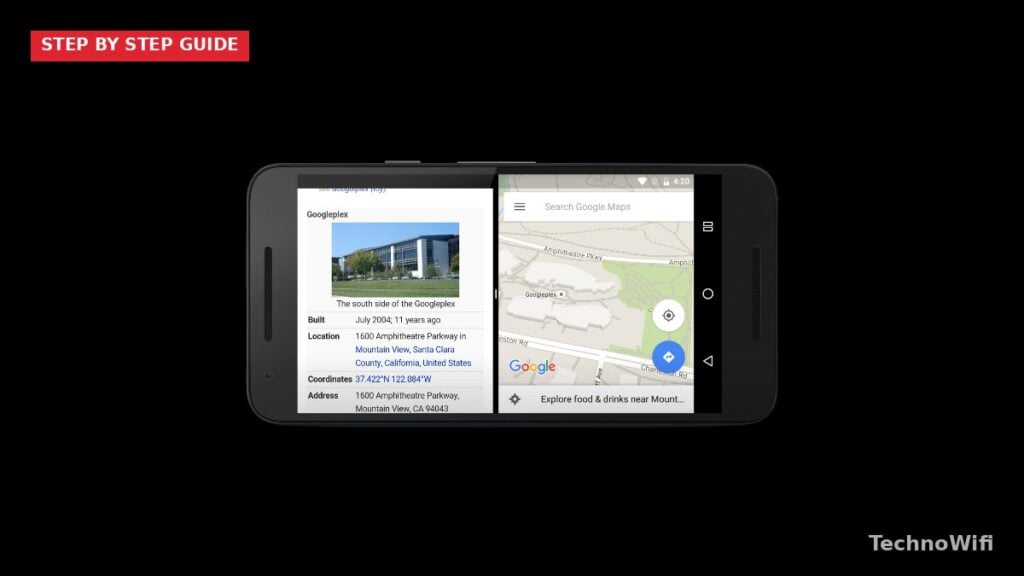
Split Screen on Stock Android (Pixel and Others)
- Open the first app you want to use in split screen.
- Tap the Recent Apps button (the square icon at the bottom of the screen, or swipe up and hold if you use gesture navigation).
- Tap the app’s icon at the top of its preview card.
- Select “Split top” (or “Split screen” on older Android versions).
- The first app moves to the top half of the screen.
- Select the second app from your recent apps list, or open a new app from the home screen or app drawer.
- The second app fills the bottom half. Both apps run simultaneously.
The divider bar between the two apps can be dragged up or down to resize. Give more space to whichever app you’re actively using. Drag the divider all the way to the top or bottom to exit split screen and return to single-app mode.
Split Screen on Samsung Galaxy
Samsung’s One UI has a slightly different approach with extra features.
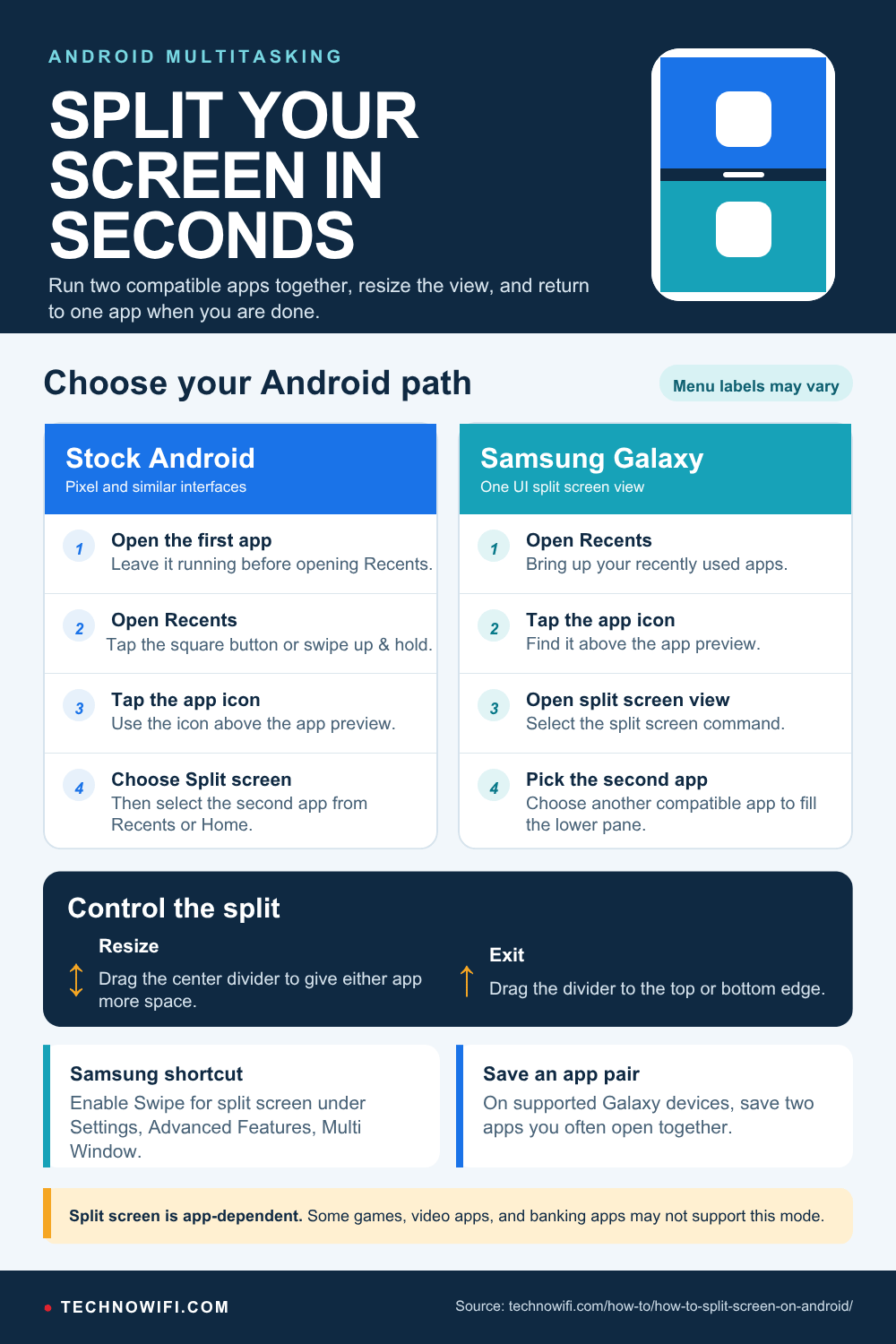
- Open the Recent Apps view (tap the three vertical lines at the bottom, or swipe up and hold).
- Tap the app’s icon at the top of its preview card.
- Select “Open in split screen view.”
- The app snaps to the top half.
- Select a second app from your recent apps or app list for the bottom half.
Samsung also lets you launch split screen from the Edge Panel. Swipe inward from the edge handle (the thin tab on the right side of the screen). Drag an app from the Edge Panel to the top or bottom half of the screen. Drag a second app to the other half.
Split Screen on Samsung Using Gestures
Samsung One UI 5 and later lets you trigger split screen with a swipe gesture.
- Go to Settings, then Advanced Features, then Multi Window.
- Toggle on “Swipe for split screen.”
- Now swipe up with two fingers from the bottom of the screen while in any app. The current app snaps to the top and you pick the second app.
Save App Pairs (Samsung)
If you frequently use the same two apps together, Samsung lets you save them as a pair that launches in split screen with one tap.
- Open both apps in split screen mode.
- Tap the divider bar between the two apps.
- Tap the star icon (or the “App pair” icon with two rectangles).
- The app pair saves to your Edge Panel or home screen.
- Tap the saved pair anytime to launch both apps in split screen instantly.
Pop-Up View (Floating Window)
If you want to multitask without splitting the screen in half, use pop-up view. This floats one app in a small movable window on top of another.
Stock Android: Open Recent Apps, tap the app icon, and select “Freeform” or “Pop-up view” (availability varies by manufacturer).
Readers who found this helpful also liked our guide on how to check WiFi router history on Android.
Samsung: Open Recent Apps, tap the app icon, and select “Open in pop-up view.” Drag the floating window around, resize it by dragging corners, and minimize it to a bubble by dragging it to the top of the screen.
Pop-up view is ideal for keeping a chat app, calculator, or note app visible while using a full-screen app underneath.
Split Screen on Android Tablets
Android tablets handle split screen better than phones because of the larger display. The process is the same, but you also get the option to split the screen vertically (side by side) instead of horizontally (top and bottom).
Samsung Galaxy Tab tablets support three-app split screen on models with large enough displays. Open two apps in split screen, then drag a third app from the Edge Panel into one of the halves to create three sections.
On Google Pixel Tablet and other stock Android tablets, split screen defaults to a side-by-side layout in landscape orientation and top-bottom in portrait. The taskbar at the bottom (on Android 12L and later) lets you drag apps directly into split screen position.
Which Apps Support Split Screen?
Most apps work in split screen mode. Some apps, particularly games, video players in fullscreen, and certain banking apps, disable split screen for usability or security reasons. If an app can’t be used in split screen, you’ll see a message saying the app doesn’t support this feature.
For more on this, take a look at our can you use AirPods with Android guide.
Samsung’s One UI includes an option to force all apps to work in split screen, even ones that normally don’t support it. Go to Settings, then Advanced Features, then Labs, and toggle on “Multi window for all apps.” This overrides the app’s restriction, though some apps may not display correctly in the smaller window.
Adjust the Split Ratio
The default split is 50/50, but you can customize it. Drag the center divider bar toward either app to change the ratio. Common useful ratios are 70/30 (main app on top, reference app on the bottom) and 30/70 (reversed). The apps resize dynamically as you drag.
On Samsung tablets, you can also set fixed ratios by tapping the divider bar and selecting a preset ratio from the quick options.
Can I use split screen with the keyboard open?
Yes, but it gets tight on phones. When the keyboard opens in one app, the other app’s visible area shrinks significantly. This is more practical on tablets. On phones, consider using a compact keyboard or switching to pop-up view for the secondary app when you need to type extensively.
Does split screen use more battery?
Slightly. Running two apps means the processor handles more work. Video playback, GPS apps, and games in split screen use noticeably more battery than a single app. Simple apps like a browser and notepad in split screen have minimal extra battery impact.
How do I exit split screen?
Drag the center divider all the way to the top or bottom of the screen. The remaining app expands to full screen. Alternatively, press the Home button or use the home gesture to exit to the home screen (both apps close split screen mode). On Samsung, you can also tap the divider and select the “X” button to close one of the apps.
Sources
For keeping your Android device safe, check our best free antivirus apps for Android roundup.
Google – Use Two Apps at Once | Samsung – Multi Window
How we verify what we publishLast checked October 10, 2026Report an error