Forgetting a WiFi password happens to everyone. Maybe you bought a new phone and the old password is buried somewhere you cannot find. Maybe you are visiting someone’s house and the router label is impossible to read. Whatever the situation, there are several legitimate ways to connect to a WiFi router without typing a password in 2026.
Some of these methods bypass the password entirely. Others help you find or reset the existing password so you can enter it normally. This guide covers every option available on modern routers, phones, and computers, along with important security warnings about open networks and unauthorized access.
How to Connect to WiFi Using the WPS Button
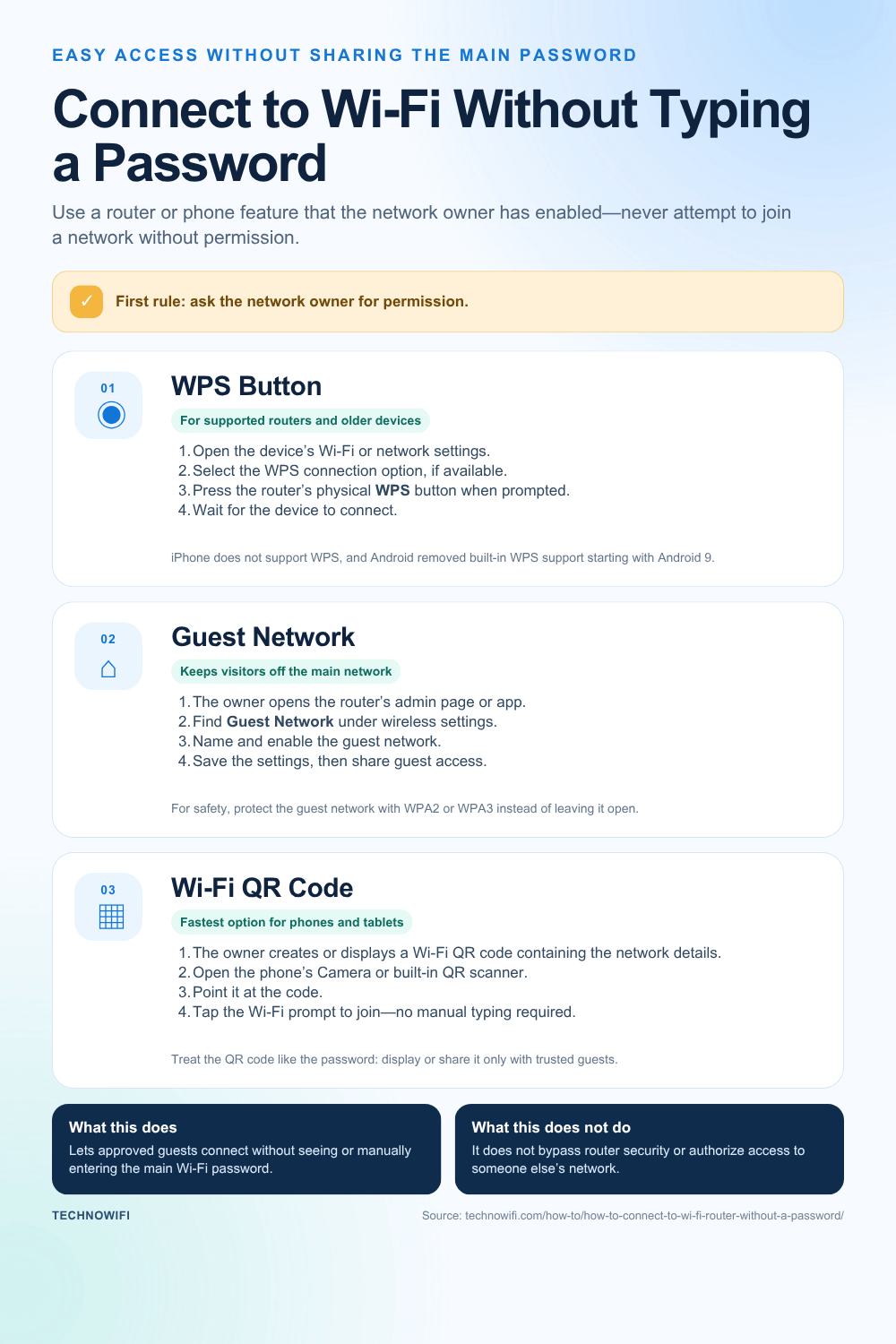
WPS stands for Wi-Fi Protected Setup. It is a feature built into most routers that lets you connect a device without entering a password. You press a physical button on the router, and any WPS-capable device within range can connect during a short window of time.
This method works with Windows laptops, Android phones, printers, smart TVs, and many other devices. Apple removed WPS support from all its products years ago, so iPhones, iPads, and Macs cannot use this method.
- Find the WPS button on your router. It is usually on the back or side of the unit, labeled “WPS” or marked with two curved arrows forming a circle. On some routers, the WPS function is combined with another button.
- On your device, go to WiFi settings and select the network you want to connect to. When prompted for a password, look for a “Connect via WPS” or “WPS Push Button” option instead of typing a password. On Windows 11, select the network and click Connect. If WPS is active on the router, the system will detect it automatically.
- Press the WPS button on the router firmly. You have about two minutes to complete the connection on your device before the WPS window closes.
- Your device should connect automatically within a few seconds. No password entry required.
Is WPS Secure to Use in 2026
WPS is convenient but it has known security vulnerabilities. The WPS PIN method (different from the push button method) is susceptible to brute force attacks. Many security experts recommend disabling WPS entirely and using a strong password instead. If you only use WPS occasionally, enable it in the router settings when needed and disable it afterward.
| WPS Feature | Details |
|---|---|
| Connection window | About 2 minutes after pressing the button |
| Works with | Windows, Android, printers, smart TVs, game consoles |
| Does not work with | iPhone, iPad, Mac (Apple does not support WPS) |
| Security risk | WPS PIN mode is vulnerable to brute force attacks |
| Router support | Most routers manufactured after 2010 |
| Wi-Fi 7 routers | Some newer models have removed WPS entirely |
Android phones can generate a QR code that shares the WiFi network name and password in one scan. The person scanning the code connects instantly without seeing or typing the password. This works on Android 10 and later versions.
- On the Android phone that is already connected to the WiFi network, open Settings and tap Network & Internet (or Connections on Samsung devices).
- Tap WiFi and then tap the gear icon next to the connected network name.
- Tap the Share button. You may need to verify your identity with a fingerprint, PIN, or face unlock.
- A QR code appears on screen. The second person opens their phone camera or a QR scanner app and points it at the code.
- The scanning device connects to the WiFi network automatically. No password entry needed.
This method is ideal for sharing WiFi with guests. The guest never sees the actual password text, so you do not have to worry about them writing it down or passing it along to others. The QR code contains the network SSID and password in an encoded format that the phone reads directly.
Apple does not use QR codes for WiFi sharing. Instead, iPhones, iPads, and Macs share WiFi passwords directly between devices over Bluetooth. Both devices need to meet a few requirements for this to work.
- Make sure both devices have WiFi and Bluetooth turned on. The sharing device must already be connected to the WiFi network.
- Both devices need to be signed into iCloud, and the sharing device must have the other person’s Apple ID email address saved in Contacts.
- Bring the two devices close together (within Bluetooth range).
- On the device that needs WiFi, go to Settings, tap WiFi, and select the network. When the password prompt appears, do not type anything.
- A popup appears on the sharing device asking “Share your Wi-Fi password with [device name]?” Tap Share Password.
- The second device connects automatically. Tap Done on the sharing device.
This only works between Apple devices. If you need to share WiFi from an iPhone to an Android phone, you will need a third-party QR code generator app instead. Several free apps in the App Store let you create a QR code from your saved WiFi credentials.
How to Find Your WiFi Password in Router Admin Settings
Every router stores its WiFi password in the admin panel. If you can access the admin page, you can view or change the password directly. This is useful when you are already connected on one device (or can connect via Ethernet) and need the password for another device.
- Open a web browser on a device connected to the router (WiFi or Ethernet).
- Type the router’s IP address in the address bar. The most common addresses are 192.168.1.1 and 192.168.0.1. If neither works, check the label on the bottom of the router or look up “Default Gateway” in your device’s network settings.
- Log in with the admin username and password. Default credentials are printed on the router’s label. Common defaults include admin/admin, admin/password, or admin/1234.
- Go to the Wireless or WiFi Settings section.
- Look for a field labeled Password, Passphrase, Pre-Shared Key, or Security Key. The current WiFi password is displayed here. Some routers hide it behind a “Show” button or eye icon.
- Copy the password or change it to something new if you prefer.
What Are the Default Login Credentials for Common Routers
| Router Brand | Default Admin URL | Default Username | Default Password |
|---|---|---|---|
| Netgear | 192.168.1.1 or routerlogin.net | admin | password |
| TP-Link | 192.168.0.1 or tplinkwifi.net | admin | admin |
| Linksys | 192.168.1.1 | admin | admin |
| ASUS | 192.168.1.1 or router.asus.com | admin | admin |
| Xfinity (Comcast) | 10.0.0.1 | admin | password |
| Verizon Fios | 192.168.1.1 or myfiosgateway.com | admin | On router label |
| Spectrum | 192.168.1.1 | admin | admin |
If you changed the admin password previously and forgot it, a factory reset restores the default credentials. Press and hold the small reset button on the back of the router for 10 to 15 seconds. Keep in mind that a factory reset also erases your WiFi password, network name, and all custom settings.
How to Connect to a Router Using an Ethernet Cable
An Ethernet connection does not require a WiFi password. You plug a cable directly from the router into your computer, and you are online. This is the fastest way to get a device connected when you do not know the WiFi password and need to access the internet or the router’s admin panel.
Interested in this area? We go deeper in our WiFi router for gaming guide.
- Get an Ethernet cable (also called a LAN cable or Cat5/Cat6 cable). Most routers come with one in the box.
- Plug one end into any available LAN port on the back of the router. These are usually yellow and grouped together. Do not use the WAN port, which connects to the modem.
- Plug the other end into the Ethernet port on your computer. Most desktop computers have one. Many laptops have removed the Ethernet port, so you may need a USB-to-Ethernet adapter or a USB-C hub with an Ethernet port.
- Your computer should detect the wired connection automatically within a few seconds. No password, no WiFi configuration. You are connected.
Once connected via Ethernet, you can open the router’s admin panel in a browser and find or change the WiFi password. This is especially useful after a factory reset when the WiFi password has reverted to the default printed on the router label but you cannot read the sticker clearly.
How to Set Up a Guest Network Without a Password
Most modern routers let you create a separate guest network that visitors can join without needing your main WiFi password. Some routers even allow you to set up the guest network with no password at all, creating an open network specifically for temporary visitors.
- Log into your router’s admin panel through a web browser (see the steps in the admin settings section above).
- Look for a Guest Network or Guest WiFi section. Most routers from Netgear, TP-Link, ASUS, and Linksys have this feature.
- Enable the guest network and give it a name that is different from your main network.
- For password, you have two options: set a simple password you can easily share with guests, or set the security to None or Open to allow password-free access.
- Configure access restrictions. Most guest network settings let you limit bandwidth, block access to local network resources (like shared drives and printers), and set a time limit after which the guest network turns off automatically.
- Save the settings. The guest network will appear as a separate WiFi network in the available networks list.
Running a guest network without a password is acceptable for short-term use in controlled environments. However, an open network means anyone within range can connect. Always keep the guest network isolated from your main network so guests cannot access your personal devices, files, or printers.
How to Connect Devices Using WiFi Direct
WiFi Direct lets two devices connect to each other without a traditional router or access point. It creates a peer-to-peer wireless connection, similar to Bluetooth but with faster speeds and longer range. WiFi Direct is commonly used for screen mirroring, file transfers, and connecting peripherals like printers.
- Enable WiFi Direct on the device acting as the host. Android users can find this in Settings then WiFi then WiFi Direct. Windows handles WiFi Direct through the Connect feature or Miracast settings.
- Search for available WiFi Direct connections from the second device. The host device should appear in the list.
- Select the host device. You may see a connection prompt on the host that you need to accept.
- Once accepted, the two devices are connected directly. You can transfer files, cast your screen, or print without being on the same WiFi network.
WiFi Direct is not a replacement for connecting to a router. It only links two devices together for direct communication. You will not get internet access through WiFi Direct unless the host device is sharing its own internet connection, which requires additional configuration.
| Feature | WiFi Direct | Traditional WiFi | Bluetooth |
|---|---|---|---|
| Requires router | No | Yes | No |
| Range | Up to 200 feet | Depends on router | Up to 30 feet |
| Speed | Up to 250 Mbps | Varies by standard | Up to 3 Mbps (classic) |
| Internet access | No (peer-to-peer only) | Yes | No |
| Common uses | Screen mirroring, printing, file transfer | Internet, streaming, all devices | Audio, wearables, peripherals |
How to Find a Saved WiFi Password on Windows
If your Windows computer is already connected to a WiFi network, you can pull up the saved password without logging into the router. This works on Windows 10 and Windows 11.
- Click the Start button and open Settings.
- Go to Network & Internet and then click WiFi.
- Scroll down and click Hardware properties to find the network name, or go to Control Panel then Network and Sharing Center.
- Click on your WiFi network name next to “Connections.”
- In the WiFi Status window, click Wireless Properties.
- Go to the Security tab and check the box that says Show characters. The password appears in the Network Security Key field.
You can also use Command Prompt for a faster approach. Open Command Prompt as administrator and type: netsh wlan show profile name=”YourNetworkName” key=clear. Replace “YourNetworkName” with your actual network name. The password appears next to “Key Content” in the output.
How to Find a Saved WiFi Password on Mac
MacOS stores WiFi passwords in the Keychain. You can access saved passwords through System Settings or the Keychain Access app.
- Open System Settings (or System Preferences on older macOS versions).
- Click WiFi in the sidebar.
- Find the network you want the password for and click the three-dot menu or info (i) button next to it.
- Click Copy Password or toggle the password visibility option. You will need to authenticate with your Mac login password or Touch ID.
Alternatively, open Keychain Access from the Applications/Utilities folder. Search for the WiFi network name, double-click it, and check the “Show password” box. Enter your Mac login password when prompted. The stored WiFi password will appear in plain text.
What Are the Security Risks of Connecting Without a Password
Connecting to an open WiFi network (one with no password) exposes your data to serious risks. On an unencrypted network, anyone within range can intercept the traffic between your device and the router using freely available tools. This includes websites you visit, login credentials sent over non-HTTPS connections, and unencrypted app data.
Here are the specific threats to be aware of on open networks.
For the complete picture, our WiFi router for large home guide fills in the gaps.
Man-in-the-middle attacks. An attacker positions themselves between your device and the router, intercepting and potentially modifying your data in transit. On an open network, this requires minimal technical skill.
Evil twin networks. An attacker creates a fake WiFi network with the same name as a legitimate one. Your device connects to the fake network, and all your traffic passes through the attacker’s device. This is common in coffee shops, airports, and hotels.
Packet sniffing. Software like Wireshark can capture all network traffic on an open WiFi network. Any data sent without encryption (HTTP instead of HTTPS) is readable in plain text.
Session hijacking. An attacker captures your session tokens from unencrypted traffic and uses them to impersonate you on websites where you are logged in.
| Risk | Open Network | Password-Protected Network |
|---|---|---|
| Data interception | Easy (no encryption) | Difficult (WPA3/WPA2 encrypted) |
| Evil twin attacks | High risk | Lower risk (password mismatch alerts) |
| Unauthorized access | Anyone can connect | Only users with the password |
| Legal liability | You may be liable for illegal activity on your network | Reduced liability with access controls |
How to Stay Safe on Public WiFi Without a Password
Sometimes you have no choice but to use an open network, like at an airport or hotel. There are steps you can take to protect your data even without network-level encryption.
- Use a VPN (Virtual Private Network). A VPN encrypts all traffic between your device and the VPN server, making your data unreadable to anyone intercepting it on the local network. NordVPN, ExpressVPN, and Surfshark are popular options in 2026.
- Only visit websites that use HTTPS. Look for the padlock icon in the browser address bar. HTTPS encrypts the connection between your browser and the website server, even on an open network. Most major websites use HTTPS by default in 2026, but some smaller sites still do not.
- Turn off automatic WiFi connections. Go into your device’s WiFi settings and disable the feature that automatically connects to open networks. On iPhone, this is under Settings then WiFi then “Ask to Join Networks.” On Android, look for “Connect to open networks” and turn it off.
- Disable file sharing and AirDrop. On Windows, turn off network discovery and file sharing in the Network and Sharing Center. On Mac, disable AirDrop or set it to “Contacts Only.” On iPhone, set AirDrop to “Receiving Off.”
- Forget the network when you are done. After disconnecting, go to your WiFi settings and tap “Forget This Network” to prevent your device from reconnecting automatically in the future.
Is It Legal to Connect to Someone Else’s WiFi Without Permission
Connecting to a WiFi network without the owner’s permission is illegal in many jurisdictions, even if the network has no password. In the United States, the Computer Fraud and Abuse Act (CFAA) covers unauthorized access to computer networks. Several states have additional laws that specifically address unauthorized WiFi access.
An open network does not imply an invitation to connect. The absence of a password is not consent. Courts have generally treated unauthorized network access the same way they treat trespassing, even when no damage was done.
Public networks in businesses, airports, and hotels are different because the owner explicitly makes them available for public use. Connecting to a clearly labeled public network in a coffee shop is fine. Connecting to your neighbor’s unsecured home network without asking is not.
Frequently Asked Questions
Can I connect to WiFi without a password using my iPhone?
You cannot use WPS on an iPhone because Apple does not support it. However, another Apple user can share their WiFi password with you through the automatic password sharing feature over Bluetooth. If no one can share the password, you will need to find it through the router’s admin panel, the router’s physical label, or use a QR code generated by an Android device or a third-party app.
Most routers manufactured after 2010 have a WPS button, but some newer Wi-Fi 7 routers have removed the feature due to security concerns. Check your router’s manual or admin panel to confirm WPS is available and enabled. Enterprise and business-grade routers typically do not include WPS at all.
Can someone hack my WiFi if I leave it without a password?
If your WiFi network has no password, there is nothing to hack. Anyone within range can connect freely and see your unencrypted network traffic. They can also use your internet connection for any purpose, potentially creating legal liability for you. Always set a strong password using WPA3 or WPA2 encryption.
What is the difference between WPA2 and WPA3?
WPA3 is the newer WiFi encryption standard, released in 2018. It provides stronger encryption, protection against brute force password guessing (through SAE handshake), and individualized data encryption for each device on the network. WPA2 is still widely used and secure with a strong password, but WPA3 is the better choice when both your router and devices support it.
How do I find my WiFi password if I forgot it and cannot access the router?
Check any device that is still connected to the network. Windows and Mac both store WiFi passwords that you can retrieve through system settings. On Android, use the QR code sharing feature to scan the code with your new device. If no device is connected, your only option is a factory reset of the router, which restores the default password printed on the router label.
Will a factory reset of my router remove the WiFi password?
Yes. A factory reset erases all custom settings, including your WiFi network name and password. After the reset, the router reverts to the default credentials printed on the sticker on the bottom or back of the unit. You will need to reconnect all your devices using those default credentials, then set a new password through the admin panel.
Sources
Getting the most out of your WiFi also depends on your internet plan. Check which providers and speeds are available at your address.
Wi-Fi Alliance – Wi-Fi Protected Setup (WPS) | Wi-Fi Alliance – Wi-Fi Security (WPA3) | Wi-Fi Alliance – Wi-Fi Direct | Google – Share WiFi on Android | Apple – Share Wi-Fi Password from iPhone | Microsoft – Find Wi-Fi Password in Windows