How to Use Autofocus for Live View Shooting on the Nikon D5300
The Nikon D5300 DSLR is one of the most popular mid-range DSLRs out there, and its Live View autofocus system is a feature worth learning how to use properly. Once you get the hang of it, shooting in Live View becomes a lot more flexible and precise.
Here’s a step-by-step walkthrough of how to set up and use autofocus in Live View on your Nikon D5300 DSLR.
Step 1: Select Your Focus Mode and AF-Area Mode
Start by choosing the right Focus mode and AF-area mode. You can adjust both settings through the control strip on the camera’s screen. Press the “i” button to bring it up.
Keep in mind that not all settings are available in every exposure mode. If you choose AF-F (full-time servo) mode, the autofocus system stays active and continuously tracks whatever’s in the focus area.
Step 2: Frame Your Subject in Live View
With Live View active, frame your subject on the screen. In Wide Area or Normal Area AF modes, you’ll see a red focus frame on the display. If the camera detects a face, it will automatically prioritize the closest person and show a bracket around their face.
Step 3: Understanding the Focus Frame Colors
If no face is detected, the camera shows a standard red frame (this is typical for longer-range shots). In AF-F mode, the frame turns green once your subject is in focus. The frame color resets each time you reframe or adjust the focus point.
Step 4: Move the Focus Frame
Use the multi-selector (the directional pad on the back of the camera) to move the focus frame up, down, left, or right. This lets you position the focus point exactly where you need it.
In face-priority mode, a double-lined yellow focusing frame appears around the detected face. This helps you confirm that the camera is locking onto the right person.
To quickly center the focus point in Wide Area and Normal Area modes, just press the OK button.
Step 5: Subject Tracking AF-Area Mode
If you’re using Subject Tracking AF-Area mode, press the OK button to start tracking your subject. This is especially useful when photographing moving subjects like people or animals.
Keep in mind that if your subject leaves the frame, you’ll need to stop tracking and wait for them to return. Press OK once to pause tracking, then press it again to resume after you’ve reframed the shot.
Step 6: Lock Focus with the Shutter Button
In AF-S (single servo) Focus mode, press the shutter button halfway down until the focus frame turns green. This confirms that the camera has locked onto your subject.
The frame’s look varies depending on which AF-Area mode you’re using. In AF-S mode, you’ll hear a beep (if it’s enabled) confirming that focus is locked. To turn off the beep, go to the Shooting/Display options in the Custom Setting menu.
In AF-F mode, the camera adjusts focus continuously as your subject moves. If it temporarily loses focus, the frame may flash red, yellow, or white. It turns solid green and stops blinking once focus is reacquired.
Keep the shutter button half-pressed to lock focus at the current distance.
Step 7: Verify Focus Accuracy
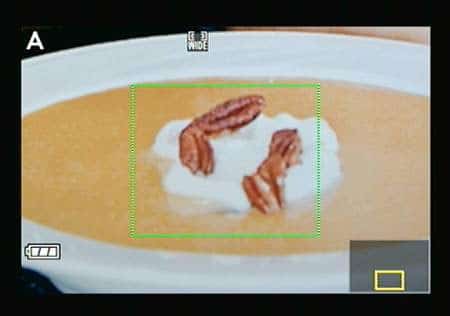
To double-check your focus, press the zoom-in button to magnify the target area. Each press zooms in closer for a detailed look. A small thumbnail in the corner shows your position within the full image, with a yellow highlight box indicating the zoomed area.
Press the zoom-out button to return to the normal view. Your Nikon D5300 DSLR is now set up for autofocus in Live View shooting.
Quick Tips for Live View Autofocus
- AF-S mode is best for stationary subjects. It locks focus and holds it until you release the shutter button.
- AF-F mode works better for moving subjects, but it uses more battery power since the motor runs continuously.
- If autofocus struggles in low light, try using a subject with more contrast or add some light to the scene.
- Always verify focus using the zoom function before taking the final shot, especially for close-up work.