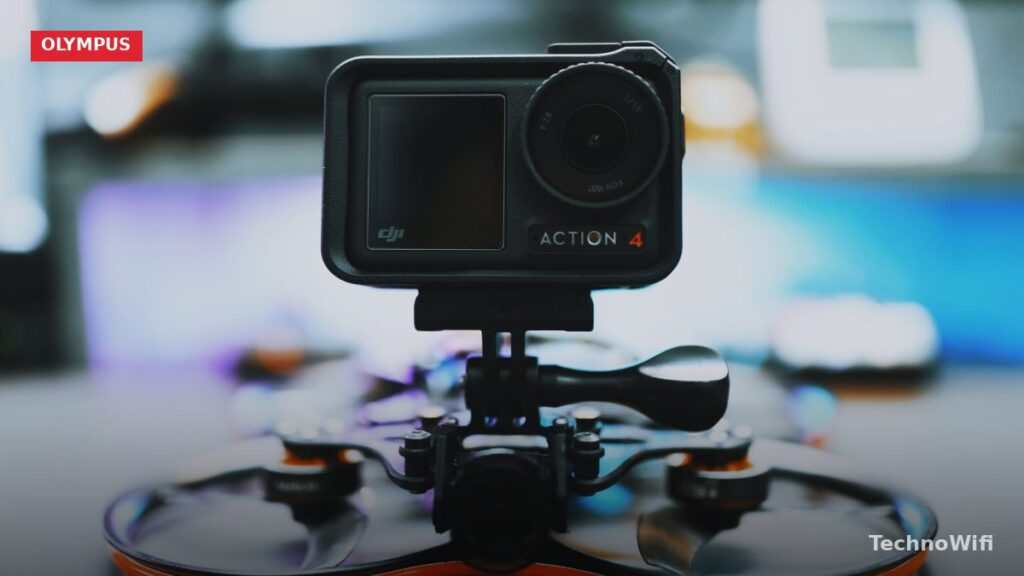
Action cameras have gotten absurdly good. The sensors are bigger, the stabilization is smoother, and some models now shoot 8K video in a package you can strap to your helmet. If you mountain bike, surf, ski, or just want a tough little camera for travel, there’s a strong option at every price point in 2026.
We tested seven action cameras head to head. We mounted them on bikes, dunked them in pools, shot footage at golden hour and midnight, and edited the results on phones and desktops. Here’s what actually matters and which camera deserves your money.
What are the best action cameras right now?
The GoPro Hero 13 Black sits at the top. It’s got the widest accessory support, excellent stabilization, and 5.3K video that looks sharp on any screen. But it’s not the only good option. DJI has closed the gap with the Osmo Action 5 Pro and the new Osmo Action 6, while Insta360 is pushing boundaries with 8K recording and AI editing tools.
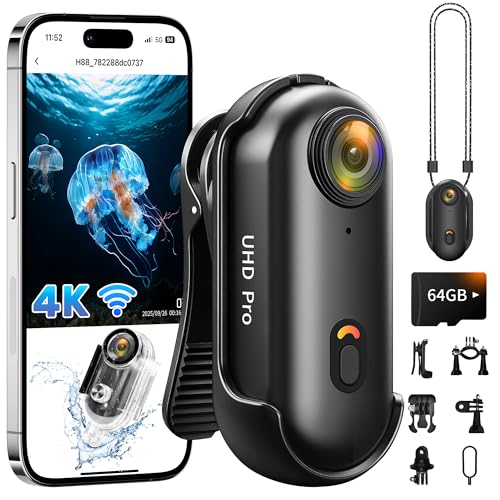
If you want raw image quality and low-light performance, the DJI Osmo Action 6 is the one to watch. If you’re a content creator who needs the highest resolution and smart editing, the Insta360 Ace Pro 2 is hard to beat. And if your budget is tight, the AKASO Brave 8 Lite delivers 4K for under $100.
Here’s how all seven cameras compare on the specs that matter most.
| Camera | Max Resolution | Stabilization | Waterproof | Battery Life | Best For | Price Range |
|---|---|---|---|---|---|---|
| GoPro Hero 13 Black | 5.3K/60fps | HyperSmooth 7.0 | 33 ft (no case) | ~2.5 hours | Best overall | $350-$400 |
| DJI Osmo Action 5 Pro | 4K/120fps | RockSteady 3.0+ | 66 ft (no case) | ~3.5 hours | Best mid-range value | $300-$350 |
| DJI Osmo Action 6 | 4K/120fps | RockSteady 3.0+ | 52 ft (no case) | ~4 hours | Best low-light | $380-$430 |
| Insta360 Ace Pro 2 | 8K/30fps | FlowState | 33 ft (no case) | ~2 hours | Best for creators | $400-$450 |
| Insta360 X4 | 8K 360-degree | FlowState | 33 ft (no case) | ~2.5 hours | Best 360 camera | $450-$500 |
| AKASO Brave 8 Lite | 4K/30fps | Electronic (6-axis) | 33 ft (no case) | ~1.5 hours | Best budget pick | Under $100 |
| GoPro Hero 13 Mini | 5.3K/60fps | HyperSmooth 7.0 | 33 ft (no case) | ~2 hours | Most compact | $250-$300 |
GoPro Hero 13 Black – best action camera overall
The Hero 13 Black is the camera most people should buy. GoPro has refined its formula over more than a decade, and it shows. The 5.3K sensor captures detail that holds up on a 4K TV or a phone screen alike. HyperSmooth 7.0 stabilization makes handheld footage look like it was shot on a gimbal. And the interchangeable lens mod system lets you swap between ultra-wide, macro, and ND filter mods without any adapters.
Waterproofing down to 33 feet means you can take it snorkeling, surfing, or out in a downpour without a housing. The mounting system is the same standard GoPro mount that’s been around for years, which means you have access to thousands of third-party accessories. Helmet mounts, chest straps, handlebar clamps, suction cups; if it exists, someone makes it for GoPro.
The rear touchscreen is responsive and bright enough to use in direct sunlight. The front screen shows a live preview for selfie-style shooting. Menu navigation is fast and logical, a real improvement over older GoPro models that felt sluggish.
Where the Hero 13 Black falls short is low-light video. It handles daytime and overcast conditions beautifully, but footage after sunset gets noticeably grainy. Battery life is also average at roughly two and a half hours of continuous recording. Carry a spare battery if you’re shooting all day.
DJI Osmo Action 5 Pro – best value mid-range action camera
DJI’s Osmo Action 5 Pro hits a sweet spot between price and performance. It costs less than the GoPro Hero 13 Black while matching it in several areas and beating it in others. Battery life is the standout, with roughly three and a half hours of continuous recording putting it well ahead of the GoPro and every Insta360 model.
The dual-screen design gives you a crisp rear touchscreen and a front-facing display that’s genuinely useful for vlogging. RockSteady stabilization keeps footage smooth during runs, bike rides, and anything else that shakes the camera. It’s not quite as polished as HyperSmooth 7.0, but the difference is small enough that most people won’t notice.
Waterproofing to 66 feet without a housing is the best depth rating on this list. Divers and snorkelers, take note. The magnetic quick-release mounting system is also excellent. Snap the camera on and off mounts in a second, no screwing or clicking required. DJI sells magnetic mounts for helmets, flat surfaces, and handlebars.
The trade-off is a smaller accessory ecosystem compared to GoPro. Third-party mount options exist, but the selection isn’t as wide. The DJI Mimo app also has a steeper learning curve than GoPro’s Quik app, though it offers more editing power once you figure it out.
DJI Osmo Action 6 – best action camera for low-light
The Osmo Action 6 is DJI’s flagship action camera for 2026, and it pushes into territory no action camera has covered before. The variable aperture is a first for the category. Most action cameras have a fixed aperture, which means they perform well in one lighting condition and struggle in others. The Action 6 adjusts its aperture automatically, pulling in more light when it’s dark and stopping down when it’s bright.
That variable aperture pairs with a large 1/1.1-inch sensor, significantly bigger than the sensors in the GoPro Hero 13 or Insta360 Ace Pro 2. A bigger sensor means bigger pixels, which means less noise in low-light footage. Nighttime city walks, sunset sessions, dimly lit bars; the Action 6 handles all of it without turning into a grainy mess.
Battery life is the other headline number. Four hours of continuous recording is the best on this list by a wide margin. You can shoot a full day of travel footage without swapping batteries. For documentary-style shooting or all-day adventures, that extra runtime removes a real headache.
The downside is price. The Osmo Action 6 costs more than every camera on this list except the Insta360 X4. It’s also slightly larger and heavier than the Osmo Action 5 Pro due to the bigger sensor. If you mostly shoot outdoors in daylight, the extra cost and size may not be worth it. But for mixed lighting conditions, this camera stands alone.
Insta360 Ace Pro 2 – best action camera for content creators
If you post regularly on YouTube, TikTok, or Instagram, the Ace Pro 2 deserves a serious look. The 8K video resolution captures an enormous amount of detail. You can crop, reframe, and zoom in post-production without losing sharpness. That’s a massive advantage for creators who want to pull multiple shots from a single clip.
If you are still exploring options, our DSLR cameras for beginners guide is a solid next read.
The Leica-branded lens produces colors and contrast that look noticeably different from GoPro and DJI footage. Skin tones are warmer and more natural. Landscapes have more depth. It’s a subtle difference on a phone screen but very noticeable on a monitor or TV.
The flip screen rotates up so you can see yourself while recording, which solves a real problem for solo creators. The front screens on GoPro and DJI cameras work fine for framing, but they’re small. The Ace Pro 2’s flip screen is larger and easier to use for checking focus and composition.
AI-powered editing features set the Ace Pro 2 apart from the pack. The Insta360 app can automatically identify the best moments in your footage, suggest edits, and apply transitions. It won’t replace a skilled editor, but it shaves hours off the process of turning raw clips into a finished video. The camera also supports voice commands for starting and stopping recordings, which is useful when your hands are busy.
Battery life is the weak point at roughly two hours. The 8K recording mode drains power fast. Stick to 4K for everyday shooting and save 8K for the shots where you know you’ll want to reframe later.
Insta360 X4 – best 360-degree action camera
The X4 is a different kind of action camera. Instead of a traditional flat lens, it uses two fisheye lenses to capture everything around you in 360 degrees. The result is 8K spherical video that you reframe after the fact. Point the camera in any direction during editing. Zoom in, zoom out, change the angle entirely. One take gives you infinite compositions.
The invisible selfie stick effect is the X4’s party trick. Mount the camera on Insta360’s official selfie stick and the stick disappears from the footage entirely. It looks like a drone is following you. The effect works remarkably well for skiing, cycling, and hiking footage. People will ask how you filmed it.
FlowState stabilization keeps the horizon level no matter how much you tilt or spin the camera. You can literally roll down a hill with the X4 and the output will look smooth and steady. It’s the most aggressive stabilization system on any action camera.
The downside of 360 cameras is that every frame covers the entire sphere around you, which means each pixel covers a smaller area. The effective resolution in any given direction is lower than a traditional action camera shooting at the same spec. 8K 360 looks great, but it doesn’t match the per-frame detail of a 5.3K flat camera pointed directly at your subject. The X4 also requires more post-production work, since you need to reframe every clip before exporting.
AKASO Brave 8 Lite – best budget action camera
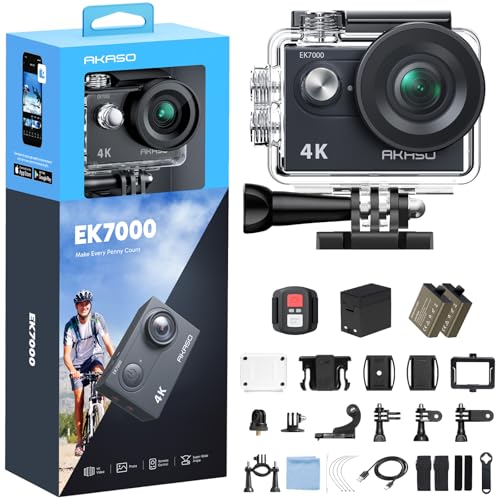
Not everyone needs 5.3K or 8K. If you want a waterproof camera that shoots clean 4K video and costs less than dinner for two, the AKASO Brave 8 Lite deserves your attention. It sells for under $100 and delivers surprisingly decent footage for the price.
The 4K/30fps recording is sharp enough for YouTube, social media, and personal archives. Dual screens give you a rear touchscreen for settings and a front display for selfie framing. Waterproofing matches the GoPro at 33 feet, so it handles pools, lakes, and snorkeling just fine.
Electronic stabilization works, but don’t expect GoPro or DJI levels of smoothness. Fast-paced mountain biking footage will show some jitter. For walking, hiking, and casual activities, the stabilization does its job. Think of it as the Honda Civic of action cameras. It gets you where you need to go, reliably and affordably.
Build quality feels like what you’d expect at this price. The plastic is thinner, the buttons are stiffer, and the touchscreen isn’t as responsive as the premium options. The app is basic too. But the AKASO shoots good video, survives rough handling, and costs a fraction of the competition. For first-time buyers or people who want a beater camera they won’t cry over if it gets lost or broken, this is the one.
GoPro Hero 13 Mini – best ultra-compact action camera
The Hero 13 Mini uses the same sensor and image processor as the full-sized Hero 13 Black but drops the rear screen to shrink the body. The result is a camera that weighs significantly less and fits in places the standard model can’t. Helmet mounts sit lower profile. Chest mounts are less obtrusive. And the camera practically disappears when attached to a drone.
Video quality matches the Hero 13 Black shot for shot. Same 5.3K/60fps, same HyperSmooth 7.0 stabilization, same color science. If you play two clips side by side, one from each camera, you wouldn’t be able to tell which is which.
The sacrifice is obvious. There’s no rear touchscreen. You control the Mini through the GoPro Quik app on your phone or use the single button on the camera body. This means you can’t review footage on the camera itself. You need your phone to check shots, change settings, or confirm framing.
For riders, skiers, and anyone who values a minimal profile, that trade-off makes sense. The Mini is also a strong option as a secondary camera for multi-angle setups. Mount a Hero 13 Black as your main camera and a Mini or two for alternate angles. They all produce matching footage, which makes editing simpler.
How do I choose an action camera?
Start with how you plan to use it. A surfer needs different things from a mountain biker, and both need different things from a travel vlogger. Narrowing down your primary use case eliminates most of the decision.
This topic ties into our point and shoot cameras guide, which covers the next steps.
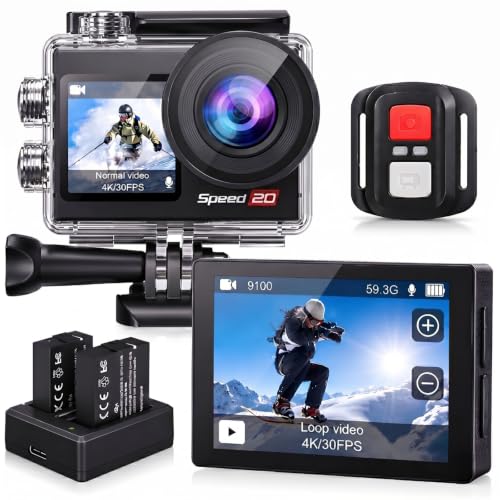
Video resolution matters, but not as much as marketing materials suggest. The jump from 4K to 5.3K is visible on a large screen. The jump from 5.3K to 8K mostly matters if you plan to crop or reframe in editing. Most social media platforms compress video heavily, so an 8K source file and a 4K source file can look almost identical on Instagram or TikTok.
Stabilization separates good action cameras from bad ones. Smooth footage is more watchable than sharp but shaky footage. GoPro’s HyperSmooth and DJI’s RockSteady are both excellent. Insta360’s FlowState is equally good in 360 mode. Budget cameras offer stabilization that works but can’t match these three.
Battery life determines how long you can shoot before swapping batteries or recharging. If you shoot in short bursts of a few minutes at a time, battery life barely matters. If you record long sessions (hiking footage, travel vlogs, event coverage) it matters a lot. The DJI Osmo Action 6 leads the pack at four hours.
Waterproofing is measured in depth and refers to the camera body without an additional housing. Every camera on this list is waterproof to at least 33 feet. The DJI Osmo Action 5 Pro goes to 66 feet. If you need to go deeper than that, look into dedicated dive housings.
Here’s a quick decision framework based on common use cases.
- Identify your primary activity. Water sports, land sports, vlogging, or travel.
- Set your budget. Under $100, $250-$350, or $350 and above.
- Decide if you need a front-facing screen for selfie-style recording.
- Check whether your existing mounts and accessories are compatible. GoPro mounts are the most universal.
- Consider your editing workflow. Insta360 cameras offer AI editing. GoPro keeps things simple. DJI falls in between.
- Pick the camera that matches the most criteria. In most cases, the answer will be obvious once you write it down.
What action camera has the best stabilization?
GoPro’s HyperSmooth 7.0 is the best traditional stabilization system available right now. It smooths out bumps, vibrations, and sudden movements without noticeable cropping or warping at the edges of the frame. Mountain bike footage looks like it was shot on rails. Running footage loses the headbob. Handheld walking shots feel like a steadicam.
HyperSmooth works by using a combination of sensor data and software processing to predict and counteract camera movement. The algorithm in version 7.0 is smarter about distinguishing intentional movement from unwanted shake. Pan the camera left and it follows smoothly. Hit a bump and it absorbs it. Earlier versions sometimes overcorrected and made footage feel floaty. Version 7.0 feels more natural.
DJI’s RockSteady is a close second. In most real-world shooting scenarios, the difference between RockSteady and HyperSmooth is marginal. Both produce footage that looks stabilized. The gap shows up in extreme situations: high-speed downhill mountain biking, aggressive motocross, or heavy vibration from engines. In those conditions, HyperSmooth holds a slight edge.
Insta360’s FlowState stabilization is in a category of its own when paired with 360 cameras like the X4. Because the camera captures everything around it, the software can reframe the shot and stabilize at the same time. The result is the smoothest possible output, with the ability to lock the horizon no matter what the camera does physically. For 360 footage, FlowState is unmatched.
Budget cameras like the AKASO Brave 8 Lite use basic electronic image stabilization. It works for slow and moderate movement but falls apart during fast action. If stabilization is your top priority, stick with GoPro, DJI, or Insta360.
| Camera | Stabilization System | Performance Rating | Best Conditions | Weaknesses |
|---|---|---|---|---|
| GoPro Hero 13 Black | HyperSmooth 7.0 | Excellent | All conditions | Slight crop at max stabilization |
| GoPro Hero 13 Mini | HyperSmooth 7.0 | Excellent | All conditions | Same as Hero 13 Black |
| DJI Osmo Action 5 Pro | RockSteady 3.0+ | Very good | General action sports | Slight edge loss vs HyperSmooth |
| DJI Osmo Action 6 | RockSteady 3.0+ | Very good | Low-light and mixed | Same as Action 5 Pro |
| Insta360 Ace Pro 2 | FlowState | Very good | Content creation | Higher battery drain at max setting |
| Insta360 X4 | FlowState (360) | Outstanding | 360 capture | Requires post-processing reframe |
| AKASO Brave 8 Lite | 6-axis EIS | Basic | Walking, hiking | Struggles with fast movement |
Are action cameras worth it for vlogging?
Yes, but with some caveats. Action cameras are small, light, and stabilized, which makes them excellent for run-and-gun vlogging where you can’t carry a larger camera. Travel vlogs, adventure content, and on-the-go shooting are where action cameras shine. You can clip one to a backpack strap, mount it on a selfie stick, or hold it in one hand while doing just about anything.
Audio is the biggest weakness for vlogging. Action cameras have small built-in microphones that pick up wind noise, handling noise, and a lot of environmental sound. The results are usable indoors but rough outdoors. If you’re serious about vlog audio quality, you’ll need an external microphone. Most action cameras support Bluetooth mic connections or USB-C audio adapters. Our guide to action camera microphone adapters covers specific options.
The wide-angle lens is another consideration. Action cameras use wide or ultra-wide lenses by default, which is great for showing off scenery but unflattering for close-up face shots. You get the classic fisheye distortion that stretches features near the edges of the frame. Some cameras offer a linear lens mode that corrects this distortion, but it narrows the field of view.
For talking-head style vlogs where you sit in front of the camera and speak, a dedicated vlogging camera or even a good smartphone will produce better results. The larger sensor, better autofocus, and natural focal length of a traditional camera makes faces look more natural. But for anything involving movement, travel, or outdoor activity, action cameras are hard to beat.
The Insta360 Ace Pro 2 is the strongest vlogging action camera thanks to its flip screen, Leica lens colors, and AI editing tools. The DJI Osmo Action 5 Pro and Action 6 are strong runners-up with their dual screens and longer battery life. The GoPro Hero 13 Black works well too, especially if you already own GoPro mounts and accessories.
Frequently Asked Questions
Can I use an action camera as a webcam?
Yes. The GoPro Hero 13 Black, DJI Osmo Action 5 Pro, DJI Osmo Action 6, and Insta360 Ace Pro 2 all support webcam mode over USB-C. Connect the camera to your computer with a USB-C cable and it shows up as a video source in Zoom, Google Meet, Teams, and OBS. The wide-angle lens gives a more dynamic look than a standard laptop webcam, and the image quality is significantly better. You’ll need to keep the camera plugged in for power during longer calls.
How long do action camera batteries last?
It depends on the camera and recording settings. The DJI Osmo Action 6 leads with roughly four hours of continuous 1080p recording. The Osmo Action 5 Pro manages about three and a half hours. GoPro Hero 13 models get around two to two and a half hours. Insta360 cameras run about two hours. The AKASO Brave 8 Lite lasts roughly ninety minutes. Recording at higher resolutions and frame rates drains batteries faster. Cold weather also reduces battery life by 20 to 30 percent.
Do action cameras work in cold weather?
Action cameras function in cold weather, but battery life drops significantly. Lithium-ion batteries lose capacity as temperatures fall below freezing. Expect 20 to 30 percent less recording time in cold conditions. Keep spare batteries in an inside jacket pocket close to your body to keep them warm. Some users report that the GoPro Hero 13 Black and DJI Osmo Action 5 Pro handle cold better than competitors, but all action cameras are affected to some degree.
What is the difference between 4K and 5.3K video?
Standard 4K records at 3840 by 2160 pixels. 5.3K records at 5312 by 2988 pixels, which is about 70 percent more total pixels. The extra resolution gives you more flexibility to crop and stabilize in post-production without losing sharpness. On a 4K TV, 5.3K footage looks slightly sharper than native 4K because the downscaling process smooths out noise. On a phone or tablet, the difference is nearly impossible to see.
Are action cameras waterproof without a case?
Every camera on this list is waterproof without an additional housing. The DJI Osmo Action 5 Pro leads with a 66-foot depth rating. The GoPro Hero 13 Black, Hero 13 Mini, Insta360 models, and AKASO Brave 8 Lite are all rated to 33 feet. The DJI Osmo Action 6 is rated to 52 feet. These ratings assume all doors and ports are properly closed and sealed. Always check the battery and USB-C port covers before submerging any camera.
Can I live stream with an action camera?
The GoPro Hero 13 Black supports live streaming to YouTube, Facebook, and Twitch over Wi-Fi. DJI Osmo Action cameras can live stream through the DJI Mimo app. Insta360 cameras support live streaming as well, including 360-degree live streams with the X4. The AKASO Brave 8 Lite doesn’t support live streaming. A stable Wi-Fi connection is required, and stream quality depends on your upload speed. Most action cameras max out at 1080p for live streaming regardless of their recording resolution.
Sources
GoPro – gopro.com, DJI – dji.com, Insta360 – insta360.com, AKASO – akasotech.com, World Health Organization – Safe Listening Guidelines, Digital Photography Review – dpreview.com, Tom’s Guide Action Camera Reviews – tomsguide.com