Every Samsung Smart TV sold since 2015 has WiFi built in. Connecting it to your home network takes about two minutes through the settings menu, and the TV remembers your credentials after the first time. You only need your network name and password.
This guide covers the standard WiFi setup through the TV menu, the faster WPS method, a wired Ethernet alternative for when wireless isn’t reliable enough, and fixes for every common connection problem Samsung TV owners run into in 2026.
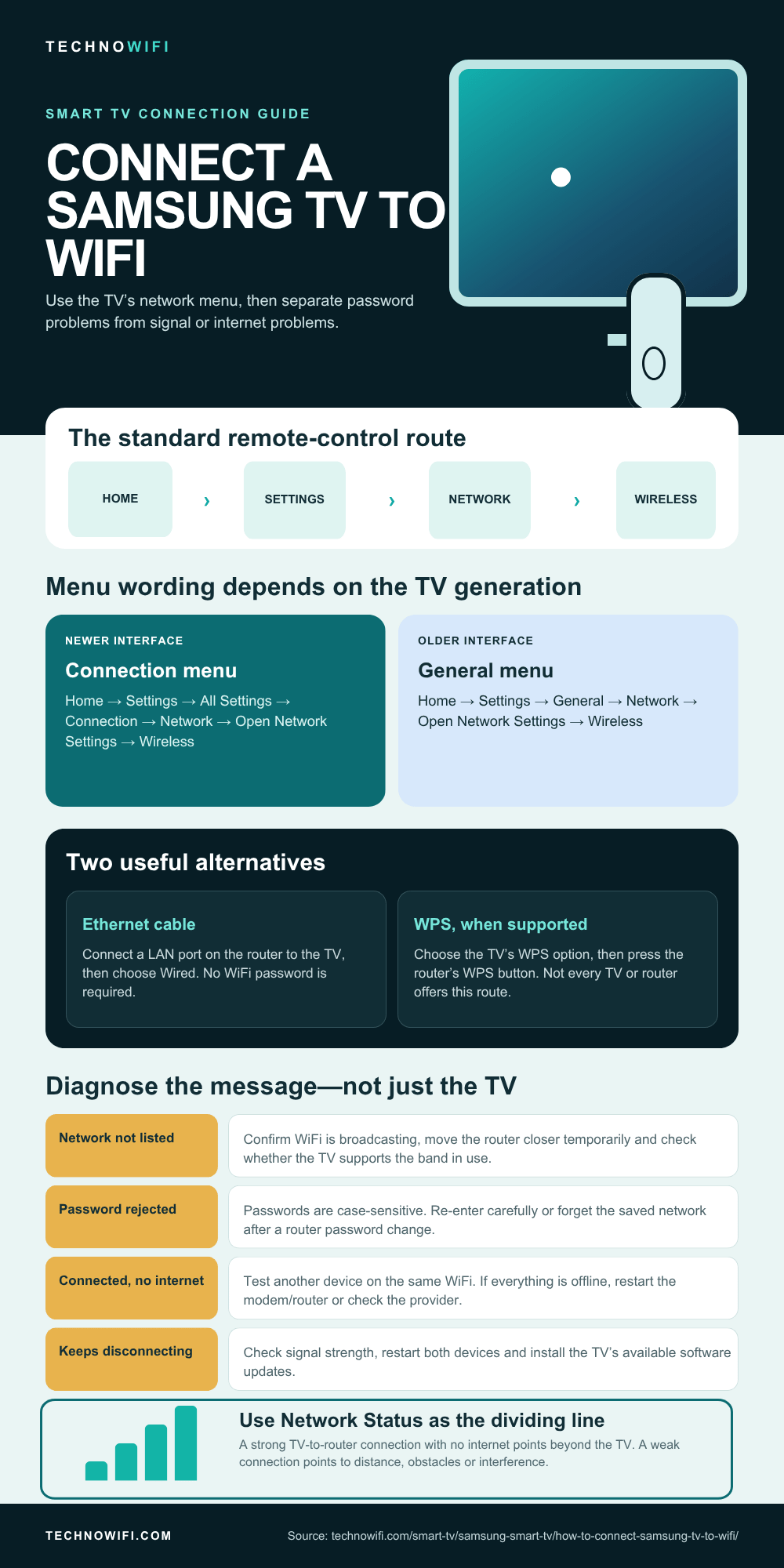
How to Connect Samsung TV to WiFi Through Settings
The settings menu is the most common way to get a Samsung TV online. The exact path depends on which year your TV was made, because Samsung has rearranged its menus a few times. Both paths are listed below.
For 2022 and newer models (Tizen 7.0+ and Eden OS):
- Press the Home button on your Samsung remote.
- Navigate to Settings (gear icon) and open it.
- Select All Settings.
- Go to Connection, then select Network.
- Choose Open Network Settings.
- Select Wireless.
- Pick your WiFi network from the list that appears.
- Enter your WiFi password using the on-screen keyboard and select Done.
- Wait for the “Connected successfully” confirmation.
For 2015 to 2021 models (Tizen OS):
- Press Home on the remote.
- Go to Settings, then General.
- Select Network, then Open Network Settings.
- Choose Wireless and select your network.
- Type your password and select Done.
Once connected, the TV stores your network credentials and reconnects automatically every time you power it on. You do not need to re-enter the password unless you change it on your router or perform a factory reset on the TV.
How to Connect Samsung TV to WiFi Using WPS
WPS (WiFi Protected Setup) lets you connect without typing a password at all. It works by pressing a physical button on your router, which tells the router to accept the next device that tries to connect within a two-minute window.
- On your Samsung TV, go to Settings > Connection (or General) > Network > Open Network Settings.
- Select Wireless.
- When the list of networks appears, look for Use WPS at the bottom of the screen.
- Select Use WPS, then immediately go to your router and press the WPS button. It is usually a small button on the back or side of the router, sometimes labeled “WPS.”
- The TV and router will negotiate a connection automatically. A confirmation message appears on screen within 30 seconds.
WPS is convenient if you have a long or complex WiFi password. Keep in mind that not every router supports WPS, and some newer routers have removed the feature for security reasons. If your router does not have a WPS button, use the standard password method described above.
How to Connect Samsung TV to Internet With Ethernet Cable
A wired Ethernet connection is faster and more stable than WiFi. It eliminates wireless interference entirely and is the best option for 4K streaming, gaming, or any situation where the TV is close enough to the router for a cable run.
- Plug one end of an Ethernet cable (Cat 5e or better) into a LAN port on your router.
- Plug the other end into the Ethernet port on the back of your Samsung TV.
- On the TV, go to Settings > Connection (or General) > Network > Open Network Settings.
- Select Wired.
- The TV detects the connection and configures the network settings automatically. A confirmation appears within a few seconds.
Wired connections do not require a password. The TV pulls an IP address from your router through DHCP automatically. If you switch from WiFi to Ethernet, the TV prioritizes the wired connection, which is the expected behavior.
| Connection Type | Speed Potential | Stability | Best For |
|---|---|---|---|
| WiFi (2.4 GHz) | Up to 150 Mbps | Subject to interference | Basic streaming, browsing |
| WiFi (5 GHz) | Up to 600 Mbps | Good with clear line of sight | 4K streaming, most usage |
| WiFi (6 GHz / Wi-Fi 6E) | Up to 1200 Mbps | Very good, less congestion | 8K streaming, gaming |
| Ethernet (wired) | Up to 1000 Mbps | Excellent, no interference | Heavy streaming, low latency |
Why Won’t My Samsung TV Connect to WiFi
If your Samsung TV refuses to connect, there are several common causes. Work through them in order, starting with the simplest fixes.
Wrong password. This is the most frequent reason. WiFi passwords are case-sensitive, and the Samsung on-screen keyboard makes typos easy. Double-check every character. If you recently changed your router password, your TV still has the old one stored. Go to Network Settings, forget the network, and reconnect with the updated password.
Interested in this area? We go deeper in our how to connect Samsung smart TV to Wi-Fi without adapter guide.
Router is too far away. Samsung TVs have decent WiFi antennas, but walls, floors, and large furniture weaken the signal. If the router is two or more rooms away, the signal may be too weak for a reliable connection. Try moving the router closer or adding a WiFi extender.
TV software is outdated. An older firmware version can cause WiFi connectivity bugs. If the TV connects intermittently or drops the connection after a few minutes, a software update often fixes it. The update process is covered later in this guide.
MAC address filtering. Some routers are configured to only allow specific devices to connect. If MAC filtering is enabled on your router, you need to add your TV’s MAC address to the allowed list. Find the TV’s MAC address at Settings > Connection (or General) > Network > Network Status > IP Settings.
Samsung TV Keeps Disconnecting From WiFi
Intermittent disconnections are a different problem from a TV that won’t connect at all. The TV joins the network successfully but drops off after minutes or hours. These are the most common fixes.
Power cycle both devices. Turn off the TV, unplug it from the wall, and wait 60 seconds. While the TV is off, restart your router by unplugging it for 30 seconds. Plug the router back in first, wait until it fully boots (solid lights), then plug the TV back in and turn it on. This clears temporary network errors on both sides.
Change the DNS settings. Samsung TVs sometimes have trouble with the default DNS server provided by your ISP. Switching to a public DNS can stabilize the connection.
- Go to Settings > Connection > Network > Network Status.
- Select IP Settings.
- Scroll down to DNS Setting and change it from Auto to Manual.
- Enter 8.8.8.8 (Google DNS) or 1.1.1.1 (Cloudflare DNS).
- Select OK and test the connection.
Disable the TV’s power-saving mode. Some Samsung TVs have an energy-saving feature that turns off the WiFi module when the screen goes idle. Go to Settings > General > Power and Energy Saving (or Eco Solution on older models) and make sure the option that turns off wireless during standby is disabled.
How to Fix Slow WiFi on Samsung TV
Slow speeds cause buffering during streaming, long app load times, and poor picture quality because streaming apps drop to lower resolutions when bandwidth is limited. Here’s how to speed things up.
Switch to the 5 GHz band. If your router broadcasts both 2.4 GHz and 5 GHz networks with different names, connect the TV to the 5 GHz network. The 5 GHz band offers significantly faster speeds and less interference from other household devices like microwaves and Bluetooth speakers. The trade-off is slightly shorter range.
Reduce the distance to the router. WiFi signal strength drops with every wall and floor between the router and the TV. If you cannot move either device, a WiFi extender or mesh network system placed between the router and the TV can bridge the gap.
Close background apps on the TV. Samsung TVs run apps in the background, and each one uses bandwidth. Press and hold the Home button, then close any apps you are not actively using. This frees up both bandwidth and processing power.
Run a speed test on the TV. Open the built-in web browser on your Samsung TV and go to speedtest.net. This tells you exactly how much bandwidth the TV is getting. Compare it to the speed your phone or laptop gets on the same network. If the TV’s speed is significantly lower, the problem is between the TV and the router (distance, interference, or WiFi band). If both devices show slow speeds, the issue is your internet plan or ISP.
For the complete picture, our how to connect phone to Samsung smart TV guide fills in the gaps.
How to Check WiFi Signal Strength on Samsung TV
Samsung TVs show your current signal strength in the network settings. Checking it takes about 10 seconds and tells you whether weak signal is causing your connection problems.
- Go to Settings > Connection (or General) > Network > Network Status.
- The screen shows your current connection details, including signal strength.
- Look for the WiFi signal bars or a percentage indicator. Four full bars or a reading above 70% indicates a strong connection.
| Signal Strength | Performance | What to Do |
|---|---|---|
| 4 bars (Excellent) | Full speed, reliable | No changes needed |
| 3 bars (Good) | Adequate for most streaming | Acceptable for daily use |
| 2 bars (Fair) | Buffering likely on 4K content | Move router closer or add extender |
| 1 bar (Weak) | Frequent disconnections | Reposition router, switch to Ethernet, or use mesh WiFi |
If the signal strength looks strong but you are still having issues, the problem is likely on the router or ISP side rather than the wireless connection between the TV and router.
How to Update Samsung TV Software Over WiFi
Keeping your TV’s software current fixes bugs, patches security vulnerabilities, and sometimes adds new streaming apps or features. Samsung pushes firmware updates automatically, but you can also check manually.
- Make sure the TV is connected to WiFi.
- Go to Settings > Support (or All Settings > Support on newer models).
- Select Software Update.
- Choose Update Now.
- If an update is available, the TV downloads and installs it. The screen may go black during installation, and the TV will restart on its own. Do not unplug the TV while the update is in progress.
To enable automatic updates so you never have to check manually, go to the same Software Update menu and turn on Auto Update. With this setting enabled, the TV downloads updates in the background and installs them when you turn the TV off.
If the TV cannot connect to WiFi at all and you need to update the firmware to fix the connection, you can update via USB. Download the latest firmware for your specific model from Samsung’s support website (samsung.com/support), copy the file to a USB flash drive, insert it into the TV’s USB port, and follow the on-screen update instructions.
Samsung TV Network Settings You Should Know
Beyond the basic WiFi connection, Samsung TVs have a few network settings that can affect performance and privacy.
IP Settings. Most users should leave this on Auto/DHCP. The TV gets an IP address from your router automatically. If you need a static IP (for port forwarding or network management), you can set it manually under Settings > Connection > Network > Network Status > IP Settings.
Network Reset. If you have tried everything and the TV still won’t connect, a network reset clears all saved WiFi credentials and network configurations without affecting your other TV settings. Go to Settings > Connection (or General) > Network > Reset Network. After the reset, you’ll need to reconnect to your WiFi as if it were the first time.
Smart Hub Reset. This is a more aggressive option that resets all Samsung account settings and app data in addition to network configurations. Use it only if a network reset alone does not solve persistent connection problems. Go to Settings > Support > Device Care (or Self Diagnosis) > Reset Smart Hub.
Samsung TV WiFi Connection Questions
Can I connect a Samsung TV to WiFi without a remote?
Yes. Download the Samsung SmartThings app on your phone (available for iOS and Android). Open the app, tap the + icon, and select your TV from the list of nearby devices. The app connects to the TV over Bluetooth for initial setup and lets you control all TV functions, including WiFi configuration. You can also plug a USB keyboard or mouse into the TV to navigate the menus if you prefer a physical input.
Does Samsung TV support WiFi 6?
Samsung TVs from 2022 and later support WiFi 6 (802.11ax) on most mid-range and premium models. Some 2026 Samsung TVs also support WiFi 6E, which adds the 6 GHz band for faster speeds with less congestion. Budget models may still use WiFi 5 (802.11ac), which is still perfectly fine for streaming. Check your specific model’s specs on Samsung’s support site to confirm which WiFi standard it supports.
Why does my Samsung TV say “connected but no internet”?
This means the TV successfully connected to your router, but the router itself does not have an internet connection. The problem is between your router and your ISP, not between the TV and the router. Restart your router and modem. When the issue persists after a reboot, check whether other devices in your home can access the internet. No devices connecting at all points to an ISP outage, so contact your provider. Should other devices work fine while the TV still shows this error, try changing the DNS settings on the TV to 8.8.8.8 as described in the troubleshooting section above.
Can I connect Samsung TV to a mobile hotspot?
Yes. Enable the hotspot on your phone, then follow the standard WiFi connection steps on the TV. The TV treats a mobile hotspot like any other WiFi network. Be aware that streaming video uses significant data. An hour of 4K streaming consumes roughly 7 GB, so monitor your mobile data usage carefully if your plan has a cap.
How do I forget a WiFi network on Samsung TV?
Go to Settings > Connection (or General) > Network > Open Network Settings > Wireless. When the list of available networks appears, highlight your current network and press the down arrow or select the options icon. Choose Forget or Disconnect. The TV removes the saved credentials for that network. You can then reconnect with a new password or select a different network entirely.
Sources
If your internet connection is part of the equation, it helps to know your options. Check which providers are available in your area.
Samsung Support – Connect your TV to a Wi-Fi network | Samsung Support – Update the software on your Samsung TV | Samsung Support – Troubleshoot network and internet issues on your Samsung TV | Samsung Support – Reset the network on your Samsung TV