MacBook Pro or Air: Which One Should You Get in 2026?
Apple’s current laptop lineup runs entirely on M4-series chips, and both the MacBook Air and MacBook Pro have received meaningful upgrades over the past year. The MacBook Air comes in 13-inch and 15-inch sizes, while the MacBook Pro is available in 14-inch and 16-inch configurations. All four models share the same Apple Silicon foundation, but they target very different users.
If you are trying to decide between a MacBook Pro or Air, this guide breaks down the differences in performance, display, battery life, ports, weight, and pricing so you can pick the right machine for your workflow.
MacBook Pro vs. MacBook Air: Performance
The MacBook Air ships with the base M4 chip, which includes a 10-core CPU and a 10-core GPU. It handles everyday tasks, photo editing, light video work, and coding without breaking a sweat. Apple removed the fan from the Air years ago, so the machine runs completely silent. The tradeoff is that under sustained heavy loads, the chip may throttle slightly to manage heat.
The MacBook Pro offers three chip options: the M4, M4 Pro, and M4 Max. The base 14-inch Pro starts with the standard M4 (same as the Air but with active cooling), while the higher configurations jump to the M4 Pro with a 14-core CPU and 20-core GPU, or the M4 Max with up to a 16-core CPU and 40-core GPU. The active cooling system in every Pro model means the chip can sustain peak performance for as long as you need it.
For video editors working in Final Cut Pro, 3D artists rendering in Blender, software developers compiling large projects, or anyone running machine learning workloads, the M4 Pro and M4 Max configurations in the MacBook Pro deliver performance that the Air simply cannot match. If your work mostly involves web browsing, documents, email, streaming, and light creative tasks, the MacBook Air’s M4 chip is more than enough.
MacBook Pro vs. MacBook Air: Display
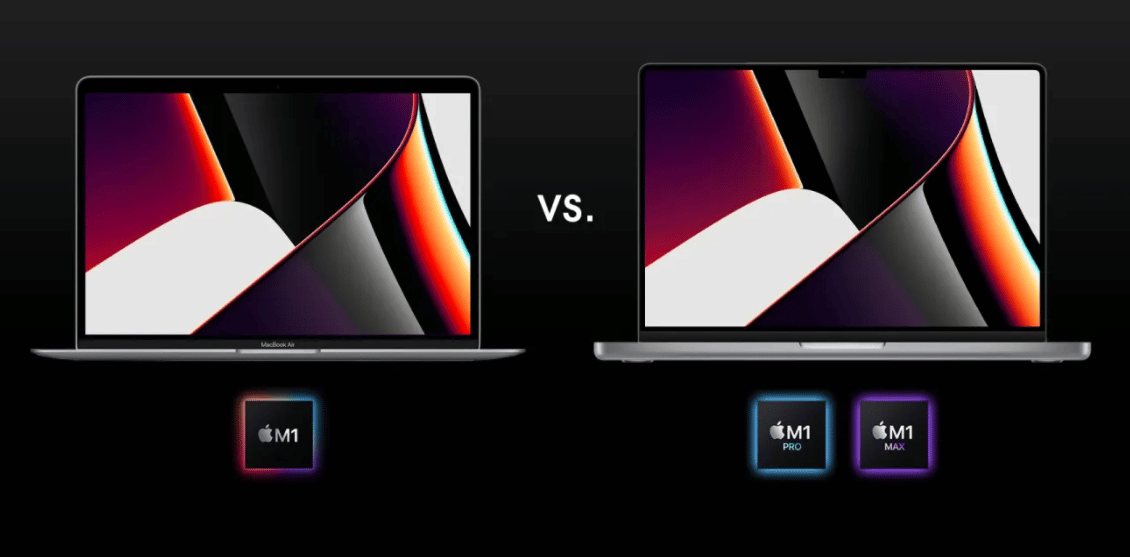
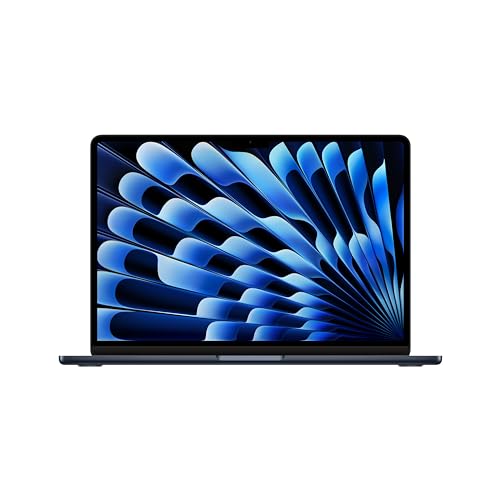
The MacBook Air uses a Liquid Retina display with up to 500 nits of brightness. It looks great for daily use, with accurate colors and sharp text at standard resolution. Both the 13-inch and 15-inch Air models share the same panel technology.
The MacBook Pro uses a Liquid Retina XDR display with mini-LED backlighting. This panel reaches 1,000 nits of sustained brightness for HDR content and peaks at 1,600 nits. It also supports ProMotion with an adaptive refresh rate up to 120Hz, which makes scrolling, animations, and video playback noticeably smoother. The higher brightness and contrast ratio make a real difference for photo and video editing, color grading, and watching HDR movies.
If display quality matters to your work, the Pro’s XDR panel is a clear step up. For general use, the Air’s display is perfectly good and most people will be happy with it.
MacBook Pro vs. MacBook Air: Size and Weight
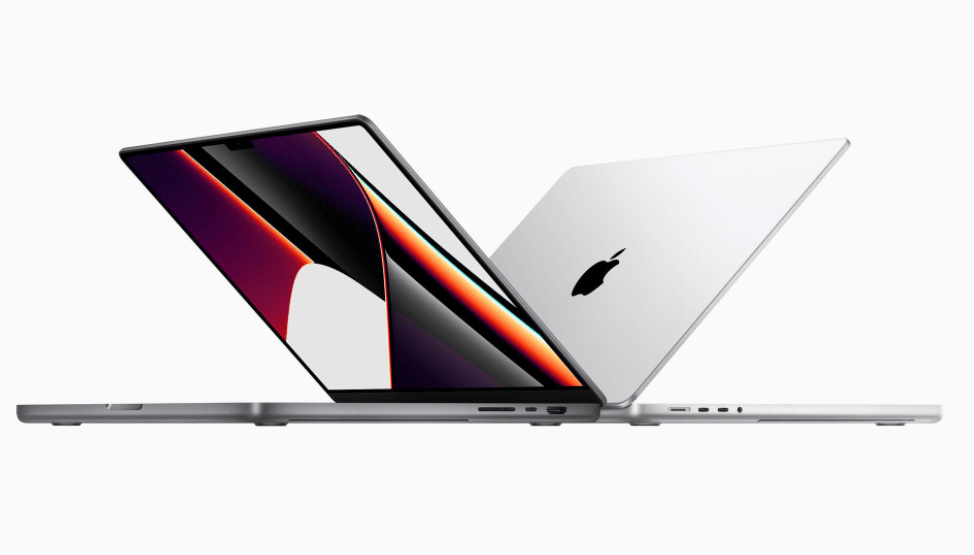
The 13-inch MacBook Air is the lightest laptop Apple makes, weighing just 2.7 pounds. The 15-inch Air comes in at 3.3 pounds, which is still lighter than the 14-inch MacBook Pro at 3.4 to 3.5 pounds depending on configuration. The 16-inch MacBook Pro is the heaviest at around 4.7 to 4.8 pounds.
Both Air models use a slim, wedge-free design that slips easily into a backpack or messenger bag. The Pro models are thicker to accommodate the larger battery, active cooling system, and additional ports. If portability is your top priority, the 13-inch Air is hard to beat. The 15-inch Air gives you a bigger screen without much extra weight, making it a strong middle-ground option.
MacBook Pro vs. MacBook Air: Battery Life
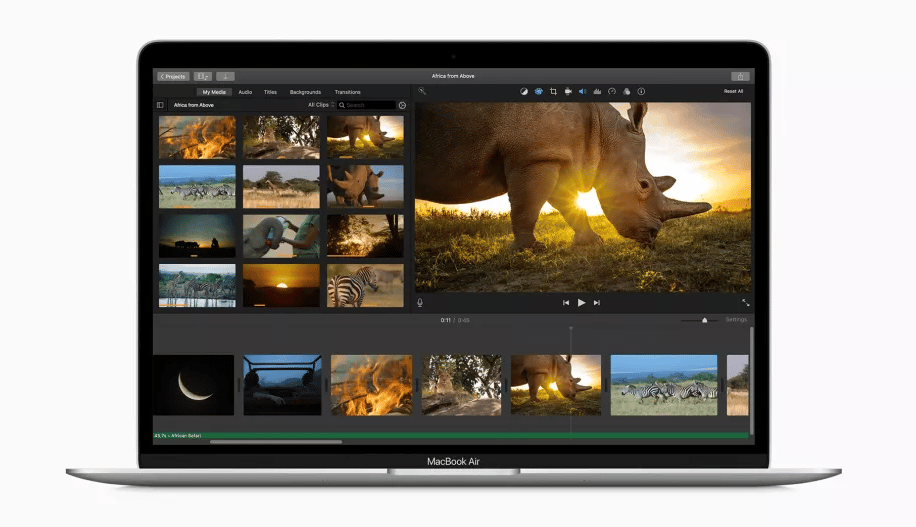
Apple rates the MacBook Air at up to 18 hours of video playback, and real-world use typically delivers 10 to 14 hours of mixed work depending on screen brightness and workload. The efficiency of the M4 chip combined with the fanless design helps the Air sip power.
The 14-inch MacBook Pro gets similar battery life in the base M4 configuration, with Apple quoting up to 24 hours for the M4 Pro model. The 16-inch MacBook Pro with M4 Max tops out at around 18 to 22 hours depending on configuration, thanks to its significantly larger battery. Under heavy sustained workloads like video rendering, the Pro models pull ahead because the active cooling lets the chip work efficiently without thermal throttling.
For all-day work away from a charger, any of these machines will last a full workday. The 14-inch Pro with M4 Pro currently offers the best overall battery life in the lineup.
MacBook Pro vs. MacBook Air: Ports and Connectivity
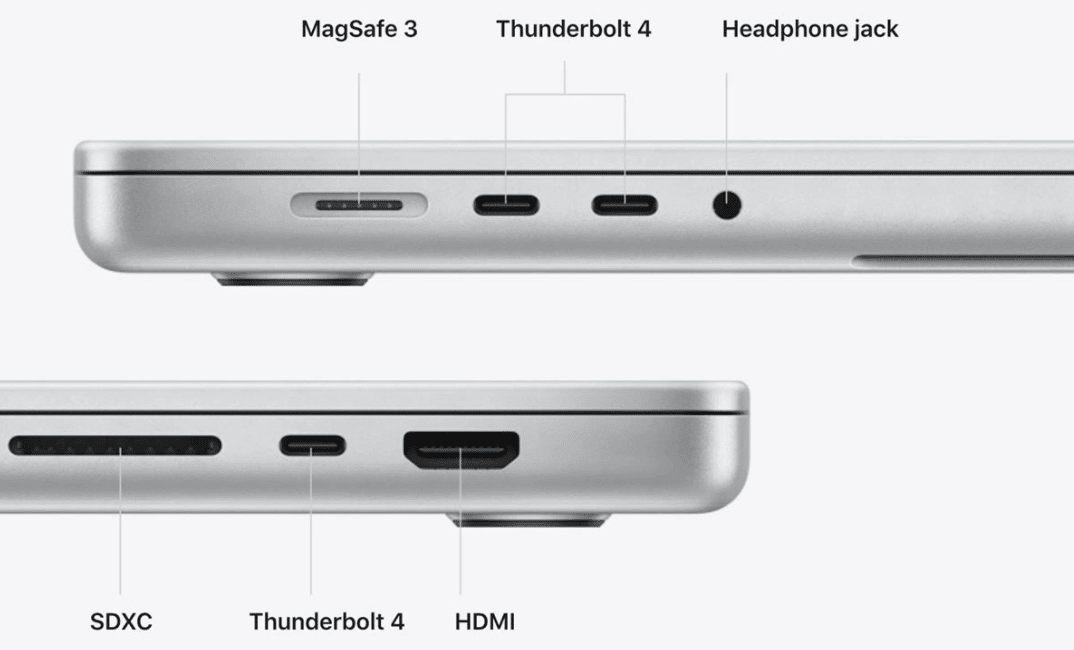
The MacBook Air includes two USB-C/Thunderbolt ports (now supporting USB 4), a MagSafe charging port, and a 3.5mm headphone jack. It supports one external display natively, though with macOS workarounds or a DisplayLink adapter you can connect two. The 15-inch Air supports up to two external displays with the lid closed.
The MacBook Pro with M4 Pro or M4 Max offers three Thunderbolt 5 ports, an HDMI 2.1 port, an SDXC card slot, a MagSafe charging port, and a headphone jack. The M4 Pro supports up to two external displays, while the M4 Max supports up to four. For photographers, videographers, and anyone who regularly connects external monitors, drives, or card readers, the Pro’s port selection eliminates the need for dongles and hubs.
All 2026 MacBook models support Wi-Fi 6E and Bluetooth 5.3.
MacBook Pro vs. MacBook Air: Pricing
The MacBook Air 13-inch starts at $1,099, making it the most affordable entry point into Apple’s laptop lineup. The 15-inch Air starts at $1,299. Both come with 16GB of unified memory and 256GB of SSD storage in the base configuration, with options to upgrade memory to 24GB or 32GB and storage up to 2TB.
The 14-inch MacBook Pro with the base M4 chip starts at $1,599. The M4 Pro configuration starts at $1,999, and the M4 Max configuration starts at $2,499. The 16-inch MacBook Pro is only available with M4 Pro ($2,499) or M4 Max ($3,499) chips. Pro configurations start with 24GB of memory and offer up to 128GB on the M4 Max, with storage options up to 8TB.
Which MacBook Should You Buy?
Get the MacBook Air if you primarily use your laptop for web browsing, email, documents, streaming, light photo editing, casual coding, or schoolwork. The 13-inch model is best for maximum portability, and the 15-inch model adds a bigger screen without much extra weight or cost. The Air gives you excellent performance and outstanding battery life in a thin, silent package.
Get the MacBook Pro if your work involves video editing, 3D rendering, music production, software development with large codebases, data science, or any task that pushes hardware for extended periods. The active cooling, brighter XDR display, additional ports, and M4 Pro/M4 Max chip options give professionals the headroom they need. The 16-inch model adds the biggest screen and longest battery life for desktop-replacement use.
If you are on the fence, the 14-inch MacBook Pro with the base M4 chip sits right between the Air and the higher-end Pro models. It gives you the better display, active cooling, and extra ports at a more moderate price, though for most people the MacBook Air remains the better value.