When Should You Factory Reset a Chromebook?
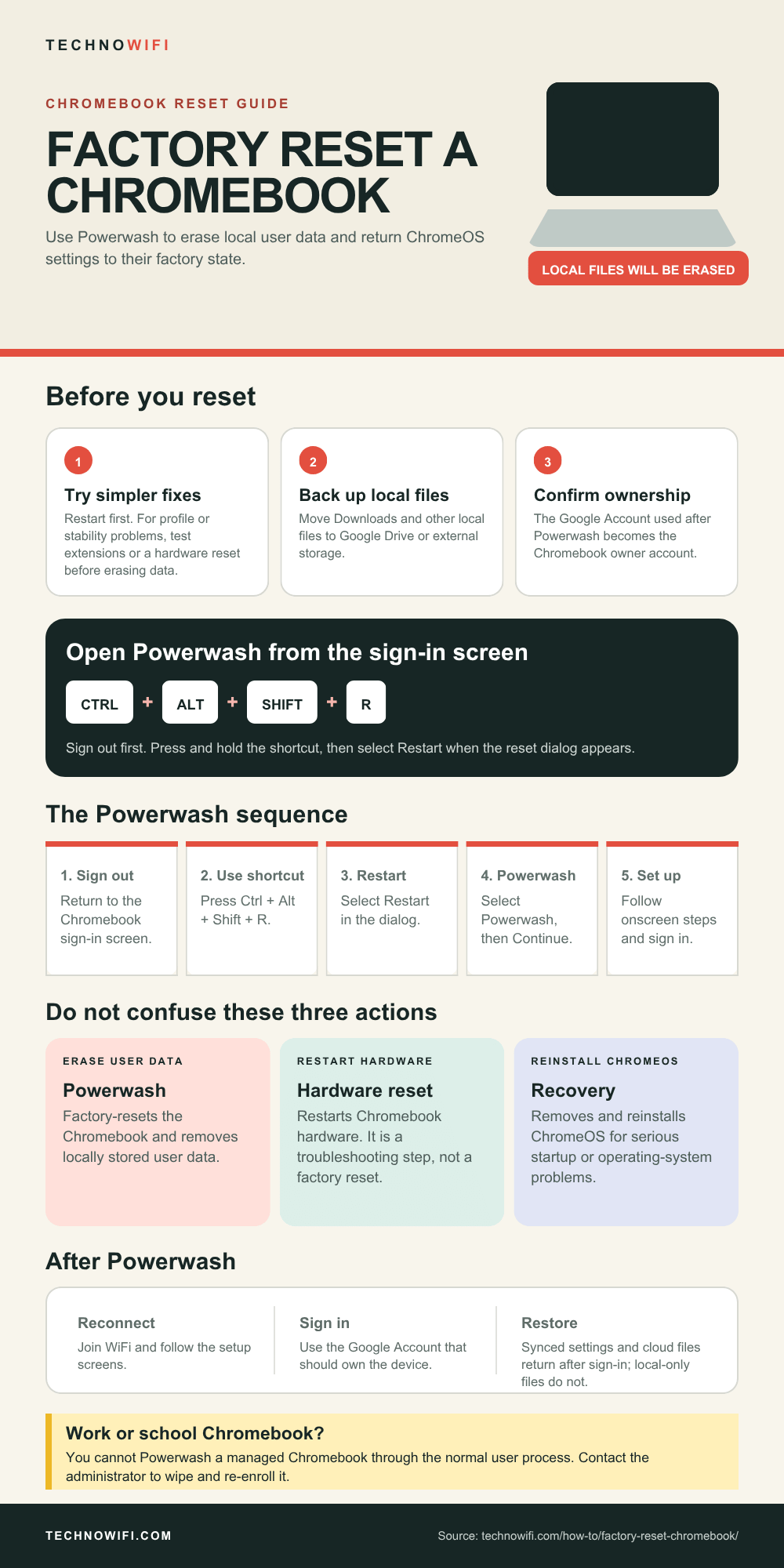
A factory reset (Google calls it “Powerwash”) wipes everything on your Chromebook and takes it back to the state it was in when you first opened the box. Your Google account, downloaded files, saved passwords on the device, Android apps, and Linux apps all get removed. Anything synced to your Google account in the cloud (Gmail, Google Drive, Google Photos) stays safe. Only local data is affected.
There are several situations where a Powerwash makes sense. Maybe your Chromebook is running slow and nothing you’ve tried has helped. Maybe you’re selling it or handing it off to someone else. A software update might have caused problems you can’t sort out. Your profile could be corrupted and throwing constant error messages. Or you might just want a fresh start after years of piled-up apps, extensions, and settings.
Back Up Your Files First
Before you do anything, save the files you want to keep. A Powerwash erases the entire local storage, including the Downloads folder and any files sitting on the Chromebook itself.
For printing, check our Chromebook printer setup guide.
- Open the Files app and look through the Downloads folder for anything you need, like documents, photos, screenshots, or downloads you haven’t moved to Google Drive yet.
- Upload important files to Google Drive by dragging them from Downloads into the Google Drive section in the Files app sidebar.
- If you have files on a connected USB drive or SD card, those won’t be touched by the reset. Still, it’s a good idea to eject them before starting.
- Check that your Google account sync is working. Go to Settings, then Accounts, and verify your Google account is signed in and syncing. Bookmarks, browser history, extensions, WiFi passwords, and Chrome settings sync automatically through your Google account and come back when you sign in again.
Android app data is a gray area. Some Android apps sync their data to the cloud (like Spotify playlists or game progress), but others store everything locally and you’ll lose it during a reset. Check any important Android apps individually before proceeding.
Method 1: Factory Reset from Settings
This is the standard method and works when your Chromebook is running normally.
- Click the clock in the bottom-right corner and select the gear icon to open Settings.
- In the left sidebar, click “Advanced” to expand the menu, then click “Reset settings.”
- Click “Powerwash” and then “Reset.”
- The Chromebook restarts and begins the reset process. This takes about 2 to 5 minutes.
- When it’s done, you’ll see the initial setup screen, the same one you saw when the Chromebook was brand new.
After the reset, sign in with your Google account and Chrome OS automatically restores your bookmarks, extensions, saved WiFi networks, and wallpaper. You’ll need to reinstall Android apps and reconfigure any settings that don’t sync.
For a different take, see our guide on how to connect 2 monitors to Chromebook.
Method 2: Keyboard Shortcut Reset
If you can get to the sign-in screen but can’t access Settings (maybe because your profile is corrupted), this shortcut gets the job done.
- Sign out of all accounts so you’re sitting at the login screen.
- Press Ctrl + Alt + Shift + R at the same time.
- A dialog box pops up asking if you want to Powerwash. Click “Restart.”
- After the restart, another prompt shows up. Click “Powerwash” and then “Continue.”
- The Chromebook resets and takes you to the setup screen.
This does exactly the same thing as the Settings method. It’s just a different way to trigger the Powerwash when you can’t navigate through the Settings menu normally.
Method 3: Recovery Mode Reset
If your Chromebook won’t boot at all, is stuck on a black screen, or shows a “Chrome OS is missing or damaged” error, recovery mode is your last option. This reinstalls Chrome OS from scratch.
- Turn off the Chromebook completely.
- Press and hold Esc + Refresh (the circular arrow key, usually F3) while pressing the Power button.
- Release the Power button. Keep holding Esc + Refresh until the recovery screen appears.
- If it asks you to insert a recovery drive, you’ll need to create one on another computer using the Chromebook Recovery Utility (a Chrome extension). Follow the on-screen instructions to make a bootable USB drive.
- Insert the recovery USB drive and the Chromebook reinstalls Chrome OS automatically.
Recovery mode goes deeper than a Powerwash. It replaces the entire operating system, which can fix firmware-level problems that a standard reset can’t touch. The trade-off is that you need a second computer and a USB drive to create the recovery media.
What Gets Erased vs What Survives
| Erased (Local Data) | Survives (Cloud Synced) |
|---|---|
| Downloaded files | Gmail, Google Drive files |
| Android app data (local) | Google Photos (if backed up) |
| Linux apps and files | Chrome bookmarks and history |
| Saved WiFi passwords (device-level) | Saved WiFi passwords (Google-synced) |
| Wallpaper and local settings | Chrome extensions list |
| Guest account data | Google account passwords (via Google Password Manager) |
| Printer configurations | Google Calendar, Contacts, Keep notes |
The simple rule: anything stored in a Google service (Drive, Photos, Gmail, Keep) is safe. Anything stored only on the Chromebook’s internal storage is gone after the reset.
If you want to go deeper, we have a separate guide on minecraft on a Chromebook.
Resetting a School or Work Chromebook
Chromebooks managed by a school, company, or organization may have Powerwash disabled by the administrator. If you try the methods above and get a message saying the option isn’t available, that’s the admin policy blocking it. You’ll need to contact your IT department. They can either remotely reset the device or unlock the Powerwash option for you.
Enterprise-enrolled Chromebooks re-enroll into the organization’s management system automatically after a reset. So if you Powerwash a school Chromebook, it doesn’t remove it from the school’s control. The admin enrollment is tied to the device’s hardware, not to the local data. Resetting won’t bypass school restrictions or filters.
After the Reset: Getting Set Up Again
- Connect to WiFi and sign in with your Google account.
- Chrome OS syncs your bookmarks, extensions, saved passwords, and wallpaper automatically. Give it a few minutes.
- Reinstall Android apps from the Play Store. The Play Store shows your previously installed apps under “My apps” so you can grab them again quickly.
- Reconfigure Bluetooth devices (mouse, headphones, etc.) since you’ll need to pair them again.
- If you use Linux (Crostini), re-enable it in Settings and reinstall your Linux applications.
Will a factory reset fix a slow Chromebook?
In many cases, yes. Over time, extensions, Android apps, and cached data pile up and eat into the Chromebook’s limited storage and memory. A Powerwash clears all of that and gives you a clean start. If the slowness comes from hardware issues (a failing storage drive or an aging battery), a reset won’t help. But for software-related sluggishness, it’s one of the most effective fixes you can try.
How often should you factory reset a Chromebook?
Most people never need to. Chrome OS is built to stay fast over time without much maintenance. A reset makes sense when you notice persistent slowdowns, run into recurring errors, or just want to clean house. There’s no real benefit to resetting on a schedule “just in case” since it only creates the hassle of reinstalling apps and reconfiguring your settings.
Does a factory reset remove Chrome OS updates?
A standard Powerwash keeps the current Chrome OS version intact, so you won’t lose any updates. The recovery mode method reinstalls Chrome OS, but it pulls the latest stable version, meaning you’ll end up on the same or a newer version than what you had before. There’s no way to downgrade to an older Chrome OS version through a reset.
Sources
Casting to your TV? See our Chromebook casting guide.
If you are still deciding between a Chromebook and a traditional laptop, our Chromebook vs laptop comparison breaks down the key differences.
Google – Reset Your Chromebook to Factory Settings | Google – Recover Your Chromebook | Google – Chromebook Recovery Utility