
4K and 8K are both ultra-high-definition resolutions, but they are not interchangeable. 8K packs four times as many pixels into the same screen size as 4K. That sounds like a massive upgrade on paper, and it is – from a pure numbers standpoint. Whether those extra pixels translate into a visible difference depends on screen size, viewing distance, and what you’re actually watching.

This article breaks down the technical differences between the two resolutions. If you’re trying to decide which one to buy, check out our separate guide on whether 8K is worth it.
What Is 4K and 8K Resolution
4K resolution is 3840 x 2160 pixels. That gives you roughly 8.3 million pixels on screen. It’s been the standard for high-end televisions since around 2015, and by 2026 it’s the default resolution for most TVs 50 inches and larger.
8K resolution is 7680 x 4320 pixels. That’s approximately 33.2 million pixels – exactly four times the pixel count of 4K. Both resolutions use a 16:9 aspect ratio, so 8K doubles the horizontal pixel count and doubles the vertical pixel count.
The jump from 4K to 8K follows the same math as the jump from 1080p to 4K. Each generation quadruples the total number of pixels while keeping the same screen shape.
4K vs 8K Specs Compared
| Specification | 4K (UHD) | 8K (UHD) |
|---|---|---|
| Resolution | 3840 x 2160 | 7680 x 4320 |
| Total Pixels | ~8.3 million | ~33.2 million |
| Aspect Ratio | 16:9 | 16:9 |
| Common Screen Sizes | 43″ – 85″ | 65″ – 98″ |
| Minimum HDMI Version | HDMI 2.0 (4K/60fps) | HDMI 2.1 (8K/60fps) |
| Streaming Bandwidth Needed | ~25 Mbps | ~50 – 100 Mbps |
| Native Content Library | Extensive | Very limited |
| Average TV Price (65″) | $500 – $1,500 | $2,000 – $5,000 |
How Pixel Density Changes With Screen Size
Resolution alone doesn’t tell the full story. Pixel density – measured in pixels per inch (PPI) – determines how sharp the image actually looks. The same resolution spread across a bigger screen means each pixel covers more physical area, and the image looks less detailed up close.
On a 55-inch TV, 4K delivers about 80 PPI. That’s sharp enough that individual pixels are invisible from a normal couch distance. On that same 55-inch screen, 8K pushes the density to around 160 PPI. Your eyes physically cannot resolve that difference from 7 or 8 feet away.
The pixel density gap starts to matter on very large screens. At 85 inches, 4K drops to about 52 PPI. Individual pixels become visible if you sit closer than 6 feet. An 85-inch 8K screen maintains about 104 PPI, which stays crisp even at closer distances.
| Screen Size | 4K PPI | 8K PPI |
|---|---|---|
| 55 inches | ~80 PPI | ~160 PPI |
| 65 inches | ~68 PPI | ~136 PPI |
| 75 inches | ~59 PPI | ~117 PPI |
| 85 inches | ~52 PPI | ~104 PPI |
| 98 inches | ~45 PPI | ~90 PPI |
Can You Actually See the Difference Between 4K and 8K
Human visual acuity has limits. Most people with 20/20 vision can resolve detail down to about 1 arcminute, which translates into a specific viewing distance for each screen size and resolution. Sit farther than that distance and your eyes literally cannot tell 4K from 8K.
For a 65-inch TV, you’d need to sit closer than about 4 feet to notice the extra pixels 8K provides. Most living rooms have a viewing distance of 7 to 10 feet, which puts you well beyond the threshold. On a 75-inch or larger screen, the math starts shifting in 8K’s favor – but only if you sit unusually close.
| Screen Size | Max Viewing Distance to See 8K Advantage | Typical Living Room Distance |
|---|---|---|
| 55 inches | ~3.5 feet | 7 – 9 feet |
| 65 inches | ~4 feet | 8 – 10 feet |
| 75 inches | ~4.5 feet | 8 – 10 feet |
| 85 inches | ~5.5 feet | 8 – 12 feet |
| 98 inches | ~6 feet | 9 – 12 feet |
The takeaway: 8K’s extra resolution is mostly invisible at typical viewing distances on screens under 80 inches. On very large screens (85 inches and above) in rooms where you sit closer than 6 feet, the improvement becomes real.
How Does 4K and 8K Content Availability Compare in 2026
This is where the gap between 4K and 8K is widest. 4K has a massive content library. Netflix, Disney+, Amazon Prime Video, Apple TV+, and YouTube all stream in 4K. Most new movies and TV shows are mastered in 4K. Ultra HD Blu-ray discs deliver native 4K content with higher bitrates than streaming. Video games on PS5 and Xbox Series X target 4K as the standard output resolution.
8K content is almost nonexistent by comparison. YouTube supports 8K uploads, and a handful of creators post 8K nature footage and city tours. Samsung TV Plus offers a few 8K demo channels. NHK in Japan broadcasts some programming in 8K. But there are no 8K Blu-ray discs, no major streaming service offers 8K tiers, and no studio regularly masters content in 8K for consumer distribution.
That means every 8K TV spends most of its time upscaling 4K or lower-resolution content to fill its 33 million pixels. The upscaling is handled by the TV’s built-in processor, and more expensive models do it better.
What Internet Speed Do You Need for 4K vs 8K Streaming
4K streaming requires about 25 Mbps for a stable picture. Netflix recommends 15 Mbps as a minimum for 4K, but 25 Mbps gives you headroom for consistent quality without buffering. Most broadband connections in the US handle this without trouble.
8K streaming would require somewhere between 50 and 100 Mbps per stream, depending on the codec used. Modern codecs like AV1 and HEVC (H.265) compress video more efficiently, but even with those, an 8K stream at full quality demands serious bandwidth. If two people in the household are streaming simultaneously, you’d need 100-200 Mbps of dedicated bandwidth just for video.
Bandwidth is one reason streaming services have been slow to adopt 8K. Many households don’t have fast enough connections, and the server-side infrastructure costs are significantly higher for delivering 8K streams.
Does 8K Need a Stronger Processor Than 4K
Yes. Processing 33 million pixels per frame is far more demanding than handling 8.3 million. This affects two things: upscaling and native playback.
Since almost no content is natively 8K, the TV’s processor spends most of its time upscaling 4K, 1080p, or even 720p source material. That means analyzing each frame, predicting what the missing pixels should look like, and filling them in – 24 to 60 times per second. High-end 8K TVs from Samsung and LG use AI-powered processors trained on thousands of images to handle this. Budget models use simpler algorithms that produce softer, less convincing results.
A 4K TV doesn’t work as hard. Most content is already native 4K, and upscaling 1080p to 4K is a simpler mathematical problem than upscaling 4K to 8K (filling in 4x the pixels versus 4x the pixels from an already-high starting point).
What HDMI Version Do 4K and 8K TVs Need
4K works with HDMI 2.0 and newer. HDMI 2.0 supports 4K at up to 60 frames per second, which covers movies, TV shows, and most gaming. If you have a 4K TV from any point in the last several years, its HDMI ports handle 4K/60fps without any issues.
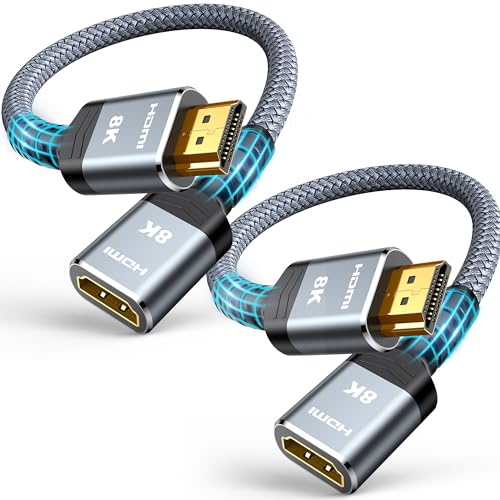
8K at full 60fps requires HDMI 2.1. This is because 8K video has four times the data of 4K, and HDMI 2.0’s maximum bandwidth of 18 Gbps isn’t enough. HDMI 2.1 bumps that ceiling to 48 Gbps, which accommodates 8K/60fps and even 4K/120fps for gaming.
If you connect an 8K source to an HDMI 2.0 port, it would be limited to 8K at 30fps or would have to drop to a lower resolution. In practice, this rarely matters right now because there are almost no 8K source devices. But it’s an important consideration for future-proofing your cable and receiver setup.
| HDMI Version | Maximum Bandwidth | 4K Support | 8K Support |
|---|---|---|---|
| HDMI 2.0 | 18 Gbps | 4K/60fps | Not supported at 60fps |
| HDMI 2.0b | 18 Gbps | 4K/60fps with HDR | Not supported at 60fps |
| HDMI 2.1 | 48 Gbps | 4K/120fps | 8K/60fps |
Is 8K Gaming Possible in 2026
Not in any practical sense. The PS5 and Xbox Series X both target 4K as their primary resolution, and many demanding games render internally at lower resolutions and upscale to 4K. Running a game at 8K means pushing four times as many pixels, which requires roughly four times the GPU power at the same frame rate.
On PC, only the highest-end graphics cards (like the NVIDIA RTX 4090 and its successors) can output 8K, and frame rates in modern games drop well below 30fps at that resolution without heavy use of DLSS or FSR upscaling. At that point, the GPU is rendering at a lower internal resolution and using AI to fill in the rest – which defeats much of the purpose of having an 8K display.
4K gaming at 60fps or higher is the realistic performance target for current hardware. Most gamers benefit more from higher frame rates at 4K than from higher resolution at lower frame rates.
How Much More Do 8K TVs Cost Than 4K
8K TVs cost roughly two to three times more than their 4K equivalents in the same size and brand tier. A 65-inch 4K OLED from LG or Samsung runs between $1,200 and $2,500. A 65-inch 8K QLED or Mini LED from Samsung typically starts around $2,500 and can reach $5,000 or more.
At larger sizes, the premium grows even steeper. A 75-inch 4K TV is widely available for $1,000 to $2,000. A 75-inch or 85-inch 8K model can easily cost $3,500 to $7,000. Samsung’s flagship 85-inch 8K Neo QLED sits above $5,000.
That price difference is hard to justify with current content availability. You’re paying a significant premium for resolution that most content can’t take advantage of yet, and that your eyes can’t distinguish at normal viewing distances on screens under 80 inches.
Frequently Asked Questions
Is 8K four times better than 4K?
8K has exactly four times as many pixels as 4K (33.2 million vs. 8.3 million). But “four times better” is misleading. Picture quality depends on much more than pixel count – contrast ratio, color accuracy, HDR brightness, and viewing distance all matter. A well-calibrated 4K OLED can look significantly better than a cheap 8K LED panel. More pixels only means more detail, and only when the source content and viewing conditions allow you to see it.
Can Netflix stream in 8K?
No. As of 2026, Netflix does not offer 8K streaming. The highest resolution available on Netflix is 4K HDR with Dolby Vision, which requires a Premium plan. No major streaming service currently offers 8K content. YouTube is the only major platform where you can find 8K video, and it’s limited to user-uploaded content.
Do I need HDMI 2.1 for 4K?
Not for watching movies and TV shows. HDMI 2.0 supports 4K at 60fps, which is more than enough for all streaming and Blu-ray content. You only need HDMI 2.1 for 4K at 120fps, which matters for gaming on PS5, Xbox Series X, or a high-end PC. If you’re not gaming at high frame rates, HDMI 2.0 handles 4K content perfectly fine.
Is 4K good enough for a 75-inch TV?
Yes. At a typical viewing distance of 8 to 10 feet, a 75-inch 4K TV delivers sharp, detailed images. The pixel density at that size is around 59 PPI, which is well above the threshold where individual pixels become visible from a normal couch. You would need to sit closer than 4.5 feet to notice any benefit from upgrading to 8K on a 75-inch screen.
Sources
If you are looking for faster speeds, it might be time to compare providers. Check which ISPs and plans are available at your zip code.
HDMI.org – HDMI 2.1 Specification | Samsung – 8K TVs and Neo QLED 8K Technology