Knowing how far wireless security cameras can work helps you set up a home or office surveillance system with no blind spots.
Before we go any further, keep in mind that a wireless camera’s performance depends on several factors. Those same factors determine how far its signal can actually reach.
In 2026, wireless camera technology has improved significantly. Better WiFi standards, longer battery life, and higher resolution sensors mean you can cover more ground than ever. But the basics still matter, and understanding them will save you from buying the wrong camera or installing it in the wrong spot.
Factors That Affect Wireless Security Camera Range
1. Camera Resolution
Resolution plays a big part in how well a wireless security camera performs overall.
So before you start thinking about range, ask yourself: can the camera actually deliver a clear picture with enough detail to be useful?
That’s why going with a higher resolution camera is always a smart move. You can find wireless security cameras with 4MP, 5MP, or even 4K resolution on the market right now, so there’s no shortage of options.
Keep in mind that higher resolution also means larger video files and more bandwidth demand. A 4K camera streaming over WiFi needs a strong, stable connection. If your network can’t handle the data throughput, you’ll get buffering, dropped frames, or reduced image quality, which defeats the purpose of going with a high-resolution model in the first place.
2. Lens Focal Length
The focal length of a security camera’s lens determines the field of view, not the camera’s range or connectivity.
Focal length is measured in millimeters (mm). Lenses come in two types: variable focal length (found in varifocal IP cameras) and fixed focal length (found in fixed-lens cameras).
The shorter the focal length, the wider the area the camera can cover. The longer the focal length, the narrower and more zoomed-in the view.
If you need to cover an area within about 40 feet, a 4.0mm fixed-lens camera should do the job. For larger areas, PTZ or zoom security cameras are a much better fit.
Here’s a quick reference for common focal lengths and their approximate coverage:
- 2.8mm: Wide angle, covers about 90 to 110 degrees. Good for small rooms and doorways.
- 4.0mm: Medium angle, covers about 70 to 80 degrees. Works well for driveways and side yards.
- 6.0mm: Narrow angle, covers about 45 to 55 degrees. Better for long hallways or focused monitoring.
- 12mm and above: Telephoto range, very narrow view. Best for reading license plates or monitoring distant areas.
3. WiFi Signal Strength and Frequency
Since wireless cameras depend on your WiFi network to transmit video, signal strength is one of the most important factors in determining effective range.
Most wireless cameras in 2026 support both 2.4 GHz and 5 GHz WiFi bands. The 2.4 GHz band offers longer range but slower speeds, while the 5 GHz band provides faster throughput but covers a shorter distance. For cameras placed far from your router, 2.4 GHz is usually the better choice. For cameras closer to the router that need to stream high-resolution video, 5 GHz works well.
WiFi 6 and WiFi 6E routers have improved range and can handle more connected devices without slowing down. If you’re running multiple cameras, upgrading your router can make a real difference in performance.
Walls, floors, and ceilings all weaken WiFi signals. Thick concrete and brick walls are the worst offenders, while wood and drywall have a smaller impact. Metal objects, large appliances, and even fish tanks can also interfere with signal strength.
If your camera location is too far from the router, a WiFi extender or mesh network system can bridge the gap. Some camera brands also sell dedicated signal repeaters designed specifically for their products.
4. Camera Placement
Where you install the camera also affects how far it can work.
Walls, trees, and other obstacles between the camera and the target area can weaken the signal. Even if your camera checks every other box, a bad location can limit its effective range.
Height matters too. Mounting a camera higher up generally gives it a clearer line of sight, both for the video feed and for the WiFi signal. A camera mounted at 9 or 10 feet has fewer obstructions between it and the area it monitors compared to one placed at eye level.
For outdoor cameras, think about seasonal changes. A clear line of sight in winter might become blocked by leaves and branches in summer. Plan your placement with full foliage in mind.
5. Build Quality
The overall quality of the wireless security camera makes a big difference in its range and field of view.
Before buying, do your homework on the brand and model. Stick with recognized sellers so you can count on after-sales support if something goes wrong. Avoid shady third-party sellers pushing knockoffs of popular brands.
Also, if you plan to use the camera at night, make sure it has these features:
- Night vision
- IR illumination range
- Lux rating
- DNR (Digital Noise Reduction)
- Infrared technology
Cameras with higher IP (Ingress Protection) ratings hold up better in harsh weather. Look for at least IP65 or IP66 for outdoor use. This ensures the camera can handle rain, dust, and temperature swings without degrading over time.
6. Power Source and Battery Life
For battery-powered wireless cameras, power management directly affects how the camera operates and how often it records.
Most battery cameras use motion-activated recording to conserve power. This means they only turn on and start recording when they detect movement. While this extends battery life significantly, it also means you might miss the first second or two of an event.
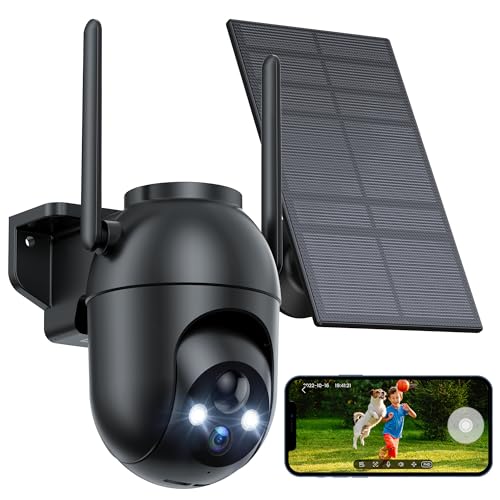
Solar-powered cameras offer a middle ground. They recharge during the day and can maintain longer recording windows. If you’re placing a camera in a location without easy access to a power outlet, solar panels can keep it running indefinitely as long as the panel gets enough sunlight.
Wired cameras don’t have this limitation at all. If range and continuous recording are your top priorities, running a power cable to the camera location and using WiFi for video transmission gives you the best of both worlds.
Now that you know what affects range and coverage, here are some practical tips to get the most out of your wireless security setup.
Tips for Getting Wider Coverage From Your Wireless Security System
- Go with a varifocal lens camera for a wider field of view. You can zoom in on details from a distance without losing image quality
- Choose cameras with higher resolution (5MP or 4K) to capture clear images and video from farther away
- Clear any obstructions between the camera and the area you’re monitoring to improve signal strength
- Stick with reputable camera manufacturers and avoid cheap knockoff sellers
- Always check for night vision and related specs before making a purchase
- Use a WiFi analyzer app to test signal strength at each planned camera location before mounting
- Consider a mesh WiFi system if you need to cover a large property with multiple cameras
- Update your camera firmware regularly to get the latest performance improvements and security patches
Wrapping Up
We’ve covered the main factors and tips that determine how far wireless security cameras can work. The answer varies based on your specific setup, but most modern wireless cameras in 2026 can maintain a solid connection at 100 to 300 feet from the router in open air, with that range dropping to 50 to 150 feet when walls and obstacles are involved.
Planning your camera placement carefully, investing in a strong WiFi network, and choosing the right resolution and lens for each location will help you get the most coverage with the fewest blind spots.
See Also