Interval Timer Shooting on the Nikon D5300
The nikon d5300 timer feature lets you shoot a series of images automatically over a set period of time. If you’ve ever wanted to create a time-lapse video of a sunset, clouds rolling by, or a busy city intersection, this is the feature you need.
Interval timer shooting tells the camera to fire the shutter at regular intervals (from seconds to hours) so you don’t have to stand there pressing the button over and over. It’s one of the most useful built-in features on the D5300, and in 2026, time-lapse content is more popular than ever across YouTube and social media. Here’s how to set it up, along with tips for getting great results.
Step 1: Set the Release Mode
Before you start, make sure the camera’s release mode is set to either single frame or quiet shutter release. You can access this using the release mode dial on the front left side of the camera body. Avoid using continuous shooting mode, because the interval timer already handles the timing for you.
Step 2: Find the Interval Timer Option
Go to the shooting menu and scroll down to the interval timer shooting option. It’s listed below the multiple exposure settings and above the movie settings section.
Nikon D5300 interval timer shootingStep 3: Choose When to Start
You have two options here. To start shooting right away, highlight now. If you want the camera to start at a specific time later, select a start time instead. The delayed start option is handy when you want to set everything up before sunrise or before a specific event begins.
Step 4: Configure Your Capture Settings
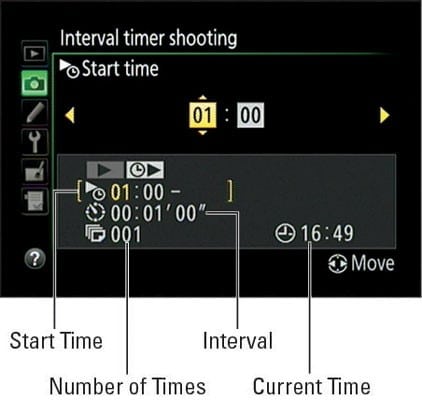
On this screen, you’ll set up three things:
– Start time
– Interval between shots
– Number of intervals and shots per interval
If you chose an immediate start, the start time field will be grayed out. Focus on setting the interval duration and shot count. The interval controls how much time passes between each group of shots, and the shots per interval tells the camera how many frames to capture each time it fires.
Step 5: Adjust the Values
A value box appears at the top of the screen, showing the setting selected at the bottom. Use the multi-selector to adjust these values.
A few things to keep in mind:
- Start time and interval use a 24-hour format based on the camera’s internal clock.
- Set the interval longer than your expected shutter speed so shots don’t overlap.
- Only hours and minutes can be set for the start time.
- If you’re shooting in low light with slow shutter speeds, add extra time to each interval to account for longer exposures.
Step 6: Confirm Your Settings
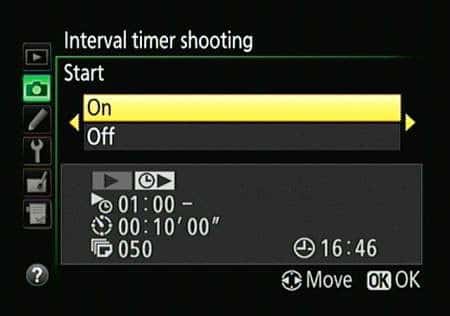
Once everything looks right, confirm your settings to start the interval timer. Double-check your interval duration and total shot count before you confirm, because you can’t change these once the sequence is running.
Step 7: Let It Run
If you chose an immediate start, the first shot fires about 3 seconds after you confirm. If you set a delayed start, the camera briefly shows that the timer is active. At this point, step away from the camera and tripod. Any bumps or movement between frames will show up as jumps in your final time-lapse.
Recommended Interval Settings for Common Subjects
Choosing the right interval between shots depends entirely on what you’re photographing. Here are some starting points that work well for popular time-lapse subjects:
- Fast-moving clouds: 3 to 5 seconds between shots
- Slow clouds or fog: 7 to 10 seconds
- Sunset or sunrise: 5 to 10 seconds
- Star trails or night sky: 15 to 30 seconds (use manual focus and a wide aperture)
- City traffic and pedestrians: 2 to 5 seconds
- Growing plants or flowers: 5 to 15 minutes
- Construction projects: 15 to 60 minutes
For most outdoor scenes, 5 seconds is a reliable starting point. If the motion in your scene is very slow, increase the interval. If it’s fast, shorten it. The goal is enough change between frames to create smooth motion when played back as video.
Turning Your Interval Shots into a Time-Lapse Video
The D5300 captures your interval sequence as individual image files, not as a video. You’ll need software on your computer to stitch them together into a finished time-lapse clip.
Popular options for this include Adobe Premiere Pro, DaVinci Resolve (which has a solid free version), and LRTimelapse for more advanced control over exposure transitions. Import your image sequence, set the playback frame rate to 24 fps or 30 fps, and export as an MP4 file.
Before assembling the video, it helps to do some light editing on the individual frames. Adjusting exposure, white balance, and contrast across the whole batch gives your time-lapse a polished, consistent look. Lightroom’s batch editing feature is great for this, since you can edit one frame and sync the adjustments across every image in the set.
As a general guideline, a 10-second time-lapse clip at 30 fps requires 300 individual photos. Plan your total shot count accordingly when setting up the interval timer.
Things to Keep in Mind
- The memory card access light blinks while interval timer shooting is active.
- Live view and some exposure settings are restricted during interval shooting.
- You can’t change camera settings once the shooting sequence has started.
- Turn off auto power-off in the camera’s setup menu so the camera doesn’t sleep during a long sequence.
- Use a fully charged battery, or connect an AC adapter for sessions that run several hours.
- Shoot in manual mode to keep exposure consistent across all frames. Auto exposure can cause visible flickering in the final video.
- Lock your focus before starting the sequence. If autofocus hunts between shots, your time-lapse will look jittery and unstable.
Stopping the Interval Timer Early
If you need to end the sequence before it finishes on its own, press the Menu button during shooting. The camera will ask if you want to stop the interval timer. Confirm your choice, and the sequence ends. All photos taken up to that point are already saved to your memory card, so you won’t lose anything.
Interval timer shooting on the Nikon D5300 is a great tool for creative photography. It opens the door to time-lapse sequences that would be impossible to capture by hand. For the best results, pick subjects that show noticeable change over time, like moving clouds, growing plants, or busy streets. With the right settings and a bit of patience, you can produce time-lapse videos that really stand out in 2026.