Canon 6D Mark II Sports Photography Settings
The Canon EOS 6D Mark II is a full-frame DSLR that took a big step forward from the original 6D. If you’re into Canon 6D Mark II sports photography, this camera has the features and speed to keep up with fast-moving subjects.
Canon packed the Mark II with the DIGIC 7 image processor and a 26.2-megapixel CMOS sensor, giving you a noticeable resolution boost. The native ISO range of 100-40,000 (expandable to 50-102,400) matches the EOS 5D Mark III and the original 6D, so low-light performance stays strong even at indoor arenas and evening events.
The autofocus system is a major upgrade: 45 points, all cross-type, compared to just 11 on the original 6D. The articulating touchscreen lets you use Live View for low and high-angle shots, and video recording goes up to 1080p at 60fps with digital image stabilization. Wi-Fi, Bluetooth, and NFC are all built in for fast sharing after the game.
Steps for Professional Sports Photography with Canon 6D Mark II
STEP 1. Learn to Use Your Camera Modes Efficiently
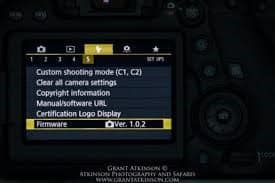
Canon 6D Mark II sports photography settings – GPS mode
One of the most common mistakes beginners make is shooting everything in full auto mode. Auto mode takes away your control over image quality, which is the last thing you want when you’re trying to freeze action.
Take some time to learn the manual and aperture priority modes on your camera. They give you far more control over exposure, shutter speed, and depth of field, all of which matter when you’re shooting fast-moving athletes and dynamic scenes.
STEP 2. Use the Correct Shutter Speed
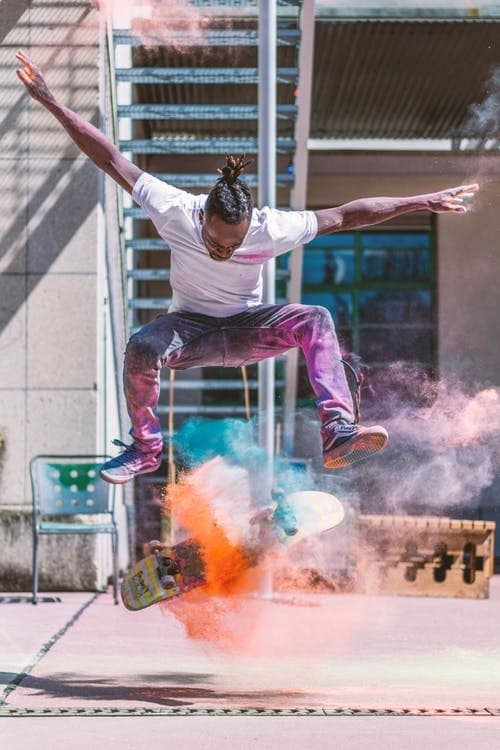
To freeze athletes mid-action, your camera needs to be fast enough to capture the movement without blur. Set your shutter speed between 1/500s and 1/2000s depending on how fast your subjects are moving.
The faster the action, the faster your shutter needs to be. A swimmer’s stroke might look fine at 1/500s, but a football player sprinting downfield will need 1/1000s or higher to stay sharp. For motorsports or track events, push it even higher to make sure every detail is frozen.
STEP 3. Aperture Priority Mode
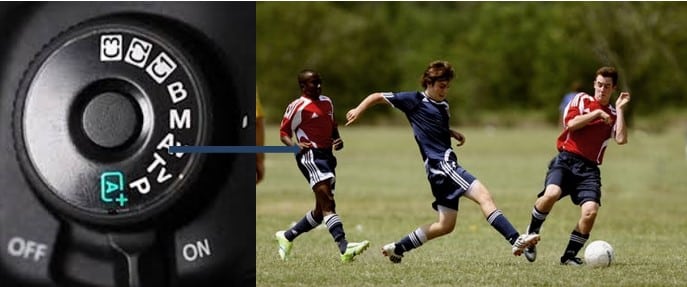
Aperture priority mode (marked as AV on the dial) is a great option for sports photography. You set the f-stop, and the camera automatically picks the right shutter speed to balance the exposure.
The f-stop number controls how much light reaches the sensor. Higher f-stops (like f/8 or f/11) let in less light but give you deeper focus. Lower f-stops (like f/2.8 or f/4) let in more light and blur the background, isolating your subject from the crowd.
On a bright, sunny day, set a large aperture (low f-stop number around f/2.8 or f/4) to let in plenty of light. The camera will respond with a faster shutter speed to correct the exposure, which is exactly what you want for freezing action.
STEP 4. Setting Up ISO Accurately
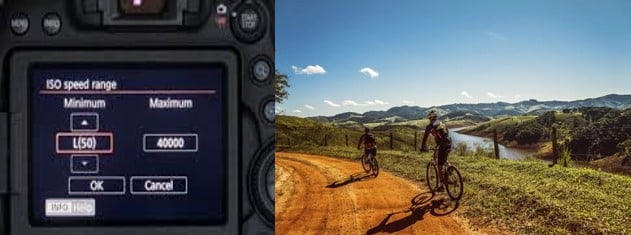
ISO, aperture, and shutter speed form the exposure triangle. When you’re shooting in a semi-manual mode like aperture priority, ISO is still your responsibility to set.
ISO measures how sensitive the sensor is to light. On a sunny day, keep it low (100-200) because there’s plenty of light available. On an overcast day or under stadium lights, push it higher (800 or 1200) to maintain a fast enough shutter speed for the action.
The 6D Mark II handles higher ISO values reasonably well thanks to its full-frame sensor, so don’t be afraid to go up when the light drops. A slightly noisy but sharp shot beats a clean but blurry one every time.
STEP 5. Use the Best Camera Lenses
The right lens can transform your sports photography. A telephoto zoom like a 55-250mm f/4-5.6 gives you a ton of reach and flexibility, letting you fill the frame even from the sidelines.
Wide-angle lenses add another dimension to your sports photos, making the viewer feel like they’re right on the field. They work well for capturing the energy of the crowd or the scale of the venue alongside the action.
Canon has a well-earned reputation as one of the top camera makers in the world, and the 6D Mark II continues that tradition. Follow these steps and you’ll be pulling sharp, professional-looking sports images from this camera consistently.