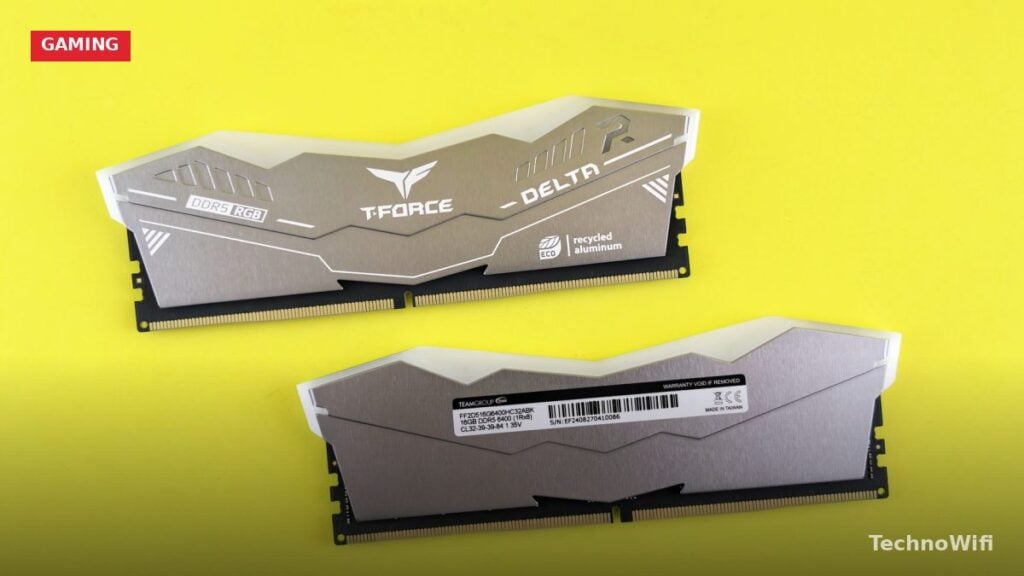
RAM is one of the first specs gamers look at when building or upgrading a PC, and for good reason. Too little RAM causes stuttering, long load times, and crashes in modern titles. Too much means you spent money on capacity that sits empty while you play. The right amount depends on what you play, what else runs in the background, and whether your system uses DDR4 or DDR5.
In 2026, 16 GB is the sweet spot for the majority of gamers. This guide breaks down every RAM tier from 8 GB to 64 GB, explains how games actually use memory, and covers the technical factors like speed, latency, and channel configuration that affect real-world performance.
How Much RAM Do I Need for Gaming in 2026
The short answer is 16 GB for most people. The longer answer depends on what you play and what else your PC does while you game. Here is how each RAM tier performs in 2026.
| RAM amount | Gaming performance | Best for |
|---|---|---|
| 8 GB | Playable but tight, stuttering in newer titles | Esports, older games, budget builds |
| 16 GB | Smooth in nearly all games at all settings | Most gamers, 1080p to 4K single-task gaming |
| 32 GB | Headroom for background apps and streaming | Streamers, content creators, heavy multitaskers |
| 64 GB | No gaming benefit over 32 GB | Video editing, 3D rendering, game development |
Windows 11 and background services consume 3 to 5 GB before you launch anything. A game using 10 to 12 GB of RAM on a system with only 8 GB total will force the OS to swap data to your SSD, which causes hitching and frame drops. With 16 GB, that same game has room to breathe without competing for memory.
Is 8 GB of RAM Enough for Gaming
8 GB works for a small category of games in 2026. Competitive shooters like Valorant, CS2, and Fortnite run on 8 GB because they are optimized for low-spec hardware. Older titles from 2020 and earlier also manage fine. Indie games and 2D titles rarely need more than a few gigabytes.
The problems show up with newer AAA releases. Games like Star Wars Outlaws, Black Myth: Wukong, and Stalker 2 list 16 GB as their minimum requirement. Running these titles on 8 GB means constant stuttering as the system swaps data between RAM and your storage drive. Texture pop-in becomes noticeable, and load times stretch out considerably.
If your budget forces you to choose between 8 GB of fast RAM or 16 GB of slower RAM, take the 16 GB every time. Capacity matters more than speed for gaming, and the performance gap between 8 GB and 16 GB is far larger than the gap between slow and fast memory.
Is 16 GB of RAM Enough for Gaming
16 GB is the recommended amount for gaming in 2026, and it handles virtually every title on the market. AAA games typically use 8 to 13 GB of system RAM during gameplay. With 16 GB installed, your OS and background processes have enough room alongside the game to avoid swapping.
At 1080p, 1440p, and even 4K resolution, 16 GB delivers consistent frame times without memory-related stutters. Resolution affects VRAM usage on your graphics card more than system RAM, so moving from 1080p to 4K does not dramatically increase system memory demand.
The one scenario where 16 GB gets tight is when you run many other applications alongside your game. A browser with 15 tabs, Discord with video, Spotify, and monitoring software can easily consume 4 to 6 GB on their own. Add a game that uses 10 to 12 GB and 16 GB becomes fully saturated. If this describes your setup, 32 GB is the better choice.
Do I Need 32 GB of RAM for Gaming and Streaming
32 GB is not necessary for gaming alone, but it becomes worthwhile when you add streaming, recording, or heavy multitasking to the mix. OBS Studio encoding a stream uses 1 to 3 GB depending on your settings. Chrome or Firefox with chat, alerts, and dashboard tabs adds another 2 to 4 GB. A game consuming 10 to 12 GB puts total system usage at 15 to 20 GB, which fits comfortably in 32 GB but overflows 16 GB.
Content creators who record gameplay, edit footage between sessions, or run a second PC’s workload through a capture card benefit from the extra headroom. So do players who alt-tab frequently to browsers, spreadsheets, or communication apps. If you tend to close everything except the game before playing, 16 GB is still plenty.
Some heavily modded games also benefit from 32 GB. Modded Minecraft with large shader packs, Cities: Skylines 2 with extensive assets, and modded Skyrim with 4K texture overhauls all push beyond 16 GB in specific configurations. Vanilla versions of these games stay well within 16 GB.
Our guide on 32gb RAM for video editing goes into more detail if you need it.
Is 64 GB of RAM Worth It for Gaming
No current game in 2026 uses anywhere close to 64 GB of system RAM. Even the most demanding titles with maxed settings, high-resolution texture packs, and mods peak at around 18 to 22 GB of system memory usage. The remaining 42 to 46 GB in a 64 GB kit sits completely idle during gameplay.
64 GB makes sense for workstations, not gaming rigs. Video editors working with 4K and 8K footage, 3D artists using Blender or Maya, and developers running Unreal Engine 5 can actually fill 64 GB during their workflows. Gamers cannot, at least not yet.
If you build a PC that doubles as a workstation and a gaming machine, 64 GB serves both purposes. For a dedicated gaming build, that money is better spent on a faster GPU or a higher-refresh monitor.
How Do Games Use RAM
Games load assets into RAM so the CPU and GPU can access them quickly. These assets include textures, character models, level geometry, audio files, AI data, and physics calculations. When you walk through an open-world game, the engine constantly loads upcoming areas into memory and discards areas you have left behind.
Open-world games use the most RAM because they need to keep large sections of the map ready in memory at all times. Linear games with smaller levels load everything at the start and use less memory overall. Multiplayer games with many players on screen simultaneously also push RAM usage higher because each player model and their associated data occupies memory.
| Game (2025/2026) | Minimum RAM | Recommended RAM | Typical usage during play |
|---|---|---|---|
| Valorant | 4 GB | 8 GB | 3 to 5 GB |
| Fortnite | 8 GB | 16 GB | 5 to 8 GB |
| Cyberpunk 2077 | 12 GB | 16 GB | 9 to 13 GB |
| Stalker 2 | 16 GB | 16 GB | 10 to 14 GB |
| Star Wars Outlaws | 16 GB | 32 GB | 11 to 15 GB |
| Black Myth: Wukong | 16 GB | 16 GB | 10 to 13 GB |
| GTA VI (expected) | 16 GB | 16 to 32 GB | 12 to 16 GB (estimated) |
When a game needs data that is not currently in RAM, it has to pull it from your SSD or hard drive. This is called a page fault, and it causes a brief stutter because storage is orders of magnitude slower than RAM. An NVMe SSD handles these page faults faster than a SATA SSD or hard drive, but none of them match the speed of having the data already in memory.
Does RAM Speed Matter for Gaming
RAM speed has a measurable but modest effect on gaming performance. Faster RAM lets the CPU access data more quickly, which helps in CPU-bound scenarios where the processor is the bottleneck rather than the GPU. In GPU-bound situations (high resolution, maxed graphics settings), RAM speed makes almost no difference because the GPU is the limiting factor.
The impact is most visible on AMD Ryzen processors because of how their Infinity Fabric architecture ties memory speed to internal communication speed between CPU cores. On Ryzen systems, faster RAM can improve performance by 5 to 10% in CPU-limited games. Intel processors also benefit from faster RAM, but the gains are typically smaller, around 2 to 5%.
DDR4 vs DDR5 RAM for Gaming
DDR5 is the current standard on new platforms in 2026. AMD’s AM5 socket and Intel’s LGA 1851 platform both require DDR5 exclusively. DDR4 remains a solid choice for anyone on an older platform like AMD AM4 or Intel 12th/13th gen.
| Specification | DDR4 | DDR5 |
|---|---|---|
| Typical gaming speeds | 3200 to 3600 MHz | 6000 to 7200 MHz |
| Typical CAS latency | CL16 to CL18 | CL28 to CL36 |
| True latency (ns) | ~10 ns | ~9 to 10 ns |
| Max module size (consumer) | 32 GB per stick | 48 to 64 GB per stick |
| Price per 32 GB kit (mid-2026) | $50 to $80 | $70 to $120 |
| Platform | AM4, Intel 12th/13th gen | AM5, Intel 14th gen+ |
DDR5 has higher raw clock speeds but also higher CAS latency numbers. The actual access time in nanoseconds ends up being similar between good DDR4 and good DDR5 kits. Where DDR5 pulls ahead is in raw bandwidth, which benefits workloads that move large amounts of data. For gaming, the real-world difference between DDR4-3600 CL16 and DDR5-6000 CL30 is typically 3 to 8% in frame rates.
What CAS Latency Means for Gaming Performance
CAS latency (CL) is the number of clock cycles the RAM needs to respond to a data request. A lower CL number means the RAM responds faster. But CL alone does not tell the full story because it depends on the clock speed. True latency, measured in nanoseconds, accounts for both.
The formula is: True latency (ns) = (CL / Clock speed in MHz) x 2000. A DDR4-3600 CL16 kit has a true latency of about 8.89 ns. A DDR5-6000 CL30 kit has a true latency of 10 ns. A DDR5-6000 CL28 kit comes in at 9.33 ns. Lower nanosecond values are better.
For gaming, aim for the lowest true latency you can afford. On DDR4, a 3600 MHz CL16 kit is the sweet spot. On DDR5, 6000 MHz CL30 or lower provides strong performance across AMD and Intel platforms. Going beyond 6000 MHz on DDR5 offers diminishing returns for gaming and often requires manual tuning in BIOS to run stable.
We also wrote a hands-on guide on 32gb RAM for laptop that you might find useful.
Single Channel vs Dual Channel RAM for Gaming
Dual channel mode doubles the memory bandwidth available to your CPU. When you install two matching sticks in the correct motherboard slots, they operate in dual channel. A single stick, or two sticks in the wrong slots, runs in single channel mode with half the bandwidth.
The performance difference is substantial. Running in single channel mode can reduce gaming frame rates by 15 to 30% compared to dual channel, especially in CPU-bound games. Some games become noticeably stuttery in single channel because the CPU cannot pull data from RAM fast enough to keep the pipeline full.
| Configuration | Channel mode | Bandwidth | Gaming impact |
|---|---|---|---|
| 1 x 16 GB stick | Single channel | Half | 10 to 30% lower FPS in CPU-bound games |
| 2 x 8 GB sticks (correct slots) | Dual channel | Full | Optimal for 16 GB total |
| 2 x 16 GB sticks (correct slots) | Dual channel | Full | Optimal for 32 GB total |
| 4 x 8 GB sticks | Dual channel | Full (but harder on memory controller) | Works but 2 sticks is preferred |
Always install RAM in pairs. If your motherboard has four slots, use slots 2 and 4 (counting from the CPU) for a two-stick kit. Your motherboard manual specifies which slots to populate first. Getting this wrong means your system runs in single channel even with two sticks installed, costing you significant performance for free.
Does More RAM Increase FPS in Games
Adding more RAM increases FPS only if your current amount is insufficient. Going from 8 GB to 16 GB in a game that needs 12 GB will produce a noticeable jump in frame rate and frame consistency. Going from 16 GB to 32 GB in a game that uses 10 GB will produce zero FPS improvement because the extra RAM never gets touched.
Think of RAM as a threshold rather than a slider. Below the threshold, your system stutters and swaps, which tanks performance. Above it, additional capacity sits idle during gameplay. The threshold varies by game, but in 2026 it sits between 12 and 16 GB for most titles.
RAM speed and channel configuration do affect FPS regardless of capacity. Switching from single channel to dual channel at the same total capacity boosts frame rates measurably. Upgrading from DDR4-2400 to DDR4-3600 with the same capacity also improves performance by a few percent. These gains are separate from having enough total RAM.
How to Check RAM Usage While Gaming
Monitoring your RAM during gameplay tells you whether your current amount is sufficient or holding you back. If your RAM is constantly at 90% or above while gaming, an upgrade will make a tangible difference.
- Press Ctrl + Shift + Esc to open Task Manager. Click the Performance tab and select Memory. Leave this open on a second monitor while you play, or check it immediately after closing a game.
- For an in-game overlay, open Xbox Game Bar by pressing Windows + G. The Performance widget shows real-time RAM usage as a percentage and a graph. Pin it to stay visible during gameplay.
- For more detailed monitoring, install MSI Afterburner (free). Go to Settings, then the Monitoring tab. Enable RAM Usage and set it to show on the on-screen display. This puts a real-time RAM counter on top of your game.
- Check the Details tab in Task Manager and sort by Memory to see which processes consume the most. Your game will typically be at the top, followed by your browser, Discord, and other background apps.
If your system uses 85% or more of available RAM with your game plus typical background apps, you are close to the limit. Upgrading from 16 GB to 32 GB in this scenario will eliminate micro-stutters caused by occasional memory pressure.
How Much RAM for Different Types of Gaming
| Gaming scenario | Minimum RAM | Recommended RAM |
|---|---|---|
| Esports (Valorant, CS2, League of Legends) | 8 GB | 16 GB |
| AAA single-player (1080p to 4K) | 16 GB | 16 GB |
| Open-world games (Cyberpunk, Starfield) | 16 GB | 16 to 32 GB |
| Gaming while streaming on Twitch/YouTube | 16 GB | 32 GB |
| Heavily modded games (Skyrim, Minecraft) | 16 GB | 32 GB |
| VR gaming | 16 GB | 32 GB |
| Gaming + video editing on same machine | 32 GB | 32 to 64 GB |
For a gaming-only PC in 2026, 16 GB of DDR5 at 6000 MHz (or DDR4-3600 on older platforms) in a dual channel configuration is the setup that delivers the best value. You get full performance in every current game without paying for capacity you will not use.
Frequently Asked Questions
Is 16 GB of RAM future-proof for gaming?
16 GB handles every game available in 2026, but the trend is moving upward. AAA titles in 2024 and 2025 started listing 16 GB as their minimum rather than their recommended spec. Within the next two to three years, 32 GB will likely become the new standard recommendation. If your system has upgradeable RAM slots, starting with 16 GB and adding more later is a reasonable strategy.
Should I get 2 x 8 GB or 1 x 16 GB?
Always get 2 x 8 GB. Two sticks enable dual channel mode, which provides double the memory bandwidth compared to a single stick. The performance difference in games is 10 to 30% in CPU-bound scenarios. A single 16 GB stick only makes sense if your motherboard has just two RAM slots and you plan to add a second 16 GB stick later for 32 GB total.
Can I mix different RAM sticks for gaming?
You can mix different sticks, but the system runs at the speed of the slowest module. Mixing sizes (8 GB + 16 GB) also creates an asymmetric dual channel configuration called flex mode, which runs part of the memory in dual channel and the rest in single channel. For the best performance, use two identical sticks from the same kit.
Does RAM affect loading times in games?
Not directly. Loading times depend primarily on your storage drive. An NVMe SSD loads games much faster than a SATA SSD, which loads faster than a hard drive. RAM speed has a negligible effect on initial load screens. However, insufficient total RAM causes longer loads because the system has to swap data back and forth between RAM and storage during the loading process.
How do I know if my RAM is running in dual channel?
Open Task Manager (Ctrl + Shift + Esc), click the Performance tab, and select Memory. Under the memory details, look for “Slots used” and the form factor information. For a definitive check, download CPU-Z (free). Open it and click the Memory tab. The “Channel #” field will say “Dual” or “Single.” If it says Single and you have two sticks installed, they are probably in the wrong motherboard slots.
Is DDR5 worth it just for gaming?
If you are building a new system, DDR5 is the default because current AMD and Intel platforms require it. If you already own a DDR4 system that performs well, upgrading to DDR5 requires a new motherboard and CPU. The 3 to 8% gaming improvement from DDR5 alone does not justify that expense. Spend that budget on a GPU upgrade instead, which has a much larger impact on frame rates.
Sources
Corsair – How Much RAM Do You Need for Gaming | Kingston Technology – How Much RAM Do You Need for Gaming | AMD – AMD Ryzen Processors and Memory Support | Microsoft – Windows 11 System Requirements | Crucial – Single vs Dual Channel Memory